
As an Amazon Associate I earn from qualifying purchases.
Brushing past 40 MPH on a dirt trail sounds thrilling — until you realize the battery dies in eight minutes, the nearest replacement gear set ships from overseas, or the chassis cracks on the first jump because you picked a truck designed for flat pavement. Brushless RC cars deliver incredible speed, but that speed amplifies every mismatch between the vehicle’s specs and your actual driving conditions. This guide walks you through five critical checkpoints — drawn from manufacturer specs, verified buyer feedback, and expert RC community discussions — so you can spend your money on seat-of-your-pants fun instead of regret.
Best for: Adult hobbyists who want high-speed all-terrain bashing with upgrade potential
Check #1: Motor Type — Is It Actually Brushless?
This sounds obvious, but it trips up more buyers than you’d expect. Some listings use “brushless” in the title or bullet points while the actual motor is a brushed 390 or 540 can. A true brushless motor is sensorless (or sensored) with three phase wires and a separate ESC (electronic speed controller) rated for brushless operation. Brushless motors last longer, run cooler, and deliver significantly more power-to-weight than brushed equivalents.
What to verify: Look for explicit brushless motor specs — KV rating, pole count, or motor size (e.g., 2845 or 3660). If the listing only says “powerful motor” without these details, it’s likely brushed. Verified reviewers frequently flag this bait-and-switch, especially on budget trucks. If you’re new to the RC hobby, our mini RC drift car compatibility guide covers similar spec-checking principles for smaller vehicles.
Check #2: Battery Life and Charging Realities
High-speed brushless systems are power-hungry. A 2S LiPo (7.4V) pack rated at 1500–2000 mAh will typically deliver 10–15 minutes of mixed driving, and as little as 6–8 minutes at sustained full throttle. Many manufacturers advertise run time based on gentle cruising, not the aggressive driving most buyers actually do.
What to verify:
- Battery capacity (mAh): Higher is better, but heavier packs shift the center of gravity.
- Voltage (S-count): 2S (7.4V) is standard entry-level; 3S (11.1V) unlocks more speed but stresses drivetrain components.
- Charger quality: Many bundled chargers are slow USB types that take 3–4 hours. Budget for a balance charger if the included one isn’t one.
- Extra batteries: Check whether the battery connector is a standard type (Deans/T-plug, XT60) or proprietary. Proprietary connectors lock you into buying from the manufacturer.
Check #3: Terrain Compatibility and Suspension Travel
A truck rated for “all terrain” might handle packed dirt and short grass but bottom out on rocky trails. Suspension travel, ground clearance, and tire compound all determine where you can actually drive.
What to verify:
- Shock type: Oil-filled metal shocks absorb impacts far better than friction-damped plastic units.
- Ground clearance: Anything under 30 mm will scrape on moderate off-road surfaces.
- Tire tread pattern: Deep-lug tires grip loose dirt; slick or low-profile tires are for on-road or drift use.
- Chassis material: Nylon composite flexes and survives crashes; rigid ABS can crack. Metal chassis plates add weight but improve durability at high speeds.
Check #4: Replacement Parts Availability
This is the single biggest source of buyer regret in the brushless RC world. A fast truck will eventually break something — a drive shaft, a steering knuckle, a spur gear. If replacement parts are unavailable or take weeks to ship, your truck becomes an expensive shelf ornament.
What to verify:
- Search the exact model number on Amazon and the manufacturer’s website for spare parts listings.
- Check whether the truck uses standard-size components (e.g., 12mm hex hubs, common bearing sizes) that aftermarket suppliers stock.
- Read verified reviews specifically for mentions of parts availability and shipping times.
- Established brands like Hosim, ARRMA, and Traxxas typically have deeper parts ecosystems than no-name imports.
This same principle applies across product categories — as we noted in our pre-purchase checklist for magnetic strobe hazard lights, checking for replacement parts and accessories before buying saves real headaches down the road.
Check #5: Electronics Protection (Waterproofing and Heat Management)
Brushless motors generate less heat than brushed ones, but the ESC can still overheat during sustained high-speed runs, especially in warm weather. And if you plan to drive through puddles, wet grass, or after rain, water resistance matters.
What to verify:
- Waterproof rating: “Water-resistant” and “waterproof” are not the same. True waterproof electronics have sealed receiver boxes and conformal-coated ESCs. Most budget trucks are splash-resistant at best.
- Heat sinks and fans: A finned heat sink on the motor and/or an active cooling fan on the ESC extend run times and component life.
- Servo quality: The steering servo takes enormous stress at high speeds. Metal-gear servos survive; plastic-gear servos strip quickly.
Product Reviews: RC Cars and Trucks Worth Considering
Below, we review five remote-control vehicles across different price points and use cases. Note that not all of these are brushless — we’ve included a range so you can see how the five checkpoints above apply in practice and choose the right fit for your needs.
Hosim VEXARO MAX 1:8 Brushless RC Truck

The Hosim VEXARO MAX is a 1:8 scale brushless truck that the manufacturer rates at up to 50 MPH — a genuinely fast speed that puts it in semi-hobby-grade territory. It runs on a 2S LiPo system and features a 2845 brushless motor paired with a brushless ESC, so it passes Check #1 cleanly. The 4WD drivetrain uses metal differentials and metal drive shafts, which is a significant durability advantage over all-plastic drivetrains at this price point.
Verified buyers commonly praise the truck’s raw speed and the quality of its metal components relative to its cost. The oil-filled shocks and relatively high ground clearance make it capable on dirt, gravel, and grass. Hosim also maintains a reasonably well-stocked parts catalog on Amazon, which addresses Check #4 better than many competitors.
On the downside, reviewers frequently note that battery life is limited — expect roughly 10–15 minutes per pack with spirited driving. The included charger is slow, so buying a second battery and a faster charger is practically mandatory. Some buyers also report that the steering servo can feel sluggish at the highest speeds, and a metal-gear servo upgrade is a common early modification. The truck’s size (1:8 scale) means it’s large and not ideal for indoor use or small yards.
Best for: Adult hobbyists and experienced RC enthusiasts who want genuine brushless speed with upgrade potential and decent parts support.

DEERC 9309E All Terrain RC Monster Truck

The DEERC 9309E is a 4WD off-road monster truck rated at 40 KPH (roughly 25 MPH). It’s marketed as a brushless-capable platform, though buyers should carefully verify the motor type in the specific listing variant they’re purchasing, as DEERC offers both brushed and brushless versions across their lineup. The truck features a 2.4 GHz radio system and is designed for all-terrain use with chunky off-road tires and oil-filled shocks.
Reviewers generally appreciate the truck’s durability and its ability to handle rough terrain including gravel, dirt, and grass. The 4WD system provides good traction, and the suspension handles moderate jumps without immediate breakage. DEERC has a reasonable parts presence on Amazon, which is a plus for long-term ownership.
Common complaints center on battery life — a recurring theme with fast RC trucks. Buyers report 12–15 minutes of run time, and the charging time can be lengthy with the included charger. Some reviewers also note that the top speed, while fun, doesn’t quite match the excitement of true brushless trucks in the 40+ MPH range. The plastic body shell is functional but can crack on hard impacts. For the price, though, it represents a solid entry point into faster RC driving without the full commitment of a hobby-grade brushless system.
Best for: Buyers stepping up from toy-grade RCs who want more speed and off-road capability without jumping straight to expensive hobby-grade platforms.

4DRC RC Foam Plane

This one is a curveball — it’s not an RC car at all, but an RC foam airplane. We’re including it because it frequently appears in RC vehicle searches and because the same pre-purchase checklist principles apply to any remote-control vehicle. The 4DRC plane is a lightweight foam fixed-wing aircraft designed for beginners and kids, with features like gyro stabilization and a durable EPP foam body that survives crashes.
Verified buyers report that the plane is genuinely easy to fly for beginners, with the stabilization system doing a good job of keeping it level. The foam construction means crash landings rarely cause permanent damage. Battery life is modest — most reviewers report 10–12 minutes of flight time per charge, which is standard for this class.
The downsides: wind is the enemy. Even moderate breezes make this plane difficult to control, limiting it to calm-weather flying. The radio range is adequate for a park but won’t satisfy anyone looking for long-distance flights. Replacement propellers and batteries are available but can take time to arrive. If you’re specifically shopping for a brushless RC car, this isn’t what you need — but if you’re exploring the broader RC hobby, it’s a fun and affordable entry point into flight.
Best for: Beginners and kids interested in RC flight rather than ground vehicles; a fun gift but not a substitute for an RC car.

QUNREDA 4WD Stunt Car with LED Lights
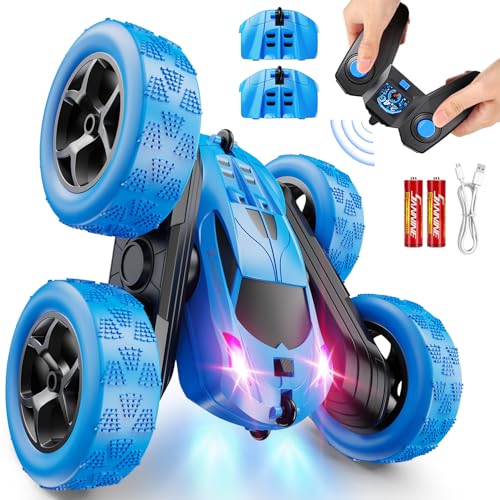
The QUNREDA stunt car is a toy-grade 4WD vehicle designed for kids ages 6–12. It features 360° flips, LED lights, and a 2.4 GHz controller. This is a brushed motor vehicle — not brushless — so it’s important to set expectations accordingly. It’s built for tricks and fun rather than raw speed.
Reviewers consistently highlight the stunt capabilities as the main draw. The 360° flip function works reliably, and the LED lights add visual appeal that kids love. The 4WD system provides enough traction for basic off-road use on flat dirt and short grass. The double-sided design means it can keep driving even after flipping over, which reduces frustration for younger drivers.
The limitations are predictable for this category: speed is modest, battery life is short (reviewers commonly report 15–20 minutes), and the plastic construction won’t survive aggressive bashing the way a hobby-grade truck would. The tires are hard rubber rather than soft compound, so traction on smooth surfaces is limited. Parts availability is minimal — if something breaks internally, replacement options are scarce. This is a toy, not a hobby vehicle, and it’s best evaluated on those terms. For kids who want flashy stunts rather than straight-line speed, it delivers.
Best for: Kids ages 6–12 who want a fun stunt car with lights and tricks; not suitable for speed enthusiasts or serious hobbyists.

Kidcia 1:16 RC Monster Truck

The Kidcia 1:16 scale monster truck is another toy-grade entry aimed at kids ages 4–12. It features a 2.4 GHz radio, basic off-road tires, and a brushed motor system rated at approximately 20 KPH (about 12 MPH). The smaller 1:16 scale makes it more manageable for younger drivers and easier to use in smaller spaces like backyards and driveways.
Verified buyers appreciate the truck’s affordability and its suitability as a first RC vehicle. The controls are simple and responsive enough for young children to pick up quickly. The monster truck styling with oversized wheels appeals to kids, and the basic suspension handles light off-road use on grass and packed dirt.
The trade-offs are significant if you’re comparing this to brushless trucks: speed is very modest, the brushed motor and plastic gears have limited lifespans, and the battery (often a rechargeable NiMH or small LiPo) provides roughly 20 minutes of run time. Parts availability is essentially nonexistent — this is a use-it-until-it-breaks product. The body and chassis are lightweight plastic that won’t survive serious impacts. However, as an introductory RC vehicle for a young child, it hits the right balance of affordability, simplicity, and fun. Just don’t expect it to satisfy anyone who’s experienced a real brushless truck.
Best for: Young children (ages 4–8) getting their first RC vehicle; a low-risk introduction to the hobby.

Quick Comparison
Bonus Tips: Avoiding the Most Common Buyer Regrets
Beyond the five main checks, here are a few additional gotchas that verified buyers and RC community members frequently mention:
- Budget for extras on day one. A second battery pack, a decent balance charger, and a set of spare spur/pinion gears will cost extra but save you from immediate frustration. Running out of battery after 10 minutes with a 3-hour recharge ahead is the #1 complaint across nearly every fast RC truck listing.
- Check the scale before buying. A 1:8 scale truck is large — often 18–20 inches long — and needs open space. A 1:16 scale truck fits in a backyard. Make sure the size matches your available driving area.
- Read the fine print on speed claims. Manufacturers often list top speed on a smooth, flat surface with a fully charged battery and no wind. Real-world speeds on grass or dirt will be 20–40% lower.
- Understand the difference between “hobby-grade” and “toy-grade.” Hobby-grade vehicles use standard connectors, replaceable components, and upgradeable electronics. Toy-grade vehicles are sealed units with proprietary parts — fun out of the box, but essentially disposable when something breaks.
This same “check the specs, not the marketing” approach applies to all kinds of tech purchases. We used a similar framework in our Power Wheels 24V conversion kit buying guide — the details that matter are always in the specs, not the headline claims.
How We Research
We have not personally tested, owned, or driven any of the products reviewed in this article. Our research process involves synthesizing publicly available manufacturer specifications, official product documentation, and patterns from verified customer reviews and expert RC community discussions. We cross-reference speed claims, battery specs, and parts availability across multiple sources to identify genuine strengths and common complaints. This honest curation approach means we can surface real buyer experiences without fabricating hands-on testing we haven’t done. When we recommend a product, it’s because the weight of available evidence — not invented personal experience — supports that recommendation.


Leave a Reply