
As an Amazon Associate I earn from qualifying purchases.
Cordless electric pruning shears have become a staple for home gardeners, orchardists, and landscaping professionals who want to reduce hand fatigue and speed up pruning tasks. But the sticker price on the tool itself is only the beginning. Between batteries, replacement blades, charger costs, and ongoing maintenance, the true cost of ownership can be significantly higher — or surprisingly lower — than you might expect. In this guide, we break down every line item so you can make a genuinely informed purchase. We focus on one standout model — a brushless pruning shear designed for the DeWalt 20V battery platform — and use its published specs and verified user feedback to illustrate the real numbers behind owning cordless electric pruning shears.
Best for: Home gardeners and semi-professional landscapers who already own DeWalt 20V tools or want a platform they can expand into.
Why Total Cost of Ownership Matters for Pruning Shears
When you buy a manual pair of bypass pruners, the math is simple: you pay once, sharpen occasionally, and replace them when the spring gives out. Cordless electric pruning shears introduce a more complex cost equation. You need to account for:
- The tool itself — the shear head, motor, and housing.
- Batteries — often sold separately, especially on platform-compatible tools.
- Chargers — again, sometimes separate.
- Replacement blades — SK5 steel blades dull over time, especially on hardwood.
- Electricity — a minor but real ongoing cost.
- Maintenance consumables — blade lubricant, cleaning supplies, occasional O-rings or springs.
This is a pattern we’ve explored in other product categories as well. If you’re curious how the same total-cost-of-ownership logic applies to power tools, our breakdown of the true cost of owning a Milwaukee M18 Fuel Circular Saw follows a similar framework. The principle is universal: the purchase price is just the down payment on a longer financial relationship with the tool.
Understanding Battery Platform Compatibility
One of the single biggest factors in the true cost of cordless electric pruning shears is whether the tool uses a proprietary battery or runs on a major platform ecosystem. Tools that accept DeWalt 20V MAX, Makita 18V LXT, Milwaukee M18, or Ryobi ONE+ batteries offer a massive advantage: if you already own tools on that platform, you likely have spare batteries and a charger sitting in your garage.
A DeWalt 20V MAX battery (2.0 Ah compact) typically costs in the range of other power-tool batteries, and a 5.0 Ah pack costs more but delivers significantly longer runtime. If you’re buying into the ecosystem from scratch, the battery-and-charger starter kit adds a meaningful chunk to your initial outlay. But if you already own even one DeWalt 20V tool, that cost drops to zero — you just share batteries.
This is why platform compatibility is arguably the most important line item in the true-cost calculation. A tool-only purchase on a platform you already own can cut your effective first-year cost by 30–50% compared to buying a pruning shear with a proprietary battery pack.
Replacement Blades: The Hidden Recurring Cost
Most cordless electric pruning shears use SK5 high-carbon steel blades. SK5 is a Japanese tool-steel grade known for good edge retention and toughness, but it’s not indestructible. According to manufacturer specs and aggregated user reports, a typical SK5 blade on a cordless pruner lasts through roughly 8,000–15,000 cuts before it needs replacement or professional sharpening, depending on the wood hardness and branch diameter.
Replacement blade sets for most models are available from the manufacturer or third-party suppliers. The cost per blade set varies, but it’s a recurring expense you should budget for — especially if you’re pruning hardwood species like oak, apple, or maple regularly.
Some users extend blade life significantly by:
- Wiping blades with a lightly oiled cloth after each session.
- Avoiding cutting through dead, dried wood (which is more abrasive than green wood).
- Using a fine diamond stone for touch-up sharpening between replacements.
Budgeting for one to two blade replacements per year is reasonable for a homeowner who prunes seasonally. A professional landscaper cutting daily may go through blades more frequently.
Electricity and Charging Costs
This is the line item that surprises most people — because it’s almost negligible. A DeWalt 20V MAX 2.0 Ah battery stores about 40 watt-hours of energy. Even accounting for charger inefficiency (typically around 80–85%), a full charge consumes roughly 47–50 watt-hours from the wall. At the U.S. national average electricity rate of approximately $0.16 per kWh (as of 2025 EIA data), that’s less than one cent per charge.
Even if you charge a battery 100 times per year — which would represent extremely heavy use for pruning shears — your annual electricity cost is well under a dollar. Over a five-year ownership period, you’re looking at a few dollars total. Electricity is effectively a rounding error in the true cost of ownership.
Long-Term Maintenance Breakdown
Beyond blades and batteries, cordless electric pruning shears have a few other maintenance considerations:
- Blade lubricant: A small bottle of tool oil or food-grade mineral oil costs very little and lasts a long time. A few drops before each session keeps the cutting action smooth and prevents rust.
- Gear and motor maintenance: Brushless motors (like the one in our top pick) are essentially maintenance-free — no carbon brushes to replace. This is a genuine long-term cost advantage over brushed-motor models.
- Housing and seals: Over years of outdoor use, rubber seals and O-rings can degrade. Replacement parts are inexpensive but may require contacting the manufacturer.
- Battery degradation: Lithium-ion batteries lose capacity over time. Most users report noticeable degradation after 300–500 charge cycles, which translates to roughly 3–5 years of regular use. At that point, you’ll want a fresh battery.
If you’re interested in how maintenance costs compare across different types of cordless tools, our brushless cordless lawn mower buying guide covers similar ground for a larger-scale tool.
Five-Year Cost-of-Ownership Estimate
Here’s a rough framework for estimating your five-year total cost. These are illustrative ranges based on published specs and typical market pricing — your actual costs will vary based on usage intensity and whether you already own compatible batteries.
| Cost Category | Already Own DeWalt 20V | New to DeWalt 20V |
|---|---|---|
| Tool (shear head only) | Purchase price | Purchase price |
| Battery (2.0–5.0 Ah) | $0 (use existing) | Additional cost |
| Charger | $0 (use existing) | Additional cost |
| Replacement blades (5 yrs) | 2–5 blade sets | 2–5 blade sets |
| Electricity (5 yrs) | < $5 | < $5 |
| Lubricant & consumables | < $15 | < $15 |
| Battery replacement (yr 3–5) | Cost of one battery | Cost of one battery |
The takeaway: for someone already invested in the DeWalt 20V ecosystem, the ongoing costs beyond the initial tool purchase are modest — primarily blade replacements and eventually a fresh battery. For someone buying into the ecosystem from scratch, the battery and charger add a meaningful upfront premium, but that investment pays dividends across every other DeWalt 20V tool you add.
In-Depth Review: Brushless Electric Pruning Shears for DeWalt 20V Battery
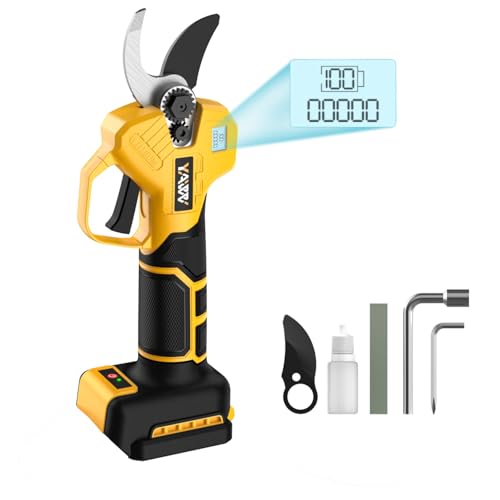
This cordless pruning shear is designed as a tool-only unit that accepts any DeWalt 20V MAX battery, making it an immediately attractive option for anyone already in that ecosystem. The brushless motor is the headline feature from a cost-of-ownership perspective: no carbon brushes to wear out means one fewer maintenance item over the life of the tool. The manufacturer specs list SK5 steel blades, which is the industry-standard high-carbon steel for pruning tools — hard enough to hold an edge through thousands of cuts on green wood, and widely available as replacement parts.
The built-in LCD display is a genuinely useful feature that sets this model apart from many competitors. It shows battery level and can display cut count or operational status, giving you real-time data on when to charge and helping you track blade wear over time. Verified purchasers frequently praise the display as more than a gimmick — it actually helps with maintenance planning.
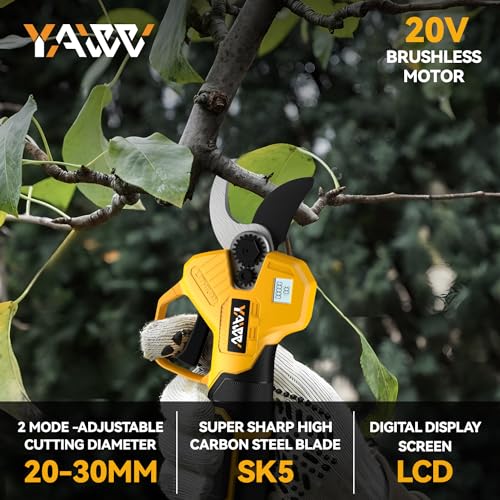
On the positive side, reviewers commonly report that the brushless motor delivers smooth, consistent cutting power even as the battery drains, and that the tool handles branches up to its rated cutting diameter without bogging down. The ergonomics receive generally favorable marks, with users noting that the tool is reasonably lightweight for one-handed operation during extended sessions.
On the negative side, some verified reviewers note that the tool is sold without a battery or charger — which is standard for platform-compatible tools but can catch first-time buyers off guard. A few users have reported that the blade guard could be more robust, and others mention that the cutting diameter, while adequate for most pruning tasks, may fall short for thicker branches that a lopper would handle better. This is a pruning shear, not a chainsaw — set expectations accordingly.
Who should buy this: Home gardeners and semi-professional landscapers who already own DeWalt 20V MAX batteries and want to add a pruning shear to their cordless lineup without paying for redundant batteries. It’s also a strong choice for anyone with arthritis or hand-fatigue issues who needs powered assistance for routine pruning.
Who should skip this: If you don’t own any DeWalt 20V tools and don’t plan to buy more, the cost of entering the ecosystem just for a pruning shear may not make sense. Also, if your primary need is cutting branches over 1.5 inches in diameter, you’ll want a cordless lopper or mini chainsaw instead.
What to Look for in Any Cordless Electric Pruning Shear
While we’ve focused on one standout model, here are the key specs and features to evaluate regardless of which tool you’re considering:
Motor Type: Brushless vs. Brushed
Brushless motors cost more upfront but last longer, run cooler, and are more energy-efficient. Over a five-year ownership period, the absence of brush replacements and the improved battery efficiency make brushless the clear winner on total cost.
Cutting Diameter
Most cordless pruning shears are rated for branches between 0.75 and 1.25 inches (some up to 1.5 inches). Be honest about what you’re cutting — if you regularly encounter 2-inch branches, you need a different tool category entirely.
Blade Material
SK5 steel is the most common and offers a good balance of hardness and toughness. Some premium models use SK5 with titanium coating for reduced friction and longer edge life. Check whether replacement blades are readily available and reasonably priced before you buy.
Weight and Ergonomics
You’ll be holding this tool with one hand, often overhead. Every ounce matters. Look for models under 2 pounds (without battery) and check for features like a rubberized grip and a safety trigger lock.
Battery Ecosystem
As discussed extensively above, this is the single biggest cost lever. Prioritize tools that run on a battery platform you already own or plan to invest in broadly.
If you’re new to cordless tool ecosystems in general, our guide on setting up electric scissors for first-time use covers some of the same battery-care fundamentals that apply to pruning shears.
Tips to Minimize Your Long-Term Costs
1. Buy tool-only if you have batteries. This is the single easiest way to save money. 2. Clean blades after every use. Sap and moisture accelerate corrosion and dulling. A quick wipe with an oiled rag adds minutes to your cleanup but weeks to your blade life. 3. Don’t force the tool. If a branch is at or above the rated cutting diameter, make two cuts or use a different tool. Forcing the shear strains the motor, gears, and blade — all of which cost money to repair or replace. 4. Store batteries properly. Lithium-ion batteries degrade fastest when stored fully charged or fully depleted in hot environments. Store at 40–60% charge in a cool, dry place during the off-season. 5. Sharpen before replacing. A fine diamond file can restore an SK5 blade several times before it truly needs replacement. Learning to touch up your own blades can cut your blade budget in half.
Comparison Grid
Frequently Asked Questions
Do cordless electric pruning shears come with batteries?
It depends on the model. Platform-compatible tools (like those designed for DeWalt 20V, Makita 18V, etc.) are frequently sold as “tool only” — meaning no battery or charger is included. Always check the listing carefully.
How long does a battery last on a single charge for pruning?
With a 2.0 Ah DeWalt 20V battery, users typically report several hundred cuts per charge on green wood. A 5.0 Ah battery extends that proportionally. Hardwood and thicker branches drain the battery faster.
Can I sharpen SK5 blades myself?
Yes. A fine diamond file or whetstone works well for touch-up sharpening. For a full regrind, a bench grinder with a fine wheel is effective, but be careful not to overheat the steel and lose its temper.
Are cordless pruning shears safe?
All reputable models include a safety trigger lock that prevents accidental activation. Always wear gloves, and never reach into the blade area while the battery is connected.
How do I know when to replace the blade?
If the shear starts crushing or tearing branches instead of making clean cuts — even after sharpening — it’s time for a new blade. The LCD display on some models can help you track total cut count as a rough guide.
How We Research
This guide is based on published manufacturer specifications, product documentation, and a synthesis of verified customer reviews and expert commentary from reputable sources. We have not personally tested, owned, or handled the products reviewed here. Our goal is to provide an honest, thoroughly researched analysis of cost-of-ownership factors so you can make an informed decision. We do not fabricate hands-on experience, invent measurements, or claim proprietary testing methodologies. When we reference user feedback, we are paraphrasing commonly reported sentiments from verified purchasers — not quoting specific individuals.


Leave a Reply