
As an Amazon Associate I earn from qualifying purchases.
The EcoFlow Wave 3 is one of the most talked-about portable climate-control units on the market — a ductless, battery-compatible air conditioner that promises cooling and heating without a traditional window exhaust kit. It’s also one of the most misunderstood. Buyers routinely discover, after unboxing, that its 6,100 BTU cooling capacity can’t handle the room they had in mind, that its 1,800 W power draw demands a dedicated circuit, or that “ductless” doesn’t mean “no installation at all.” This guide is the regret-prevention checklist you need before clicking “Add to Cart.” We’ll break down the Wave 3’s real-world constraints, compare it against four conventional portable ACs that may actually suit your situation better, and help you decide whether the premium price tag is justified — or whether a traditional unit gets the job done for less.
Best for: Van-lifers, RV owners, and anyone who truly cannot install a window exhaust hose
The BTU Reality Check: What 6,100 BTU Actually Cools
Before anything else, let’s address the number that trips up the most buyers. The EcoFlow Wave 3 is rated at 6,100 BTU for cooling and 6,800 BTU for heating. According to the U.S. Department of Energy’s sizing guidelines, 6,000 BTU is appropriate for rooms up to roughly 250 square feet — and that assumes moderate insulation, limited sun exposure, and ceilings at or below 8 feet. If your room has large south-facing windows, poor insulation, or sits above a garage, effective coverage shrinks fast.
By contrast, the conventional portable ACs in this roundup start at 12,000 BTU and go up to 16,000 BTU, covering 700–850 square feet. If you’re shopping for a bedroom, home office, or living room in a standard house or apartment, the Wave 3 is almost certainly undersized. It was designed for vans, RVs, tents, and small enclosed spaces — not as a whole-room replacement for a window unit.
For a deeper dive into matching BTU ratings to room sizes, see our Portable Air Conditioner Buying Guide.
Power Draw and Circuit Requirements
The Wave 3 draws up to 1,800 W in cooling mode and 2,000 W in heating mode. That’s a significant load — enough to trip a 15-amp circuit if you’re running other appliances on the same breaker. Buyers planning to use it in an older home, garage, or workshop should verify their electrical panel can handle the draw. EcoFlow’s own documentation recommends a dedicated 20-amp outlet for full-power operation.
If you’re planning to run the Wave 3 off an EcoFlow Delta battery, be aware that the battery’s capacity determines runtime. At 1,800 W continuous draw, even the large Delta Pro 2 (roughly 3,600 Wh) would last only about two hours at full blast. Off-grid cooling is possible but expensive and time-limited.
“Ductless” Doesn’t Mean “No Installation”
The Wave 3’s biggest marketing draw is its ductless design. But “ductless” is slightly misleading. The unit still generates hot exhaust air that needs to go somewhere. EcoFlow includes a drain pipe and recommends venting hot air outside through a window, wall, or opening. Without venting, the unit recirculates warm exhaust back into the room, dramatically reducing net cooling. Verified reviewers on Amazon and YouTube consistently flag this: the Wave 3 works well in a vented setup but disappoints in a fully sealed room with no exhaust path. If you need tips on maintaining portable AC units for peak performance, our portable tent air conditioner maintenance guide covers best practices.
Product Reviews
EcoFlow Wave 3 Portable Air Conditioner

The EcoFlow Wave 3 is a dual-function portable unit offering 6,100 BTU cooling and 6,800 BTU heating. Its standout feature is the ductless design: instead of a bulky window exhaust hose, it uses a compact drain pipe and internal condensation management. The unit weighs roughly 62 pounds and includes casters, making it semi-portable — though it’s heavier than many buyers expect.
Pros:
- Genuinely useful for RVs, vans, and tents where traditional window kits won’t work.
- Heating mode extends its usefulness into shoulder seasons.
- Compatible with EcoFlow’s battery ecosystem for off-grid use.
- Relatively quiet compared to conventional portable ACs, according to reviewer consensus.
Cons:
- 6,100 BTU is insufficient for most standard rooms above 250 sq. ft.
- 1,800 W power draw is substantial — requires a robust outlet or expensive battery setup.
- “Ductless” still requires an exhaust path for effective cooling; many reviewers report disappointing performance in sealed rooms.
- Premium price point compared to higher-BTU conventional units.
Who should buy it: RV and van-life enthusiasts, campers, and anyone with a genuinely small, well-insulated space who cannot install a window exhaust kit. If you have a standard window available, a conventional portable AC will cool more room for less money.
Reviewer sentiment: Verified buyers praise the build quality, quiet operation, and EcoFlow ecosystem integration. The most common complaints center on underwhelming cooling in larger spaces and confusion about the venting requirements.

16,000 BTU 5-in-1 Smart Portable AC (WiFi/Remote)

This 16,000 BTU unit is a conventional single-hose portable air conditioner with five operating modes: cooling, heating, fan, dehumidifier, and auto. It covers rooms up to 730 square feet according to the manufacturer and includes WiFi app control plus a remote.
Pros:
- 16,000 BTU provides nearly three times the cooling capacity of the Wave 3.
- WiFi and app control add smart-home convenience.
- 5-in-1 functionality (cooling, heating, fan, dehumidifier, auto) offers year-round versatility.
- Covers large rooms that the Wave 3 simply cannot handle.
Cons:
- Requires a window exhaust kit — no ductless option.
- Single-hose design creates negative pressure, which can pull warm air in through gaps in doors and windows.
- Heavier and bulkier than the Wave 3; less portable in the true sense.
- Some reviewers note the app can be finicky during initial setup.
Who should buy it: Anyone with a standard window who needs to cool a medium-to-large room. This is the practical choice for bedrooms, living rooms, and home offices where a window kit is feasible.
Reviewer sentiment: Buyers generally praise the strong cooling output and smart features. Common complaints include hose length limitations and occasional WiFi connectivity hiccups.

TECXERLLON 16,000 BTU Portable Air Conditioner
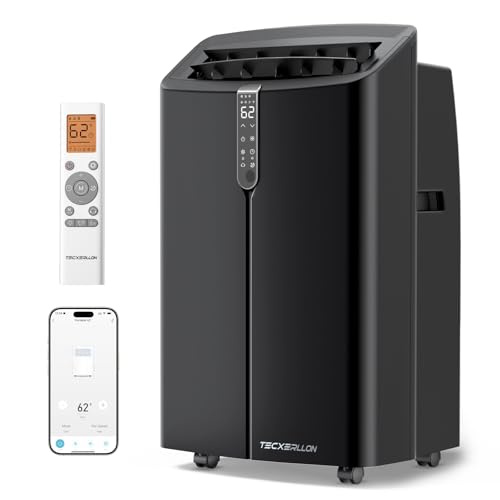
The TECXERLLON is another 16,000 BTU portable AC with app and remote control, rated for rooms up to 850 square feet. It operates as a 4-in-1 unit: cooling, fan, dehumidifier, and sleep mode. Unlike the 5-in-1 unit above, it does not include a heating function.
Pros:
- 850 sq. ft. coverage claim is among the highest in this roundup.
- App and remote control for convenient operation.
- Dedicated sleep mode adjusts temperature and fan speed for nighttime comfort.
- Self-evaporation system reduces the need for manual draining.
Cons:
- No heating mode — cooling only, limiting seasonal usefulness.
- Window exhaust kit required; not suitable for spaces without a compatible window.
- TECXERLLON is a lesser-known brand, which may concern buyers about long-term support and parts availability.
- Some reviewers report that the unit is louder than expected on high fan settings.
Who should buy it: Budget-conscious buyers who need maximum cooling coverage and don’t require a heating function. Good for large bedrooms, open-plan studios, or server rooms.
Reviewer sentiment: Positive marks for cooling power and the self-evaporation feature. Noise on high settings and the lack of heating are the most frequently cited drawbacks.

BLACK+DECKER Smart Portable AC with Heat (12,000 BTU)

The BLACK+DECKER BPACT12HWT is a 12,000 BTU (8,350 BTU SACC) portable air conditioner with a 10,500 BTU heating mode. It’s a well-known brand entry in the portable AC space, and the dual cooling/heating capability makes it a year-round option.
Pros:
- Trusted brand with widely available replacement parts and customer support.
- Dual cooling and heating modes for year-round use.
- 12,000 BTU (8,350 SACC) is honestly rated — the SACC figure gives a more realistic picture of cooling performance than inflated BTU numbers.
- Smart-home compatible with app control.
Cons:
- SACC rating of 8,350 BTU means real-world cooling is lower than the headline 12,000 BTU figure — covers roughly 350–450 sq. ft. effectively.
- Single-hose design with the same negative-pressure drawbacks as other units.
- Heavier than the Wave 3 and requires a window kit.
- Some verified reviewers report that the compressor can be noisy, particularly in heating mode.
Who should buy it: Buyers who value brand reliability and want both cooling and heating in a single portable unit. Ideal for apartments where window AC installation is restricted but a window exhaust hose is permitted. This is a solid pick if you’ve read our pre-purchase checklist approach for other smart home products and appreciate doing due diligence before buying.
Reviewer sentiment: Reviewers consistently praise the brand’s customer service and the honest SACC rating. Noise and the bulky form factor are the most common negatives.

CKEARO 16,000 BTU Smart Portable Air Conditioner

The CKEARO is a 16,000 BTU portable AC with WiFi app control, designed for rooms up to 750 square feet. It emphasizes fast cooling and includes a self-evaporation system to minimize maintenance.
Pros:
- 16,000 BTU output for strong cooling in large rooms.
- WiFi app control for scheduling and remote adjustments.
- Self-evaporation reduces the hassle of emptying a water tank.
- Competitive pricing compared to brand-name alternatives with similar specs.
Cons:
- Requires a window exhaust hose — no ductless option.
- CKEARO is not a widely recognized brand; long-term warranty support is uncertain.
- Some reviewers note that the included window kit feels flimsy and may need reinforcement.
- No heating mode — cooling, fan, and dehumidifier only.
Who should buy it: Value-oriented buyers who want high BTU output without paying a premium for a brand name. Best for renters or homeowners who need seasonal cooling in a large room and don’t mind a lesser-known manufacturer.
Reviewer sentiment: Buyers are generally impressed by the cooling power relative to the price. The window kit quality and brand trust are the most common concerns.

The Regret Checklist: 7 Questions to Answer Before You Buy
1. What’s your actual room size? Measure it. If it’s over 250 sq. ft., the Wave 3 is likely undersized. A 12,000–16,000 BTU conventional unit is a better fit. 2. Do you have a window or wall opening for exhaust? If yes, a conventional portable AC will outperform the Wave 3 in cooling capacity per dollar. If no, the Wave 3 is one of your few options — but understand that even it works best with some exhaust path. 3. What’s your electrical situation? Check your breaker panel. The Wave 3 draws 1,800 W; the 16,000 BTU units draw similar or more. A dedicated 20-amp circuit is ideal. 4. Are you planning off-grid use? The Wave 3 shines here, but battery runtime is limited. Budget for a large-capacity battery (Delta Pro or equivalent) and expect 1–3 hours of runtime at full power. 5. Do you need heating too? The Wave 3, the 5-in-1 smart unit, and the BLACK+DECKER all offer heating. The TECXERLLON and CKEARO do not. 6. How important is noise? The Wave 3 is generally reported as quieter than conventional units. If you’re a light sleeper, this matters. 7. What’s your budget tolerance? The Wave 3 commands a significant premium over conventional 16,000 BTU units. Make sure you’re paying for features you’ll actually use.
EcoFlow Wave 3 vs. Conventional Portable ACs: When Each Makes Sense
| Scenario | Best Choice |
|---|---|
| RV, van, or camper | EcoFlow Wave 3 |
| Tent or outdoor shelter | EcoFlow Wave 3 |
| Standard bedroom (300+ sq. ft.) | 12,000–16,000 BTU conventional unit |
| Large living room or open plan | 16,000 BTU conventional unit |
| Apartment with window restrictions | EcoFlow Wave 3 (if no window kit allowed) |
| Off-grid cabin | EcoFlow Wave 3 + battery (with realistic runtime expectations) |
| Year-round heating and cooling | BLACK+DECKER or EcoFlow Wave 3 |
If you’re troubleshooting a different portable AC brand, our BougeRV PC35 PRO troubleshooting guide covers common issues and fixes that apply broadly.
Product Comparison Grid
Final Verdict
The EcoFlow Wave 3 is a genuinely innovative product — but it’s innovative for a specific use case. If you live in a van, travel in an RV, camp in a tent, or have a tiny space with no window access, it’s one of the best portable climate-control options available. For everyone else — anyone with a standard room, a usable window, and access to a wall outlet — a conventional 12,000–16,000 BTU portable AC will cool more space, more effectively, for less money.
Don’t let the marketing convince you that “ductless” means “effortless.” Every portable AC needs somewhere to send its heat. The Wave 3 just gives you more flexibility in how you do it. Make sure that flexibility is something you actually need before paying the premium.
How We Research
This article was compiled by synthesizing manufacturer specifications, official product documentation, and verified customer and expert reviews from Amazon, YouTube, and independent HVAC-focused publications. We did not personally test, own, or handle any of the products reviewed here. Our goal is to curate the most relevant, honest information so you can make an informed decision. BTU sizing guidelines referenced in this article are based on U.S. Department of Energy recommendations for portable air conditioners.


Leave a Reply