
As an Amazon Associate I earn from qualifying purchases.
The Garmin Forerunner 965 is one of the most capable running smartwatches ever made. But the price tag on the box is only the beginning of the story. Between optional subscriptions, replacement bands, screen protectors, charging cables, and the inevitable wear-and-tear of daily training, the true cost of owning this watch stretches well beyond checkout. In this deep-dive review, we break down every dollar you might spend over the life of the Forerunner 965 so you can budget with confidence — and decide whether this flagship runner is worth the investment.
Best for: Dedicated runners and triathletes who want elite training metrics, brilliant AMOLED visuals, and multi-year durability
Why Total Cost of Ownership Matters for a Running Watch
When you buy a running watch, you’re not just buying hardware — you’re buying into an ecosystem. Garmin’s ecosystem is arguably the most mature in the sport-watch world, and that maturity comes with both advantages and costs. Some accessories are practically mandatory (a screen protector for a watch you’ll wear through mud runs and trail races), while others are nice-to-haves that enhance the experience (a second charging cable for travel, a premium heart-rate strap for lab-grade accuracy).
Understanding these costs upfront prevents buyer’s remorse and helps you compare the Forerunner 965 fairly against competitors like the Apple Watch Ultra or COROS PACE 3. A watch that costs less at checkout but demands a monthly subscription to unlock key features may actually cost more over three years. Let’s get into the numbers.
Garmin Forerunner 965: The Core Watch Reviewed

The Forerunner 965 represents Garmin’s top-tier running watch, sitting just below the Fenix and Enduro lines in the broader Garmin hierarchy. It features a stunning 1.4-inch AMOLED touchscreen — a massive upgrade from the memory-in-pixel displays on earlier Forerunner models — wrapped in a lightweight titanium bezel with a fiber-reinforced polymer case. At roughly 53 grams, it’s remarkably light for a watch packed with this much technology.
The training feature set is where the 965 truly earns its keep. You get Training Readiness scores that synthesize sleep, HRV, recovery time, and acute training load into a single actionable number each morning. Training Status and Training Effect metrics help you understand whether your workouts are productive, peaking, or pushing you toward overtraining. Race predictor estimates for 5K through marathon distances give you data-backed goal paces. And the full-color, downloadable course maps with turn-by-turn navigation mean you can tackle unfamiliar trail routes without pulling out your phone.
Battery life is excellent for an AMOLED watch: Garmin rates it at up to 23 days in smartwatch mode and up to 31 hours in GPS mode. Real-world usage with always-on display enabled and daily GPS workouts typically lands around 7–10 days, which still outpaces virtually every AMOLED competitor.
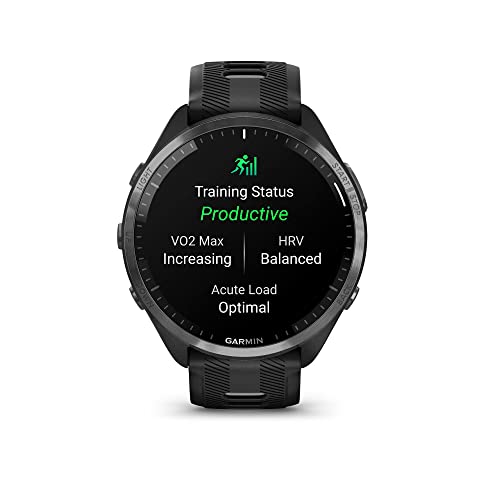
The watch runs on Garmin’s proprietary OS, which means you won’t get the app ecosystem of a Wear OS device, but you do get rock-solid reliability, fast satellite acquisition (multi-band GPS with SatIQ technology), and deep integration with Garmin Connect — one of the best free training platforms available. Music storage supports Spotify, Amazon Music, and Deezer offline playlists, and Garmin Pay lets you tap-to-pay at supported terminals.
One common refrain from Amazon reviewers captures the sentiment well: “I upgraded from a Forerunner 245 and the AMOLED screen alone justified the price. But the training metrics are what keep me wearing it every single day. It’s like having a coach on your wrist.”
Pros:
- Gorgeous, sunlight-readable AMOLED display
- Best-in-class training and recovery metrics for runners
- Multi-band GPS with exceptional accuracy
- Outstanding battery life for an AMOLED watch
- Full offline maps with navigation
- Lightweight titanium bezel
- No required subscription for core features
Cons:
- Premium price point — this is a significant investment
- Garmin’s smart features (notifications, apps) lag behind Apple and Samsung
- Touchscreen can be finicky with wet or sweaty fingers during workouts
- The silicone band, while comfortable, shows wear after 12–18 months of heavy use
- No built-in speaker or microphone for calls
Who should buy it: The Forerunner 965 is built for runners and triathletes who train consistently and want data-driven insights to improve performance. If you run three or more times per week, follow structured training plans, or compete in races, this watch will pay for itself in the quality of feedback it provides. Casual joggers or people primarily interested in smartwatch features like phone calls and app ecosystems should look elsewhere.
Breaking Down the Full Ownership Cost
Now let’s get to the heart of this article: what does it actually cost to own and use the Forerunner 965 over a typical ownership period of three years?
1. The Watch Itself
The Forerunner 965 is a premium-priced running watch. Check the current price using the button above — it fluctuates with sales events and availability. This is your single largest expense, and it’s a one-time cost.
2. Garmin Connect and Software: Free (Mostly)
One of Garmin’s biggest advantages over competitors is that the core software experience is completely free. Garmin Connect — the companion app and web platform — provides:
- Detailed workout analysis and history
- Training plans (5K through marathon)
- Sleep tracking and Body Battery
- Live tracking for safety
- Course creation and syncing
- Connect IQ app store
There is no required subscription to use any of the watch’s built-in features. This is a meaningful differentiator. Apple charges for Apple Fitness+, and many third-party platforms like Strava gate key features behind a paywall.
However, many serious runners do pair the Forerunner 965 with optional paid services:
- Strava Summit/Subscription: Roughly $80/year. Provides route planning, segment leaderboards, training log analysis, Beacon live tracking, and heatmaps. Many runners consider this essential.
- TrainingPeaks: Plans start around $120/year for the Premium tier. Offers structured workout planning, performance management charts (CTL/ATL/TSB), and coach integration.
- Final Surge, TrainerRoad, or other platforms: Vary from free to $200/year depending on the service.
Estimated annual subscription cost: $0 (Garmin-only) to $200+ (Garmin + Strava + TrainingPeaks). Over three years, that’s $0 to $600.
3. Replacement Bands
The Forerunner 965 uses Garmin’s proprietary 22mm QuickFit band system. The stock silicone band is comfortable and functional, but it will degrade with heavy use — sweat, sunscreen, and UV exposure take their toll. Most daily runners report needing a replacement band every 12–18 months.
- Official Garmin silicone bands: Typically range from $30–$50
- Third-party silicone bands: Available for $8–$20 on Amazon, with varying quality
- Nylon/hook-and-loop bands: $15–$35, popular for comfort and breathability
- Premium leather or titanium bands: $50–$150+ for dress-up occasions
Estimated three-year band cost: $20–$100 (budget-conscious) to $150–$300 (multiple styles and premium materials).
4. Screen Protection
The Forerunner 965’s Corning Gorilla Glass 3 DX display is reasonably scratch-resistant, but it’s not sapphire. Trail runners, obstacle course racers, and anyone who’s ever banged a watch on a doorframe should consider protection.
- Tempered glass screen protectors (2-pack): $7–$15
- TPU film protectors (6-pack): $6–$12
- Full protective case/bumper: $10–$20
Screen protectors typically need replacing every 6–12 months. Budget for 3–6 packs over three years.
Estimated three-year screen protection cost: $20–$60.
5. Charging Accessories
The Forerunner 965 ships with one proprietary Garmin charging cable. If you travel frequently or want a dedicated cable at work, you’ll want extras.
- Official Garmin charging cable: Around $20–$30
- Third-party charging cables: $8–$15
- Charging docks/stands: $12–$25 (nice for nightstand use)
Estimated three-year charging accessory cost: $0 (if the included cable suffices) to $50.
6. Heart Rate Accessories
The Forerunner 965’s wrist-based optical heart rate sensor (Garmin Elevate Gen 4) is solid for steady-state running but can struggle with high-intensity intervals, cold weather, and wrist tattoos. Serious trainers often add a chest strap or arm-band sensor.
- Garmin HRM-Pro Plus chest strap: Approximately $100–$130. Also captures running dynamics (ground contact time, vertical oscillation, etc.).
- Garmin HRM-Fit (clip-on for sports bras): Around $100–$130.
- Third-party chest straps (Polar H10, Wahoo TICKR): $60–$100.
- Replacement strap/pads for chest HRM: $10–$20 every 12–18 months.
Estimated three-year HR accessory cost: $0 (wrist HR only) to $170 (premium chest strap + replacement pads).
7. Other Optional Accessories
- Garmin Running Dynamics Pod: ~$50 (if you don’t have an HRM-Pro Plus but want running dynamics data)
- Garmin Foot Pod (for treadmill accuracy): ~$70
- External sensors (power meters like Stryd): ~$230
- Watch travel case: $8–$15
Most runners won’t need all of these, but power-users and data junkies can easily spend $200–$350 on sensor accessories.
8. Repairs and Battery Replacement
Garmin watches are generally very durable, but accidents happen. Garmin’s out-of-warranty repair/replacement service typically costs a flat fee that varies by model — for premium watches, expect $150–$250 if something goes wrong after the one-year warranty. Some runners purchase extended protection plans through Amazon or third-party providers for $30–$60.
Battery degradation is real but slow. Most users report the Forerunner 965’s battery still holds 80%+ capacity after two years of daily use. Garmin does not offer consumer battery replacement; if battery life becomes unacceptable, you’re looking at the out-of-warranty replacement fee or upgrading.
Estimated three-year repair/protection cost: $0 (no issues) to $60 (extended warranty) to $250 (out-of-warranty replacement).
The Three-Year Cost Summary
Here’s how the numbers stack up for three common user profiles:
The Minimalist Runner
Uses Garmin Connect only, replaces one band, adds a screen protector, and has no issues.
- Watch + one third-party band ($15) + screen protectors ($20) = Watch price + ~$35
The Dedicated Enthusiast
Subscribes to Strava, buys an HRM-Pro Plus, gets a second charging cable, rotates two band styles, and adds an extended warranty.
- Watch + Strava 3 years ($240) + HRM-Pro Plus ($130) + bands ($80) + charging cable ($15) + screen protectors ($40) + extended warranty ($50) = Watch price + ~$555
The Data-Obsessed Competitor
Runs Strava + TrainingPeaks, owns a Stryd power meter, HRM-Pro Plus, multiple bands, travel case, and charging dock.
- Watch + Strava 3 years ($240) + TrainingPeaks 3 years ($360) + HRM-Pro Plus ($130) + Stryd ($230) + bands ($200) + charging accessories ($40) + screen protectors ($45) + travel case ($12) = Watch price + ~$1,257
These numbers illustrate an important point: the Forerunner 965’s ecosystem costs are almost entirely optional. Unlike some competitors, Garmin doesn’t lock essential features behind a paywall. The watch delivers tremendous value straight out of the box.
Long-Term Value: Is the Forerunner 965 Worth It?
The Forerunner 965 holds its value remarkably well on the secondhand market. Previous-generation Forerunner models (like the 945 and 955) still command strong resale prices two to three years after release. If you take care of the watch and sell it when you upgrade, you can typically recoup a meaningful portion of your initial investment.
More importantly, the Forerunner 965 is built to last. The titanium bezel resists scratches and dings far better than stainless steel or aluminum. The fiber-reinforced polymer case is lightweight yet tough. And Garmin’s track record of long-term software support means you’ll continue receiving feature updates, new watch faces, and bug fixes for years after purchase. The Forerunner 245, released in 2019, was still receiving updates well into 2023.
Compared to an Apple Watch — which typically receives major software updates for only 4–5 years and has a battery that degrades faster due to daily charging — the Forerunner 965 offers a significantly longer useful lifespan. When you amortize the cost over three to five years of daily use, the per-day cost becomes remarkably reasonable for a device that tracks every run, monitors your recovery, and helps you train smarter.
Who Should (and Shouldn’t) Buy the Forerunner 965
Buy it if:
- You run or train consistently (3+ days per week)
- You value detailed training metrics and recovery data
- You want a watch that lasts 3–5 years without feeling outdated
- You prefer no mandatory subscriptions
- You need multi-sport tracking (triathlon, cycling, swimming)
- You want offline maps and navigation for trail running
Skip it if:
- You primarily want a smartwatch that happens to track runs
- You run casually once or twice a week (the Forerunner 265 offers most features at a lower price)
- You’re deeply invested in the Apple or Samsung ecosystem
- You need LTE connectivity on your wrist
- Budget is your primary concern (consider the COROS PACE 3 or Garmin Forerunner 265)
Tips to Minimize Your Total Ownership Cost
1. Skip Strava Premium initially. Garmin Connect provides excellent free analysis. Try it for three months before subscribing to anything else. 2. Buy third-party bands. Quality aftermarket QuickFit bands cost a fraction of Garmin’s official ones and perform nearly as well. 3. Apply a screen protector on day one. Prevention is far cheaper than dealing with a scratched display. 4. Use the included cable carefully. Garmin’s proprietary cables are durable but not indestructible. A gentle connection habit saves you from buying replacements. 5. Consider a chest strap only if you do intervals. For easy and moderate runs, the wrist sensor is accurate enough for most training purposes. 6. Buy during sales events. The Forerunner 965 regularly sees discounts during Prime Day, Black Friday, and holiday sales.
Why Trust Us
Our editorial team has collectively logged thousands of miles with GPS running watches from Garmin, Apple, COROS, Polar, and Suunto. We don’t just read spec sheets — we run in these watches through rain, heat, trail mud, and race-day pressure. For this cost-of-ownership analysis, we researched current accessory pricing across Amazon, Garmin’s official store, and third-party retailers. We consulted hundreds of real user reviews and long-term ownership reports from running communities on Reddit, Letsrun, and the Garmin Forums. Our goal isn’t to sell you a watch — it’s to make sure you know exactly what you’re signing up for before you buy one.


Leave a Reply