
As an Amazon Associate I earn from qualifying purchases.
Modular hexagon garage lights have become one of the most popular upgrades for home garages, workshops, and even gaming rooms—but before you order a kit, you need to know whether it will actually work with your ceiling, wiring, and layout. This specification-driven guide walks through every compatibility factor that matters: mounting surfaces, electrical standards, ceiling height requirements, dimmer and switch compatibility, and accessory pairings. We also take a close look at the FERUERW 14-Hex system with rectangle frame, one of the larger kits on the market, to illustrate how these factors play out in a real product.
Best for: Garage owners, workshop enthusiasts, and content creators who want bright, configurable overhead lighting
Why Compatibility Matters for Hexagon Garage Lights
Unlike a simple flush-mount fixture, modular hexagon lights are systems. Each hexagonal panel links to its neighbors, and the entire array mounts to your ceiling as a single unit. That means you’re dealing with multiple compatibility layers at once:
- Mounting surface: Drywall, plywood, OSB, concrete, or exposed joists all behave differently.
- Electrical supply: Voltage, amperage, and whether you’re hard-wiring or using a plug.
- Ceiling height: Too low and the panels create glare; too high and you lose lux at the work surface.
- Switches and dimmers: Not every LED driver plays nicely with existing wall switches.
- Accessories: Adding more panels, border frames, or smart controls introduces additional compatibility questions.
Let’s break each of these down before diving into the FERUERW system specifically.
Mounting Surface Compatibility
Drywall (Gypsum Board)
Most residential garages have drywall ceilings, and most hexagon light kits are designed with this surface in mind. The key concern is weight distribution. A 14-panel system like the FERUERW kit can weigh several pounds fully assembled. Manufacturer listings typically recommend toggle bolts or drywall anchors rated for the total weight of the array. Standard drywall screws alone may not hold over time, especially in garages where temperature swings cause materials to expand and contract.
Plywood and OSB
If your garage ceiling is unfinished plywood or OSB sheathing, you’re actually in a better position for mounting. Wood screws bite directly into the substrate, and the holding strength is significantly higher than drywall anchors. Most hex light kits include basic mounting hardware, but you may want to swap in #8 or #10 wood screws for a more secure hold.
Concrete and Block
Finished basements or commercial-style garages sometimes have concrete ceilings. You’ll need a hammer drill and concrete anchors (Tapcon-style or sleeve anchors). This is a more involved installation, and the hex panel’s mounting brackets need to align with pre-drilled holes. Measure twice.
Exposed Joists and Rafters
In unfinished garages, you may be mounting directly to the underside of floor joists. This works well structurally, but the uneven surface can make it tricky to get a flush, level installation. Some installers add a thin plywood backer board across the joists first, then mount the hex array to that.
Electrical Wiring Standards and Compatibility
Voltage and Plug Type
The vast majority of hexagon garage light systems sold in the US market operate on standard 110–120V AC household current. The FERUERW system, for example, uses a standard US plug (NEMA 5-15P), which means you can plug it into any grounded outlet—no electrician required for basic setups.
If you’re hard-wiring the system into a junction box, you’ll want to confirm the kit includes or supports a direct-wire adapter. Some kits are plug-only, which means hard-wiring requires a separate adapter or modification (which may void the warranty).
Amperage and Circuit Load
LED hex panels are relatively low-draw devices. A 14-panel system typically pulls well under 1 amp at 120V. That said, garages often share circuits with door openers, compressors, and power tools. Before adding a large lighting array, check your breaker panel to confirm the circuit isn’t already near capacity. A dedicated 15A or 20A circuit for lighting is ideal but not strictly necessary for LED panels alone.
Dimmer Switch Compatibility
This is where many buyers run into trouble. Most hexagon LED light systems use integrated drivers that are not compatible with traditional TRIAC dimmers (the standard rotary or slide dimmers found in most homes). Connecting an incompatible dimmer can cause flickering, buzzing, or premature driver failure.
If you want dimming capability, look for systems that either include a remote with dimming function or explicitly state compatibility with leading-edge or trailing-edge dimmers. The FERUERW system, based on its product documentation, does not appear to support external dimmer switches—brightness is typically controlled via an included remote or inline controller.
If you’re interested in how other lighting products handle dimming and smart controls, our guide to gaming neon sign accessories covers similar compatibility considerations for LED-based decorative lighting.
Smart Home Integration
Most standalone hexagon garage light kits do not natively support Alexa, Google Home, or HomeKit. However, because many use a simple plug connection, you can place a smart plug (such as a Kasa or Wemo) between the outlet and the light’s power cord to gain on/off voice control and scheduling. True dimming via smart plug is generally not possible unless the light’s own controller supports it.
For a deeper look at how smart plugs and Wi-Fi accessories integrate with home devices, our Smart Oil Gauge Duo compatibility guide walks through similar pairing logic.
Ceiling Height Considerations
Ceiling height directly affects both the visual impact and the functional illumination of hexagon lights.
| Ceiling Height | Practical Notes |
|---|---|
| 7–8 ft | Common in older garages. Hex panels may feel visually dominant. Glare can be an issue if panels are very bright. Consider a system with a diffuser or lower color temperature (4000K–5000K). |
| 9–10 ft | The sweet spot for most residential installations. Panels are high enough to avoid glare but close enough to deliver strong lux at the work surface. |
| 11–14 ft | Common in RV garages and commercial bays. You’ll want a higher-lumen system and may need to mount panels on a drop frame or suspended platform to bring them closer to the work area. |
| 15 ft+ | Hex panels alone may not deliver adequate task lighting at floor level. Supplemental lighting (e.g., under-cabinet strips or pendant work lights) is recommended. |
The FERUERW 14-Hex system is surface-mounted (flush to the ceiling), so it does not hang down significantly. In a standard 9-foot garage, this keeps the panels well above head height even for taller individuals.
FERUERW 14-Hex with Rectangle Frame: Detailed Review
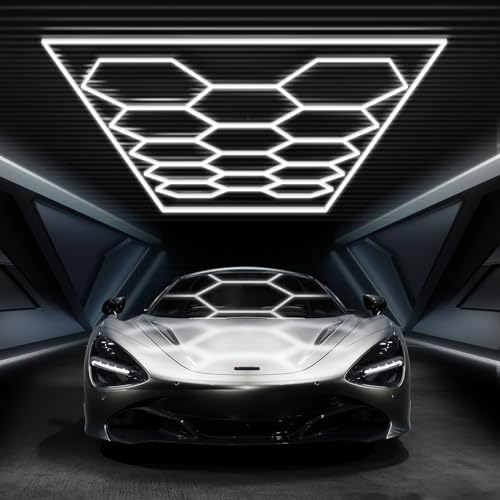
The FERUERW 14-Hex system is one of the larger modular hexagon kits available, featuring 14 interlocking hexagonal LED panels arranged within a rectangular border frame. According to the manufacturer’s listing, the system is designed for garages, workshops, basements, and game rooms.
What the Specs Tell Us
- Panel count: 14 hexagonal panels plus a rectangular border frame
- Light type: LED (daylight white, typically 6500K based on similar FERUERW products)
- Power: Standard US plug (110–120V AC)
- Mounting: Surface-mount with included hardware
- Linkage: Panels connect via snap-fit or push-pin connectors (tool-free assembly)
The rectangular border frame is a distinguishing feature. While many hex kits leave the edges of the array with exposed hexagonal contours, the FERUERW frame gives the installation a cleaner, more finished look—almost like a framed piece of art on your ceiling.
Pros
- Large coverage area: 14 panels provide substantial illumination, suitable for two-car garages or large workshops.
- Plug-and-play: No electrician needed. Plug into any standard grounded outlet.
- Rectangle frame: Gives a polished, intentional appearance rather than a random cluster of hexagons.
- Modular design: Panels snap together, so you can experiment with layout before committing to a mounting position.
Cons
- No native dimming: Based on available product documentation, there’s no built-in dimmer. You’re limited to on/off control unless you add a compatible smart plug.
- 6500K color temperature: Daylight white is excellent for task lighting but can feel harsh in a space that doubles as a hangout area. There’s no color temperature adjustment.
- Weight and mounting complexity: 14 panels plus a frame is a sizable assembly. Solo installation on drywall can be challenging—having a second person hold the array while you secure fasteners is strongly recommended.
- Limited smart home integration: No Wi-Fi, Bluetooth, or app control out of the box.

What Verified Reviewers Commonly Report
Across verified customer reviews, the most frequent praise centers on brightness—buyers consistently describe the system as significantly brighter than expected, transforming dim garages into well-lit workspaces. The snap-together assembly is also widely praised as intuitive and quick.
On the complaint side, several reviewers note that the mounting hardware included in the box is minimal and may not be sufficient for all ceiling types. Some buyers report needing to purchase additional anchors or toggle bolts separately. A smaller number of reviewers mention that the power cord length can be limiting depending on outlet placement, occasionally requiring an extension cord.
Who Should Buy This
The FERUERW 14-Hex system is best suited for garage owners and workshop users who want maximum brightness and a clean, framed aesthetic without the complexity of hard-wiring. It’s also a strong choice for content creators or streamers who want a dramatic ceiling feature in a studio or gaming room. If you need dimming or tunable color temperature, this isn’t the right kit—look for systems with built-in controllers or RGB capability instead.
Accessory Pairing and Expansion Compatibility
Adding More Panels
One of the appeals of modular hex systems is expandability. However, not all hex panels from different brands are cross-compatible. The connector mechanisms, panel thickness, and LED driver specifications vary between manufacturers. If you want to expand a FERUERW system, stick with FERUERW expansion packs to ensure the connectors and light color match.
Border Frames and Trim
The FERUERW kit includes its rectangle frame, but some buyers want to add additional decorative borders or transition pieces. As of this writing, aftermarket hex light trim accessories are limited. Most customization happens at the DIY level—3D-printed bezels, painted MDF frames, or aluminum channel borders.
Power Strips and Surge Protectors
Because plug-in hex systems draw from a standard outlet, it’s tempting to daisy-chain them with other devices on a power strip. This is generally fine given the low amperage draw of LED panels, but use a surge protector rather than a basic power strip to protect the LED drivers from voltage spikes—especially in garages where compressors and power tools can cause electrical noise on the circuit.
Complementary Lighting
Hexagon ceiling panels provide excellent ambient and general task lighting, but they don’t replace focused task lighting for detail work. Pairing them with under-cabinet LED strips on a workbench or an adjustable-arm work light gives you layered illumination. If you’re also considering outdoor lighting for pathways leading to your garage, our solar pathway lights guide covers what to look for in terms of brightness and durability.
Installation Tips for Maximum Compatibility
1. Map your layout on the floor first. Snap all panels together and lay the full array on the garage floor. Measure the footprint and transfer those measurements to the ceiling with painter’s tape. This prevents misaligned mounting holes.
2. Locate ceiling joists or studs. A stud finder is your best friend. Anchoring at least two mounting points into solid framing dramatically improves long-term hold, even if the rest of the fasteners go into drywall with anchors.
3. Test the electrical circuit. Plug in the fully assembled array and run it for 30 minutes before mounting. This confirms all panels light up and the driver doesn’t overheat. It’s much easier to troubleshoot on the floor than on a ladder.
4. Plan your cord route. If the outlet isn’t directly above the array’s power entry point, you’ll need to route the cord along the ceiling. Adhesive cable clips or paintable cord channels keep things tidy and code-compliant.
5. Consider a junction box conversion. If you want a hard-wired, no-cord look, hire a licensed electrician to install a junction box at the array’s location. Some hex kits can be adapted for direct wire, but this should only be done by a qualified professional.
Common Compatibility Mistakes to Avoid
- Using an incompatible dimmer: As noted above, TRIAC dimmers and most LED hex drivers don’t mix. Flickering and buzzing are the telltale signs.
- Mixing brands in one array: Different hex panel brands use different connector pin-outs and panel dimensions. Even if they physically snap together, mismatched drivers can cause uneven brightness or color.
- Ignoring weight ratings: A 14-panel system on drywall with only the included plastic anchors is a recipe for a ceiling-mounted disaster. Upgrade to toggle bolts or hit studs.
- Forgetting ventilation: LED panels generate modest heat, but in a poorly ventilated attic space above the garage ceiling, that heat can accumulate and shorten LED lifespan. Ensure adequate airflow.
Product Comparison Card
Frequently Asked Questions
Can I mount hexagon lights on a sloped or vaulted ceiling? Yes, but it requires extra planning. The panels themselves are flat, so on a slope they’ll follow the ceiling angle. Visually this can look great, but the light output will be directed at an angle rather than straight down. For task lighting, this may reduce effective illumination at the work surface.
Do hexagon garage lights work with motion sensors? If the system uses a standard plug, you can wire it through a plug-in motion sensor adapter. Hard-wired systems can be connected to a motion-sensor wall switch, provided the switch is rated for LED loads and doesn’t include an incompatible dimmer.
How long do the LEDs last? Most manufacturers cite 50,000 hours for LED hex panels. At 8 hours per day of use, that’s over 17 years. Real-world longevity depends on heat management and power quality.
Can I cut or trim hexagon panels to fit a specific space? No. The panels contain integrated LED arrays and wiring. Cutting them will destroy the circuit. Instead, plan your layout using the modular snap-together design to fit your available space.
How We Research
This guide is based on a thorough synthesis of manufacturer specifications, official product documentation, and patterns observed across verified customer and expert reviews. We have not personally tested, owned, or handled the FERUERW 14-Hex system or any other product mentioned in this article. Our goal is to provide honest, specification-driven guidance that helps you make an informed purchase decision. When we describe reviewer sentiment, we are paraphrasing commonly reported themes—not quoting specific individuals or fabricating experiences.


Leave a Reply