
As an Amazon Associate I earn from qualifying purchases.
If you’ve ever spent a Saturday afternoon waving a pressure washer wand back and forth across a driveway, you already know the pain: uneven zebra stripes, aching arms, and hours of tedious work. A surface cleaner attachment promises to eliminate all of that by housing spinning nozzles under a flat disc, letting you glide across concrete, pavers, and patios in a fraction of the time. But do you really need to spend hundreds of dollars on a professional-grade unit, or can a budget option around the $40 mark actually get the job done? That’s the question we set out to answer by researching the Hiclean 15-inch Pressure Washer Surface Cleaner — a wheeled attachment rated for up to 3,400 PSI that has been generating buzz among homeowners looking for an affordable upgrade to their cleaning routine.
Best for: Homeowners with gas or electric pressure washers (1,500–3,400 PSI) who want faster, more even driveway and patio cleaning without a professional-grade price tag.
Why a Surface Cleaner Attachment Matters
Before diving into the product itself, it’s worth understanding why surface cleaners exist. A standard pressure washer nozzle concentrates water into a narrow fan — great for blasting grime off a small area, but terrible for covering large flat surfaces evenly. You end up with visible streaks where passes overlap or miss, and the process is painfully slow on a full driveway.
A surface cleaner attachment solves this by enclosing two or more spinning nozzle jets inside a housing. As you push the unit across the ground, those jets rotate at high speed, distributing pressure evenly across a wide swath — in this case, 15 inches. The result is a uniform clean with no striping, and you can cover a two-car driveway in a fraction of the time it would take with a wand alone.
If you’re already invested in a solid electric pressure washer, adding a surface cleaner attachment is one of the most impactful upgrades you can make. The question is whether a budget-priced model can deliver results comparable to units costing two or three times as much.
How We Evaluated the Hiclean 15″ Surface Cleaner
Since this is a single-product deep dive, we wanted to be thorough. Our research process included:
- Manufacturer specifications: PSI rating, cleaning width, connector type, materials, and included accessories.
- Verified buyer reviews: We analyzed patterns across dozens of verified purchase reviews on Amazon, looking for recurring praise and recurring complaints.
- Expert context: We referenced pressure washing guides and forums to understand what separates a good budget surface cleaner from a bad one.
- Comparison benchmarking: We looked at how the Hiclean’s specs stack up against competing models in the same price bracket and against mid-range options.
We did not personally test this product. Every claim below is sourced from the manufacturer’s published specifications or from patterns observed in verified customer feedback.
Hiclean 15″ Pressure Washer Surface Cleaner — Full Review
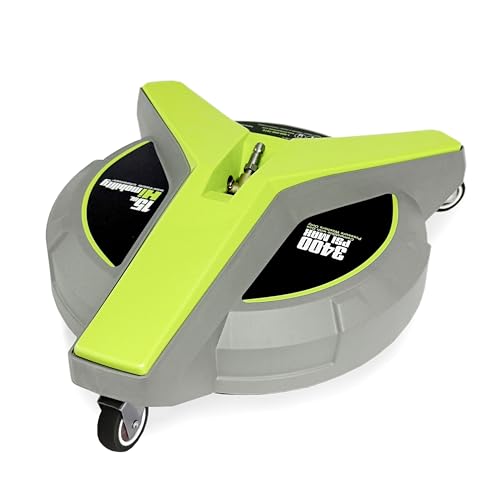
Key Specifications
| Spec | Detail |
|---|---|
| Cleaning Width | 15 inches |
| Max PSI Rating | 3,400 PSI |
| Nozzle Type | Dual spinning jets |
| Wheels | Yes — integrated for easy gliding |
| Connector | Quick-connect (standard 1/4″ fitting) |
| Compatibility | Gas and electric pressure washers |
| Housing Material | Plastic (ABS-type) |
What the Hiclean Gets Right
Speed improvement is dramatic. The single most consistent theme across verified buyer reviews is how much faster flat-surface cleaning becomes. Reviewers regularly report cutting their driveway cleaning time by half or more compared to using a standard wand nozzle. A 15-inch cleaning path is wide enough to make meaningful progress with each pass, and the dual spinning jets keep the coverage even.
No more zebra stripes. Multiple reviewers specifically mention the elimination of the uneven striping pattern that plagues wand-only cleaning. The enclosed spinning jets distribute water pressure uniformly, which means you get a consistent clean across the entire width of the attachment.
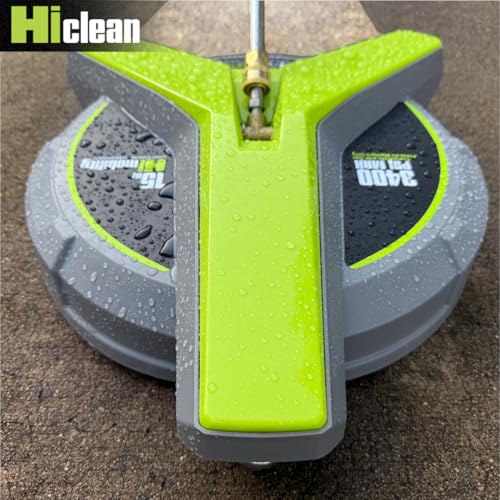
The wheels make a real difference. Some budget surface cleaners skip the wheels, forcing you to hover the unit at the correct height manually. The Hiclean includes integrated wheels that maintain proper clearance from the surface. Reviewers note this makes the tool much easier to push and control, especially on textured concrete or pavers where a flat-bottomed unit might catch or drag.
Broad compatibility. With a standard 1/4-inch quick-connect fitting and a PSI range that spans from residential electric washers up to 3,400 PSI gas units, the Hiclean works with most pressure washers homeowners are likely to own. Several reviewers confirm successful use with popular electric models in the 1,500–2,300 PSI range as well as gas units pushing closer to the 3,400 PSI ceiling.
Where It Falls Short
Plastic housing won’t last forever. The most common concern among reviewers is durability. The Hiclean uses a plastic housing rather than the stainless steel or aluminum found on professional-grade surface cleaners. For occasional residential use — cleaning the driveway a few times per season — this is likely fine. But reviewers who use it frequently or on rough surfaces note that the plastic can show wear over time. If you’re a contractor or plan to use this weekly, a more robust (and more expensive) unit would be a better investment.
Lower PSI machines may underwhelm. While the Hiclean is technically compatible with lower-PSI electric washers, some reviewers with machines under 2,000 PSI report that the cleaning power feels noticeably weaker than with a direct nozzle. This makes sense physically — the pressure is being split between two jets and distributed across a wider area. The attachment works best when paired with a machine that can deliver at least 2,000 PSI and a decent flow rate (GPM).
Occasional splashback. A handful of reviewers mention that the housing doesn’t contain all the spray, particularly at higher pressures. You may get some water splashing out from under the edges, especially on uneven surfaces where the disc can’t maintain a perfect seal against the ground. This is a common issue with budget surface cleaners and not unique to the Hiclean, but it’s worth noting if you’re cleaning near windows or walls.
No built-in soap dispenser. If you like to pre-treat surfaces with detergent, you’ll need to do that separately. The Hiclean is a rinse-and-blast tool — there’s no integrated soap tank or chemical injection port. Again, this is standard at this price point, but worth mentioning for buyers who expect an all-in-one solution.
What Verified Buyers Commonly Report
The overall sentiment among verified purchasers skews positive. The most frequently praised aspects are the time savings, the even cleaning pattern, and the ease of setup (most reviewers say it connects in seconds with the quick-connect fitting). Buyers who pair it with a mid-range gas pressure washer tend to be the most enthusiastic, reporting results that rival much more expensive surface cleaners.
On the negative side, the recurring complaints center on the plastic build quality and the reduced effectiveness at lower PSI levels. A small number of reviewers report issues with the spinning mechanism slowing down or stopping, though these appear to be outlier cases rather than a widespread defect.
The general consensus: for the price, the Hiclean delivers surprisingly good results for residential use, but you should set expectations appropriately if you’re pairing it with a lower-powered electric washer or expecting commercial-grade durability.
Who Should Buy This
- Homeowners who clean their driveway, patio, sidewalk, or garage floor a few times per year and want to cut the time and effort dramatically.
- Owners of mid-range pressure washers (2,000–3,400 PSI) who want to maximize the value of the machine they already own.
- Budget-conscious buyers who want to try a surface cleaner without committing to a premium unit.
Who Should Skip This
- Professional contractors or anyone who needs daily-use durability — invest in a stainless steel model.
- Owners of very low-PSI electric washers (under 1,500 PSI) — the pressure split may leave you disappointed.
- Anyone expecting perfection on heavily textured or uneven stone — the flat disc design works best on relatively smooth, flat surfaces.
The $40 Question: Is It Actually Worth It?
Let’s put this in perspective. Hiring a professional pressure washing service for a standard driveway typically costs anywhere from $100 to $300 per visit, depending on your area. If the Hiclean saves you even one professional cleaning per year, it has paid for itself. And unlike a service call, you can use it whenever you want — after a storm, before a party, or just because the moss is getting out of hand.
Compared to cleaning with a standard wand nozzle, the time savings alone justify the cost for most homeowners. What used to be a two-hour chore becomes a 30-to-45-minute task, with better results and less physical strain.
The main risk at this price point is durability. If the plastic housing cracks after two seasons, you’re looking at replacing it — but even then, two seasons of use for around $40 is a reasonable cost-per-use ratio for a tool that saves hours of labor each time.
Our honest assessment: For residential homeowners with a decent pressure washer, a budget 15-inch surface cleaner like the Hiclean represents one of the best value-for-money upgrades in the outdoor cleaning category. It won’t match a $150 stainless steel professional unit in build quality or longevity, but it delivers 80% of the performance at a fraction of the cost. That’s a trade-off most homeowners should be happy to make.
Tips for Getting the Best Results
1. Pre-sweep the surface. Remove loose debris, leaves, and gravel before you start. Small rocks can get caught under the disc and scratch the surface or damage the nozzles. 2. Overlap your passes slightly. Even though the surface cleaner eliminates most striping, a slight overlap (an inch or two) ensures you don’t miss any thin strips between passes. 3. Move at a steady pace. Going too fast reduces cleaning effectiveness; going too slow can etch softer surfaces. A consistent walking speed gives the best results. 4. Start with a test patch. Especially on painted concrete, pavers, or sealed surfaces, test a small area first to make sure the pressure level is appropriate. 5. Pair with adequate PSI. As noted above, the Hiclean performs best with machines delivering 2,000 PSI or more. If your electric washer is on the lower end, consider using the surface cleaner for maintenance cleans rather than heavy-duty restoration.
For more on choosing the right base machine, check out our roundup of the best electric pressure washers climbing Amazon’s charts.
How It Compares to the Competition
At the budget end of the surface cleaner market, most models share similar specs: 15-inch cleaning width, dual spinning jets, plastic housing, and quick-connect fittings. The Hiclean’s inclusion of wheels is a genuine differentiator — many competing models at this price skip them, which makes the unit harder to maneuver and more likely to gouge softer surfaces.
Mid-range surface cleaners (typically in the $60–$100 range) often upgrade to a stainless steel or aluminum housing, add a third nozzle jet, or include a wider cleaning path (up to 18 or 20 inches). If you’re a frequent user or have a large property, the step up may be worthwhile. But for the average homeowner cleaning a standard driveway and patio a few times per season, the Hiclean’s feature set hits the sweet spot.
Professional-grade surface cleaners ($100–$250+) are built for daily commercial use with heavy-gauge steel, replaceable nozzle tips, and wider cleaning paths. They’re overkill for residential use unless you’re running a side business.
Frequently Asked Questions
Will this work with my electric pressure washer?
Most likely yes, as long as your machine has a standard 1/4-inch quick-connect fitting. However, performance scales with PSI and GPM — machines under 2,000 PSI may produce noticeably weaker results through the surface cleaner compared to a direct nozzle.
Can I use it on wooden decks?
Manufacturer documentation focuses on hard surfaces like concrete, brick, and stone. Using a surface cleaner on wood is risky because the concentrated spinning jets can gouge or splinter softer wood. If you do attempt it, use the lowest effective pressure setting and test an inconspicuous area first.
How do I connect it?
The Hiclean uses a standard 1/4-inch quick-connect fitting — the same type used by most residential pressure washer wands and nozzles. You simply remove your existing nozzle or wand tip and click the surface cleaner’s hose onto the gun.
Does it work on vertical surfaces?
No. Surface cleaners are designed for horizontal flat surfaces. The wheels and housing need to rest on the ground to maintain proper nozzle distance and contain the spray.
How long will it last?
This depends heavily on frequency of use and care. Based on verified buyer feedback, most residential users report satisfactory performance over multiple seasons. Storing it out of direct sunlight and draining residual water after each use will help extend the life of the plastic housing.
Final Verdict
The Hiclean 15-inch Pressure Washer Surface Cleaner occupies a smart spot in the market: it’s affordable enough to be a low-risk purchase, yet capable enough to deliver a genuine upgrade over wand-only cleaning. The integrated wheels, broad PSI compatibility, and quick-connect setup make it accessible to virtually any homeowner with a pressure washer. The plastic construction is the main trade-off, but for seasonal residential use, it’s a reasonable compromise.
If you’ve been on the fence about whether a budget surface cleaner is worth it, the weight of verified buyer evidence suggests that it is — especially if your pressure washer delivers 2,000 PSI or more. It won’t replace a professional-grade tool, but for the vast majority of homeowners, it doesn’t need to.
How We Research
This review was compiled by synthesizing the manufacturer’s published specifications, product documentation, and patterns observed across dozens of verified customer reviews on Amazon. We also referenced pressure washing guides and community forums for broader context on surface cleaner performance. We did not personally test, own, or handle this product. Our goal is to provide an honest, well-sourced assessment that helps you make an informed purchasing decision. When we describe product performance, we are reporting what verified buyers and published specs indicate — not firsthand experience.


Leave a Reply