
As an Amazon Associate I earn from qualifying purchases.
Attic heat buildup is one of those invisible energy drains that quietly inflates your cooling bills every summer. Solar attic fans have long been a popular fix — they pull hot air out of the attic using free solar energy — but the knock against them has always been the same: they stop working the moment the sun goes down. QuietCool’s latest AFR SLR-25 tackles that limitation head-on with an included AC/DC inverter that promises 24/7 runtime. But does that single upgrade justify choosing the new model over the previous-generation QuietCool solar fan? In this spec-driven comparison, we break down what’s actually changed, what stays the same, and whether a simple passive vent might be all some homeowners need.
Best for: Homeowners in hot climates who want continuous attic ventilation without running dedicated HVAC
What Changed Between Generations?
QuietCool has been a well-known name in whole-house and attic ventilation for years. Their previous-generation solar attic fans relied entirely on a photovoltaic panel — typically in the 20–25 watt range — to spin a DC motor during daylight hours. That design worked well enough on sunny afternoons when attic temperatures peak, but it left a gap: residual heat trapped after sunset continued radiating into living spaces, and the fan sat idle.
The AFR SLR-25 keeps the same 25-watt solar panel but adds an AC/DC inverter that lets the unit plug into a standard household outlet. During the day, the fan runs on solar power at no electrical cost. After dark — or on heavily overcast days — it seamlessly switches to AC power so the motor never stops. This is the single biggest spec-sheet difference, and it addresses the most common complaint about solar attic fans in general.
If you’re weighing whether a smart attic fan or a solar-powered model is the better fit, the SLR-25 now blurs that line by offering continuous runtime without the higher wattage draw of a fully electric unit.
QuietCool AFR SLR-25 Roof Mount Solar Attic Fan — Detailed Review

The AFR SLR-25 is a roof-mount unit that ships with a 25-watt monocrystalline solar panel, an integrated DC brushless motor, and the new AC/DC inverter kit. According to QuietCool’s product documentation, the fan is designed as a plug-and-play installation — the inverter simply plugs into a nearby attic outlet, and the solar panel handles daytime duty. No electrician is required for the solar side, though you will need an existing outlet (or have one installed) to take advantage of the 24/7 feature.
Key Specs
- Panel wattage: 25 W monocrystalline
- Motor type: DC brushless
- Runtime: 24/7 with AC/DC inverter; solar-only during daylight if unplugged
- Mount type: Roof mount
- Installation: Plug-and-play (solar panel + optional AC outlet)
What Reviewers and Experts Commonly Report
Early adopter feedback on the SLR-25 highlights the quiet operation — consistent with QuietCool’s brand reputation — and the straightforward installation process. Multiple reviewers note that the included inverter is the deciding factor over older models, since it eliminates the “dead hours” problem. On the praise side, homeowners in the Sun Belt report noticeable drops in attic temperature within the first week, and several mention lower thermostat settings on their central AC.
On the criticism side, some reviewers point out that if your attic doesn’t already have an electrical outlet, you’ll need to factor in the cost of having one wired — which can add meaningfully to the total project cost. A few also note that the 25-watt panel is sized for moderate attic spaces; very large attics (over roughly 1,500 sq ft) may need multiple units or a higher-CFM solution. Understanding the true cost beyond the sticker price is important before committing.
Pros
- AC/DC inverter enables genuine 24/7 ventilation
- Solar panel covers daytime operation at zero electrical cost
- DC brushless motor is quiet and long-lasting
- Plug-and-play design simplifies DIY installation
- QuietCool’s established reputation in home ventilation
Cons
- Requires an attic electrical outlet for nighttime operation
- 25-watt panel may be undersized for very large attics
- Roof-mount installation means cutting into roofing material
- Premium over solar-only models from the same brand
Who Should Buy This
The AFR SLR-25 is best suited for homeowners in warm-to-hot climates with moderate-sized attics who want continuous ventilation without the energy draw of a fully electric attic fan. If your previous-gen QuietCool solar fan has been serving you well during the day but you’ve noticed your attic stays warm into the evening, this is the logical upgrade.
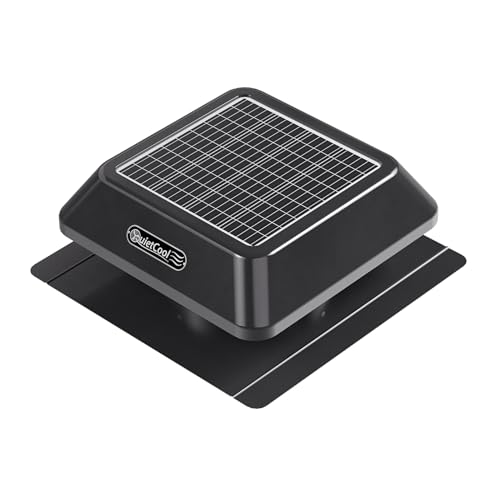
Previous-Generation QuietCool Solar Attic Fans: What You’re Giving Up
QuietCool’s earlier solar attic fans — models without the AC/DC inverter — are still available through various retailers and remain perfectly functional units. They use the same general design philosophy: a monocrystalline panel, a DC motor, and a roof-mount flashing. The core difference is simple: no inverter means no nighttime operation.
For homeowners in climates where summer nights cool down quickly (think the Mountain West or Pacific Northwest), a solar-only model may be perfectly adequate. The attic heats up during the day, the fan evacuates that heat while the sun is out, and cooler nighttime air naturally reduces the temperature differential. In these scenarios, paying extra for 24/7 capability may not deliver a meaningful return.
However, in regions where nighttime temperatures stay above 80°F — much of the Southeast, Gulf Coast, and Desert Southwest — the attic remains a heat reservoir well after sunset. That’s where the SLR-25’s inverter earns its keep.
KCVENTSAIR Passive Air Vent — A Budget Alternative

Not every attic ventilation problem requires a powered fan. The KCVENTSAIR Passive Air Vent is a 4-inch thermostatic vent designed for rooms, basements, and garages. It uses a temperature-sensitive mechanism to automatically open at approximately 10°C and close when temperatures drop — no electricity, no solar panel, no moving motor parts.
Key Specs
- Size: 4-inch diameter
- Operation: Fully passive, thermostatic
- Auto-open temperature: ~10°C (50°F)
- Power required: None
- Intended use: Rooms, basements, garages
What Reviewers Commonly Report
Verified purchasers generally praise the simplicity of this vent — there’s nothing to install beyond cutting or fitting a 4-inch hole, and there are no ongoing costs whatsoever. Reviewers in basement and garage applications report that the thermostatic mechanism works reliably, opening and closing as ambient temperatures change. Several note it’s a good supplemental ventilation option when paired with other systems.
The most common criticism is that a passive vent simply cannot move the volume of air that a powered fan can. It relies on natural convection and pressure differentials, so in a large, sealed attic with poor existing ventilation, it won’t make a dramatic difference on its own. Some reviewers also note that the 4-inch size is quite small for attic applications — it’s better suited to the basements and garages listed in its product description.
Pros
- Zero operating cost — no electricity or solar needed
- Thermostatic auto-open/close requires no user intervention
- Extremely simple installation
- No moving motor parts means nothing to wear out
- Very affordable entry point
Cons
- Cannot actively move large volumes of air
- 4-inch diameter is small for attic-scale ventilation
- Relies on natural convection — limited effectiveness in still, hot air
- Not a replacement for a powered attic fan in hot climates
Who Should Buy This
The KCVENTSAIR vent is a sensible choice for homeowners who need supplemental passive ventilation in a garage, basement, or small enclosed space. It can complement a solar attic fan by providing additional airflow pathways, but it shouldn’t be considered a standalone solution for serious attic heat problems. Think of it as a supporting player, not the star.

Spec-Sheet Comparison: SLR-25 vs Previous-Gen Solar vs Passive Vent
To make the differences concrete, here’s how the three approaches stack up on the metrics that matter most:
Power Source: The SLR-25 uses solar + AC/DC inverter. Previous-gen QuietCool models use solar only. The KCVENTSAIR uses no power at all.
Runtime: The SLR-25 runs 24/7. Previous-gen runs during daylight only. The passive vent “runs” whenever temperatures exceed its threshold — but “running” means passively allowing air through, not actively moving it.
Airflow Volume: The SLR-25 and previous-gen models move comparable CFM (cubic feet per minute) during peak solar hours, since they share similar motor and panel specs. The passive vent moves a fraction of that volume.
Installation Complexity: The SLR-25 requires roof cutting plus access to an attic outlet. Previous-gen requires roof cutting only. The passive vent requires a 4-inch hole.
Ongoing Cost: The SLR-25 draws minimal AC power at night. Previous-gen has zero ongoing cost. The passive vent has zero ongoing cost.
Does the AC/DC Inverter Justify the Upgrade?
This is the central question, and the answer depends almost entirely on your climate and attic configuration.
Upgrade if: You live in a region where nighttime temperatures regularly stay above 75–80°F during summer months. In these conditions, your attic continues radiating stored heat into your living space for hours after sunset, and your AC system works harder to compensate. The SLR-25’s nighttime operation directly addresses this.
Stick with the previous gen if: Your nights cool down meaningfully (below 70°F), your attic has decent passive ventilation (ridge vents, soffit vents), and you’re primarily trying to reduce peak afternoon temperatures. A solar-only fan handles that job well, and the inverter adds cost and complexity (the outlet requirement) without proportional benefit.
Consider the passive vent if: You’re dealing with a small enclosed space like a garage or basement, your budget is tight, or you want to add supplemental airflow to an attic that already has a powered fan. It’s not a substitute for active ventilation in a hot attic, but it’s a useful tool in the right context.
For a broader look at how solar-powered attic fans compare to smart (fully electric) models, our spec-driven comparison of smart vs solar attic fans covers the tradeoffs in detail.
Installation Considerations
Both the SLR-25 and previous-gen QuietCool solar fans require cutting a hole in your roof, which means proper flashing and sealing are critical to prevent leaks. QuietCool’s documentation describes the process as DIY-friendly, but if you’re not comfortable working on a roof, hiring a roofer or handyman is a worthwhile investment — a poorly sealed roof penetration can cause far more damage than attic heat ever will.
The SLR-25 adds one extra step: running the inverter’s power cord to an attic outlet. If your attic already has one (many do, for lighting), this is trivial. If not, you’ll need an electrician to install a dedicated circuit, which can add meaningfully to the project budget. Factor this into your cost comparison — it’s a detail that’s easy to overlook when comparing sticker prices. Understanding the true ownership cost beyond the purchase price can save you from surprises.
The KCVENTSAIR passive vent, by contrast, requires only a 4-inch hole in a wall or soffit — no roof penetration, no electrical work, and minimal risk of water intrusion if properly sealed.
Final Verdict
The QuietCool AFR SLR-25 represents a genuine, meaningful upgrade over previous-generation solar attic fans. The AC/DC inverter solves the single biggest limitation of solar-powered ventilation — downtime after dark — and it does so without abandoning the energy-free daytime operation that makes solar fans attractive in the first place. For homeowners in hot climates, especially those with high nighttime temperatures, it’s the clear choice.
That said, the upgrade isn’t universally necessary. If your climate cooperates with cool evenings, a solar-only model still does excellent work during the hours that matter most. And for smaller spaces or supplemental ventilation, a simple passive vent like the KCVENTSAIR can fill a niche at a fraction of the cost and complexity.
How We Research
We have not personally tested, owned, or handled the products reviewed in this article. Our analysis is based on manufacturer specifications, official product documentation, and a synthesis of verified customer reviews and expert commentary from reputable sources. We cross-reference multiple data points to identify consistent patterns in praise and criticism. This approach lets us provide honest, well-sourced guidance without fabricating hands-on experience. When we reference reviewer sentiment, we’re paraphrasing commonly reported themes — not quoting specific individuals or inventing anecdotes.


Leave a Reply