
As an Amazon Associate I earn from qualifying purchases.
Smart tower fans promise whisper-quiet cooling, app control from the couch, and sleek designs that disappear into your décor. But scroll through verified buyer reviews and you’ll find a pattern: disappointment that could have been avoided with five minutes of spec-checking before clicking “Add to Cart.” Noise ratings that only apply on the lowest speed, apps that lose connection every firmware update, oscillation arcs too narrow for open-concept rooms — these are the gotchas manufacturers bury in fine print. This guide surfaces the five most common regrets smart-fan buyers report, then reviews five cooling products — from a premium Levoit bladeless tower fan to a portable neck fan — so you can match the right device to your actual room, budget, and comfort needs.
Best for: Bedroom and living-room users who want app and voice control without sacrificing sleep-friendly noise levels
The 5-Point Pre-Purchase Checklist
Before we dive into individual product reviews, here are the five things you should verify on any smart tower fan listing. Think of this as your insurance policy against buyer’s remorse.
1. Noise Level — At Which Speed?
Manufacturers love to advertise a whisper-quiet decibel rating, but that number almost always refers to the lowest fan speed. A fan rated at 25 dB on speed 1 might hit 50–55 dB on its highest setting — louder than a normal conversation. Before buying, look for noise specs across multiple speeds. If the listing only shows one number, assume it’s the best-case scenario. Verified reviewers frequently note that “quiet” fans become noticeably loud above medium speed, which matters if you plan to use the fan in a bedroom while sleeping.
2. App Reliability and Smart-Home Ecosystem
Wi-Fi connectivity is the headline feature of a “smart” fan, but app quality varies wildly. Common complaints in verified reviews include: the fan dropping off the network after firmware updates, sluggish response times, and apps that require account creation with intrusive permissions. Check whether the fan supports your preferred ecosystem — Alexa, Google Home, Apple HomeKit — and read recent app-store reviews (not just the product listing) for the companion app. A fan with great hardware but a buggy app is just an expensive dumb fan.
3. Room-Size Fit and Airflow Reach
A tower fan’s airflow velocity (measured in feet per second) and its effective throw distance determine whether it can actually cool your room. A compact 36-inch fan might be perfect for a 150-square-foot bedroom but useless in a 400-square-foot open living area. Evaporative coolers add another variable: they work well in dry climates but struggle in humid environments where the air is already saturated. Match the product’s stated coverage area to your room — and be skeptical of inflated claims.
4. Oscillation Range
Not all oscillation is created equal. Some tower fans sweep only 60°, which barely covers a loveseat. Others offer 80° or even 120° arcs. If you’re cooling a wide room or want airflow to reach multiple people, oscillation range is a spec you can’t afford to ignore. Also check whether oscillation is horizontal only or includes a vertical tilt — the latter distributes air more evenly from floor to ceiling. This is one of the most overlooked specs, and it’s a frequent source of regret in buyer reviews.
5. Filter and Maintenance Requirements
Evaporative coolers and some bladeless fans include filters or water tanks that need regular cleaning or replacement. Forgetting this step leads to musty smells, reduced performance, and negative reviews blaming the product for what is really a maintenance issue. Before buying, check: Does it have a washable filter? How often does the water tank need refilling? Are replacement parts readily available? A fan that’s cheap to buy but expensive or annoying to maintain isn’t the bargain it appears to be.
If you’ve enjoyed this checklist format, you might also find our pre-purchase checklist for renewed Dyson vacuums helpful — same idea, different product category.
Product Reviews
LEVOIT Smart 42-Inch Tower Fan
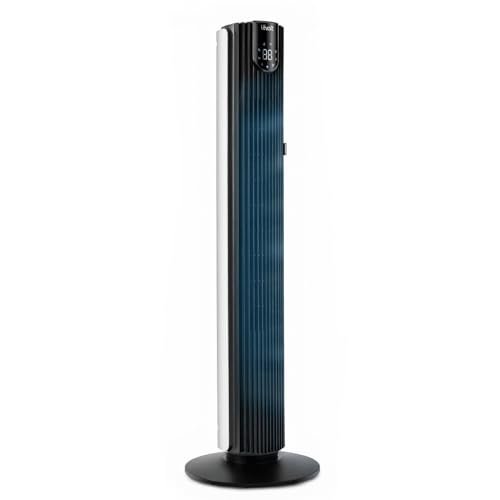
The LEVOIT Smart 42-Inch Tower Fan is the standout in this roundup for bedroom and living-room use. It features a DC motor — a meaningful upgrade over cheaper AC-motor fans — which translates to quieter operation and finer speed control. LEVOIT advertises a 25 dB noise floor on the lowest setting and an airflow velocity of 26 ft/s, which according to the manufacturer is enough to push air across a medium-sized room.
The bladeless design is both an aesthetic and a safety advantage, especially in homes with small children or pets. Oscillation helps distribute air across a wider area, though the listing doesn’t specify the exact arc in degrees — a minor transparency gap worth noting. Smart connectivity supports voice assistants, and the VeSync app (LEVOIT’s companion platform) generally receives decent marks in app-store reviews, though some users report occasional disconnection issues after updates.
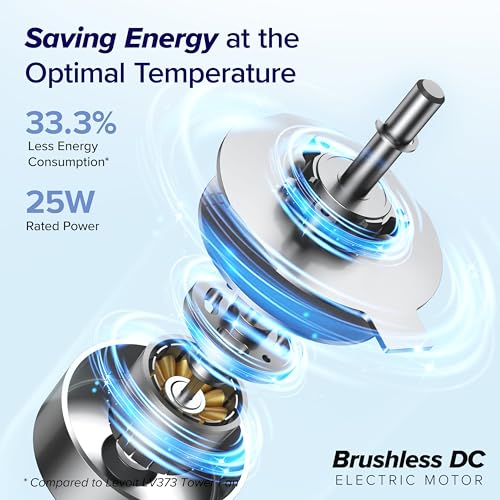
Pros: Genuinely quiet DC motor at low speeds; sleek bladeless profile; smart-home integration with Alexa and Google Assistant; multiple speed settings for fine-tuned comfort.
Cons: Noise increases noticeably at higher speeds (as with all fans); the VeSync app has mixed long-term reliability reviews; the 42-inch height may be overkill for very small rooms.
Who should buy this: Anyone looking for a primary bedroom or living-room fan with smart controls and a priority on quiet nighttime operation. If you’ve been researching Dreo tower fans for bedrooms, the LEVOIT is a strong alternative worth comparing side by side.
Portable Evaporative Air Cooler (Mini Personal Cooler)

This compact evaporative cooler is marketed as a personal air conditioner, but it’s important to set expectations: it is not an air conditioner. It’s a small evaporative cooler with three wind speeds, designed to cool the immediate area around your desk or nightstand. It works by passing air over water-soaked pads, which provides a noticeable chill in dry climates but does very little in humid environments.
Verified reviewers generally agree that it’s effective within a 2–3 foot radius and appreciate its portability and low power consumption. Common complaints center on the small water tank requiring frequent refills and the fact that it simply cannot cool an entire room. Some buyers also note that the build quality feels budget-oriented.

Pros: Extremely portable; low energy use; provides localized cooling at a desk or bedside; affordable entry point.
Cons: Not a true air conditioner — won’t lower room temperature; ineffective in humid climates; small water tank needs frequent refilling; build quality reflects the budget price.
Who should buy this: Someone who needs a personal-space cooler for a desk, dorm room, or RV in a dry climate. Do not buy this expecting whole-room cooling.
DREO Evaporative Air Swamp Cooler (43-Inch)

The DREO 43-inch evaporative cooler bridges the gap between a standard tower fan and a portable AC. It combines fan-style airflow with evaporative cooling, offering an 80° oscillation arc — one of the wider sweeps in this category and a direct answer to checklist item #4. The 2026 upgraded model promises improved cooling efficiency and quieter operation compared to earlier versions.
Buyer reviews highlight the strong airflow and the genuinely cooler air output compared to a dry fan, particularly in arid or semi-arid climates. The 80° oscillation is frequently praised for covering wider seating areas. On the downside, reviewers in humid regions (Southeast US, for example) report minimal cooling benefit from the evaporative function, essentially turning it into a regular fan. The water tank and filter also require regular maintenance to prevent odor buildup.

Pros: Wide 80° oscillation; effective evaporative cooling in dry climates; tall 43-inch profile for good air distribution; floor-standing design doesn’t need a table.
Cons: Evaporative cooling is climate-dependent — poor in humid areas; water tank and filter require regular cleaning; larger footprint than a standard tower fan.
Who should buy this: Homeowners in dry or semi-arid climates who want more cooling power than a standard fan without the energy cost of a portable AC. If you live somewhere humid, a standard tower fan or a true AC unit is a better investment.
16,000 BTU Portable Air Conditioner (Smart Wi-Fi)

This is the heavy hitter in the roundup — a 16,000 BTU portable air conditioner rated for rooms up to 750 square feet. Unlike the fans and evaporative coolers above, this is a true refrigerant-based AC that will actually lower room temperature regardless of humidity. It offers 5-in-1 functionality (cooling, heating, fan, dehumidifier, and sleep mode) and includes Wi-Fi app control.
Verified reviewers praise the fast cooling performance and the convenience of app-based scheduling. However, common complaints include significant noise (portable ACs are inherently louder than fans), the need for a window exhaust hose, and the unit’s bulk and weight. The smart app reportedly works well for basic controls but can be finicky with advanced scheduling. Energy consumption is also substantially higher than any fan — something to factor into your summer electricity bill.

Pros: True air conditioning — actually lowers room temperature; 750 sq. ft. coverage; 5-in-1 versatility including dehumidification; Wi-Fi and app control.
Cons: Loud compared to any fan; requires window exhaust setup; heavy and bulky; higher energy costs; app can be inconsistent with advanced features.
Who should buy this: Anyone who needs real temperature reduction in a large room and doesn’t have central AC or a window unit. This is not a fan — it’s a commitment in terms of space, noise, and energy, but it delivers genuine cooling.
Hionly AI Neck Fan

The Hionly AI Neck Fan is the wildcard in this lineup — a wearable, rechargeable personal fan with six speed settings and AI-assisted airflow adjustment. It sits around your neck and directs air upward toward your face, making it ideal for outdoor activities, commuting, or working in spaces where a traditional fan isn’t practical.
Reviewers appreciate the hands-free convenience and the surprisingly strong airflow for such a compact device. The “ultra quiet” claim holds up reasonably well on lower speeds, according to buyer feedback, though higher speeds produce a noticeable hum close to the ears. Battery life varies by speed setting — expect several hours on low but significantly less on maximum. Some reviewers note that the neck band can feel warm after extended wear, which is somewhat counterproductive. Build quality reviews are mixed, with some users reporting that the flexible band loosens over time.
If you’re also looking to stay cool during sleep, you might want to check out our guide on cooling sheets for home office naps — a complementary approach to personal comfort.

Pros: Truly portable and hands-free; six speed settings; rechargeable via USB; lightweight for on-the-go use.
Cons: Neck band can feel warm during extended wear; higher speeds are audible near the ears; battery life drops significantly at max speed; long-term durability is a concern based on some reviews.
Who should buy this: Commuters, outdoor workers, gym-goers, or anyone who needs personal cooling in situations where a desk or floor fan isn’t an option. Not a replacement for room cooling.
Quick Comparison
Frequently Asked Questions
Is a smart tower fan worth it over a regular fan?
If you value scheduling, voice control, and remote operation from your phone, yes. The convenience of adjusting speed or setting a sleep timer without getting out of bed is a genuine quality-of-life upgrade. However, if you just need airflow and don’t care about app features, a well-built “dumb” fan will cool you just as effectively for less money.
Do evaporative coolers work in humid climates?
Generally, no. Evaporative cooling relies on dry air absorbing moisture from wet pads. In regions where relative humidity regularly exceeds 50–60%, the cooling effect is minimal. If you live in the Southeast US, Gulf Coast, or similar humid areas, a standard fan or a true air conditioner is a better choice.
How loud is 25 dB really?
About as loud as a whisper or rustling leaves. For reference, a quiet library is around 30–40 dB, and normal conversation is roughly 60 dB. A fan rated at 25 dB on its lowest setting will be nearly inaudible — but remember, that rating almost certainly doesn’t apply to higher speeds.
Can a tower fan replace an air conditioner?
No. A fan moves air, which helps sweat evaporate and makes you feel cooler, but it does not lower the actual temperature of a room. If your space regularly exceeds 85–90°F, you’ll need a true air conditioner (window unit, portable AC, or central system) for real relief.
How We Research
We synthesize publicly available manufacturer specifications, product documentation, and verified customer and expert reviews from Amazon, retailer sites, and independent publications. We have not personally tested, owned, or handled any of the products reviewed in this article. Our goal is to curate the most honest, comprehensive analysis possible so you can make an informed decision. When we reference buyer sentiment — praise or complaints — we’re paraphrasing patterns observed across multiple verified reviews, not quoting any single individual or fabricating anecdotes.


Leave a Reply