
As an Amazon Associate I earn from qualifying purchases.
The sixth-generation Ford Bronco has cemented itself as one of the most capable off-road SUVs on the market, and the used market is now flush with 2024 models as early adopters trade up or move on. For off-road enthusiasts, two trims stand out at opposite ends of the capability spectrum: the Big Bend, a well-equipped entry point that punches above its weight on trails, and the Raptor, Ford’s desert-running, high-performance flagship. This guide breaks down both trims using manufacturer specifications and patterns from verified owner feedback so you can decide which used 2024 Bronco matches your off-road ambitions — and your budget.
Best for: Off-road enthusiasts who want a capable, customizable platform without paying the Raptor premium.
Why Buy a Used 2024 Ford Bronco?
The 2024 model year brought refinements to the Bronco lineup that make it particularly attractive on the used market. Ford addressed several early-production quality concerns that plagued 2021–2022 models, including improved hardtop fitment and revised SYNC 4 infotainment software. Buying used also lets you sidestep the dealer markups that were common on new Broncos throughout the model’s early years. If you’re also shopping other used performance-oriented vehicles, our used performance car buying guide covers the broader landscape of spec-based comparisons.
Understanding the Bronco Trim Ladder
Ford offers the 2024 Bronco in multiple trims: Base, Big Bend, Black Diamond, Outer Banks, Badlands, Wildtrak, Everglades, and Raptor. For off-road buyers, the Big Bend and Raptor represent two distinct philosophies:
- Big Bend: A value-oriented trim that includes meaningful upgrades over the Base while remaining affordable enough to leave budget for aftermarket modifications.
- Raptor: Ford’s no-compromise, factory-built desert runner with exclusive hardware you can’t option onto any other trim.
Let’s look at each in detail.
Used 2024 Ford Bronco Big Bend — Detailed Review

The Big Bend sits one step above the Base trim and has become one of the most popular Bronco configurations for a reason: it delivers genuine off-road capability with enough creature comforts for daily driving, all at a price point that leaves room for trail upgrades.
What You Get
The 2024 Big Bend comes standard with Ford’s 2.3-liter EcoBoost turbocharged four-cylinder producing 300 horsepower and 325 lb-ft of torque — numbers that are more than adequate for trail work and highway merging alike. A seven-speed manual transmission (with a dedicated crawler gear) is standard on two-door models, while a 10-speed automatic is available and standard on four-door variants. The part-time 4×4 system with a two-speed electronic transfer case is standard across all Broncos.
Big Bend-specific features include cloth seats with contrast stitching, an 8-inch SYNC 4 touchscreen, Ford Co-Pilot360 driver-assist technology, and 17-inch painted aluminum wheels wrapped in 255/70R17 all-terrain tires. Ground clearance sits at approximately 8.4 inches with the standard suspension, and approach/departure angles of 35.5° and 29.8° respectively give it respectable geometry for moderate trail work.
On the Trail
While the Big Bend doesn’t include the Sasquatch Package or Bilstein position-sensitive dampers found on higher trims, it’s far from a pavement queen. The electronic-locking rear differential is available, and the standard Terrain Management System with G.O.A.T. (Goes Over Any Type of Terrain) modes gives drivers preset configurations for sand, mud, rock crawl, and more.
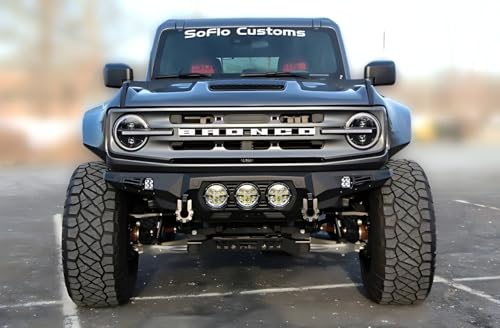
Verified owners frequently praise the Big Bend as an excellent “blank canvas” for modification. Common upgrades reported in owner forums include aftermarket bumpers, winches, rock sliders, and suspension lifts. Many owners note that starting with the Big Bend and adding the Sasquatch Package (available as a factory option on 2024 models) creates a vehicle that rivals the capability of higher trims at a lower total cost.
What Owners Say
The general sentiment among verified Big Bend owners is overwhelmingly positive for the value proposition. Commonly praised aspects include the removable doors and roof panels (a feature across all Bronco trims), the surprisingly refined ride quality for a body-on-frame SUV, and the 2.3L EcoBoost’s torque delivery at low RPMs during trail crawling.
On the complaint side, owners frequently mention fuel economy in the 19–21 MPG combined range (EPA estimates are 20 city / 22 highway for the 2.3L automatic), wind noise at highway speeds with the hardtop, and the infotainment system occasionally being sluggish. Some owners of early 2024 production units reported minor fit-and-finish issues with interior trim pieces, though this appears less common than in earlier model years.
If you’re curious how the Big Bend stacks up against the absolute base model, our Ford Bronco Big Bend vs Base comparison dives deeper into that specific question.
Who Should Buy the Big Bend
The Big Bend is ideal for the off-road enthusiast who wants a capable trail rig they can customize over time. It’s also a strong choice for buyers who plan to use the Bronco as a daily driver with weekend trail duty — the balance of comfort and capability is well-calibrated. If you’re budget-conscious but unwilling to compromise on core off-road DNA, this is your trim.
Pros
- Strong value proposition on the used market
- 2.3L EcoBoost delivers ample torque for trail work
- Highly customizable — large aftermarket support
- Removable doors and roof for open-air driving
- Available Sasquatch Package adds serious capability
Cons
- Standard suspension lacks the sophistication of Bilstein or Fox setups
- Highway wind noise with hardtop is noticeable
- Fuel economy is mediocre for a four-cylinder
- Infotainment can feel laggy compared to competitors
- No factory front locker without additional packages
Used 2024 Ford Bronco Raptor — Detailed Review

The Bronco Raptor is a different animal entirely. Where the Big Bend invites you to build your dream trail rig piece by piece, the Raptor arrives from the factory as a fully realized high-speed desert machine. It shares its philosophy with the F-150 Raptor: take the platform, widen it, give it massive suspension travel, and drop in the most powerful engine available.
What You Get
The Raptor is powered by Ford’s 3.0-liter EcoBoost twin-turbo V6, producing 418 horsepower and 440 lb-ft of torque — a substantial jump over the Big Bend’s 2.3L four-cylinder. Power routes through a 10-speed automatic transmission exclusively (no manual option) to an advanced 4×4 system with a Torsen front differential and an electronic-locking rear differential.
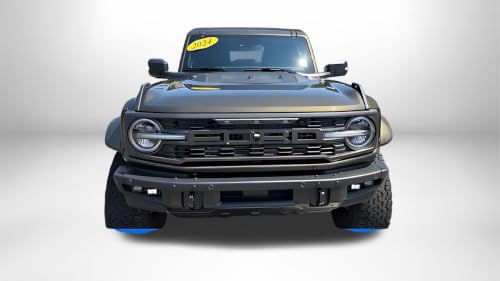
The suspension is the Raptor’s party piece. Ford Performance-tuned FOX 3.1 Internal Bypass semi-active dampers with Live Valve technology provide position-sensitive damping that adjusts in real time. The Raptor rides on unique long-travel front and rear suspension arms, delivering significantly more wheel travel than any other Bronco trim. The body is 8.6 inches wider than a standard Bronco to accommodate 37-inch BFGoodrich KO2 all-terrain tires on 17-inch beadlock-capable wheels.
Ground clearance jumps to 13.1 inches, and the approach angle increases to 47.2° — numbers that put it in rarefied company among production vehicles.
On the Trail (and Beyond)
The Raptor’s defining characteristic is its ability to handle high-speed desert running — the kind of terrain that would destroy a standard Bronco’s suspension. The FOX Live Valve dampers continuously adjust to terrain inputs, and the Raptor includes a dedicated Baja mode in its Terrain Management System that optimizes throttle response, transmission shift points, and stability control for high-speed off-road driving.
That said, the Raptor’s wider stance can actually be a disadvantage on tight, technical trails. At 85.4 inches wide, it won’t fit through some narrow rock passages that a standard-width Bronco handles easily. Verified owners consistently note this trade-off: the Raptor excels in open desert, sand dunes, and fast fire roads but can feel unwieldy on tight East Coast or Pacific Northwest single-track trails.
What Owners Say
Raptor owners tend to be enthusiastic about the vehicle’s raw capability. The twin-turbo V6’s power delivery is frequently described as “addictive,” and the FOX suspension’s ability to absorb massive hits at speed draws near-universal praise. The interior upgrades — including Recaro sport seats, a 12-inch SYNC 4A touchscreen, and orange accent stitching — are generally well-received.
Common complaints center on practicality. Fuel economy is a frequent pain point, with owners reporting 14–17 MPG in mixed driving (EPA estimates are 15 city / 16 highway). The wider body makes parking in standard garage spaces and navigating urban environments more challenging. Some owners also report that the aggressive 37-inch tires generate significant road noise on pavement, and tire replacement costs are notably higher than for the Big Bend’s 32-inch rubber.
Depreciation is another factor worth considering. The Raptor commanded significant dealer markups when new, and used examples have seen steeper percentage depreciation than lower trims as supply has normalized. This can work in a used buyer’s favor — you may find Raptors that have depreciated more in dollar terms, though they still command a substantial premium over a Big Bend.
For enthusiasts who also enjoy maintaining high-performance vehicles, our guide on electric dirt bike maintenance covers complementary off-road ownership topics.
Who Should Buy the Raptor
The Raptor is purpose-built for the enthusiast who prioritizes high-speed off-road performance and wants a factory-engineered solution rather than a build-it-yourself project. If your off-roading involves desert running, dune bashing, or fast fire-road blasts, the Raptor’s suspension and powertrain are specifically tuned for that mission. It’s also the right choice for buyers who want maximum capability out of the box with no wrenching required.
Pros
- 418 HP twin-turbo V6 is genuinely thrilling
- FOX Live Valve suspension is best-in-class for high-speed off-road
- 37-inch tires and 13.1 inches of ground clearance from the factory
- Beadlock-capable wheels for serious off-road tire pressure management
- Premium interior with Recaro seats and larger touchscreen
Cons
- Fuel economy of 14–17 MPG in real-world driving
- 8.6 inches wider than standard Bronco — tight trails and parking are challenging
- Significantly higher purchase price, even used
- Road noise from 37-inch tires on pavement
- No manual transmission option
- Higher maintenance and tire replacement costs
Big Bend vs Raptor: Head-to-Head Comparison
To help you decide, here’s how the two trims compare across the specifications that matter most to off-road enthusiasts:
| Specification | Big Bend | Raptor |
|---|---|---|
| Engine | 2.3L EcoBoost I-4 Turbo | 3.0L EcoBoost V6 Twin-Turbo |
| Horsepower | 300 hp | 418 hp |
| Torque | 325 lb-ft | 440 lb-ft |
| Transmission | 7-speed manual / 10-speed auto | 10-speed auto only |
| Ground Clearance | ~8.4 in (standard) | 13.1 in |
| Approach Angle | 35.5° | 47.2° |
| Tire Size | 255/70R17 (32 in) | 37 in BFGoodrich KO2 |
| Width | ~75.9 in | ~85.4 in |
| Suspension | Standard coil springs | FOX 3.1 Live Valve semi-active |
| Front Differential | Open (locking available) | Torsen limited-slip |
| Rear Differential | Electronic-locking (available) | Electronic-locking (standard) |
| EPA Combined MPG | ~21 MPG (auto) | ~15 MPG |
| Terrain Modes | G.O.A.T. (standard modes) | G.O.A.T. + Baja mode |
Which Trim Matches Your Off-Road Style?
The decision between these two trims ultimately comes down to how and where you off-road:
Choose the Big Bend if you:
- Prefer technical trail crawling over high-speed desert running
- Want a daily-drivable SUV that’s also trail-capable on weekends
- Enjoy the build process — choosing your own suspension, bumpers, and accessories
- Need to fit through narrow trails and tight parking spaces
- Want to keep fuel and maintenance costs manageable
- Prefer the option of a manual transmission
Choose the Raptor if you:
- Prioritize high-speed off-road performance (desert, dunes, fire roads)
- Want maximum capability from the factory with no modifications needed
- Value the FOX Live Valve suspension and don’t want to source aftermarket equivalents
- Need 37-inch tires and beadlock-capable wheels without a lift kit
- Don’t mind the fuel economy and width trade-offs
- Want the most powerful Bronco engine available
What to Inspect on a Used 2024 Bronco
Regardless of trim, here are key inspection points that verified owners and automotive journalists consistently recommend when shopping for a used 2024 Bronco:
1. Hardtop condition: Check for cracks, water leaks around seals, and proper alignment of removable panels. Early Bronco hardtops were prone to cracking; the 2024 models use an improved design, but it’s still worth inspecting. 2. Undercarriage: Look for signs of hard off-road use — bent skid plates, scraped differential housings, and damaged rock rails. A Bronco that’s been wheeled hard isn’t necessarily a bad buy, but it should be priced accordingly. 3. Suspension components: On the Raptor specifically, inspect the FOX dampers for leaks or damage. Replacement costs for the Live Valve system are substantial. 4. Transfer case and differential operation: Engage 4H, 4L, and the locking differentials during a test drive to confirm smooth operation. 5. Recall status: Check Ford’s recall database. The 2024 Bronco has had several recalls related to various components; confirm all have been completed. 6. Modification history: If the vehicle has aftermarket parts, ask about warranty implications and whether modifications were professionally installed.
Used Bronco Ownership Costs to Consider
Beyond the purchase price, factor in these ongoing costs that owners commonly report:
- Tires: The Raptor’s 37-inch BFGoodrich KO2s are significantly more expensive to replace than the Big Bend’s 32-inch all-terrains. Budget accordingly for a set every 30,000–40,000 miles depending on driving style.
- Fuel: At current fuel prices, the difference between 21 MPG and 15 MPG adds up quickly over 15,000 annual miles.
- Insurance: The Raptor typically commands higher insurance premiums due to its higher value and performance classification.
- Maintenance: Both trims follow Ford’s standard maintenance schedule, but the Raptor’s specialized suspension components can be costlier to service.
Final Thoughts
Both the Big Bend and the Raptor are genuinely capable off-road machines, but they serve different masters. The Big Bend is the smarter buy for most off-road enthusiasts — it delivers the core Bronco experience (removable top, solid 4×4 system, body-on-frame toughness) at a price that leaves room for personalization. The Raptor is a specialized tool for a specific kind of off-roading, and if that’s your kind of off-roading, nothing else in the Bronco lineup comes close.
Whichever trim you choose, the 2024 model year represents one of the most refined iterations of the sixth-generation Bronco. Buying used lets you benefit from someone else absorbing the initial depreciation while getting a vehicle that’s likely had its recall work completed and any early quirks sorted out.
How We Research
This guide was compiled by synthesizing manufacturer specifications from Ford’s official documentation, published automotive journalist reviews, and patterns observed in verified owner feedback across forums and review platforms. We have not personally tested, driven, or owned either of these vehicles. All claims about real-world performance, fuel economy, and ownership experience are attributed to verified owner reports and published expert reviews. Our goal is to curate the most accurate, honest, and useful information available so you can make a confident buying decision.


Leave a Reply