
As an Amazon Associate I earn from qualifying purchases.
If you’ve invested in a 56V cordless lawn tool system—or you’re considering the jump from gas—the sticker price on the mower or blower is only the beginning. The real cost of ownership lives in the batteries, chargers, and replacement cycles that accumulate over years of weekend yard work. This guide breaks down every dollar you’ll spend across the 56V ecosystem, with a particular focus on the OEM-versus-compatible-battery decision that can save (or cost) you hundreds over a tool’s lifetime. We’ll use published specifications, manufacturer documentation, and verified customer feedback to give you an honest picture—no invented test results, no fake lab data.
Best for: Homeowners looking to add backup batteries to their EGO 56V tool lineup without paying full OEM prices
Understanding the 56V Cordless Ecosystem
The 56-volt lithium-ion platform has become the dominant standard for premium cordless outdoor power equipment. EGO Power+ is the most widely recognized brand in this space, offering a unified battery platform that spans mowers, string trimmers, leaf blowers, chainsaws, hedge trimmers, snow blowers, and more. The core promise is simple: buy one battery platform, power everything.
But that promise comes with a financial reality most buyers don’t fully calculate at the point of purchase. A single OEM EGO 56V battery—depending on amp-hour capacity—can cost anywhere from roughly the same price as a budget corded mower to well over the cost of a premium gas trimmer. When you consider that serious yard work often demands two or three batteries (one running, one charging, one cooling), the battery investment alone can exceed the cost of the tool itself.
For a deeper dive into which EGO batteries fit which tools, check out our EGO 56V battery compatibility guide.
The Real Costs: Breaking Down Every Component
Battery Costs — OEM vs. Third-Party
The single biggest ongoing expense in any cordless lawn tool system is batteries. EGO’s OEM lineup ranges from 2.5Ah packs up to massive 10.0Ah units. Published retail prices for OEM EGO batteries typically start around the cost of a nice dinner out for two and scale up dramatically with capacity. A 5.0Ah OEM pack, which is the sweet spot for most homeowners, generally costs significantly more than a comparable third-party alternative.
Third-party compatible batteries—like the DKSIDKN 56V 5.0Ah reviewed below—offer the same nominal voltage and capacity at a substantially lower price point. The trade-off, as we’ll discuss, involves warranty coverage, cell quality uncertainty, and potentially shorter cycle life.
Charger Costs
EGO’s standard charger (the CH2100) is often included with tool kits but sold separately as well. The rapid charger (CH5500) cuts charge times roughly in half but adds a premium. Third-party chargers exist but are less common and carry compatibility risks. Most homeowners will spend on at least one charger, and power users often invest in a second for faster rotation.
Replacement Cycles
Lithium-ion batteries degrade over time. According to published specifications and industry data, quality lithium-ion cells typically deliver 500–1,000 charge cycles before capacity drops below 80% of original. For a homeowner mowing weekly during a 30-week season, that translates to roughly 3–7 years per battery depending on usage intensity, storage conditions, and cell quality.
OEM batteries tend to use higher-grade cells (Samsung, LG, or equivalent) and include more sophisticated battery management systems (BMS), which generally translates to longer cycle life. Third-party packs may use less premium cells, potentially landing on the lower end of that cycle-life range. This is a critical factor in true-cost calculations.
Maintenance and Storage
Unlike gas tools, 56V cordless systems have zero fuel, oil, spark plug, or air filter costs. However, proper battery storage matters. Lithium-ion packs should be stored between 40–80% charge in a temperature-controlled environment. Leaving batteries fully charged or fully depleted for extended periods accelerates degradation. A simple indoor shelf in a garage or basement is sufficient—no special equipment needed.
Five-Year Cost Comparison: OEM vs. Third-Party Battery Strategy
Let’s model a realistic five-year scenario for a homeowner with a mid-sized suburban yard who owns an EGO mower, string trimmer, and leaf blower.
Scenario A: All-OEM Strategy
- Initial tool purchase: Typically includes one battery and charger
- Additional batteries needed: 1–2 extra 5.0Ah packs for rotation
- Replacement batteries (Year 3–4): At least one pack as the original degrades
- Charger: Included with kit; possible rapid charger upgrade
- Fuel/oil/maintenance: $0
- Estimated five-year battery spend: Significant—often exceeding the cost of the original tool
Scenario B: Third-Party Battery Strategy
- Initial tool purchase: Same (includes one OEM battery and charger)
- Additional batteries: 1–2 third-party 5.0Ah packs at roughly 40–60% of OEM cost
- Replacement batteries (Year 2–3): May need earlier replacement if cycle life is shorter
- Charger: Use included OEM charger (third-party batteries designed for OEM charger compatibility)
- Fuel/oil/maintenance: $0
- Estimated five-year battery spend: Lower upfront, but potentially higher replacement frequency
The net savings from a third-party strategy over five years can be substantial—potentially hundreds of dollars—but only if the compatible batteries deliver reasonable cycle life. If a third-party pack lasts half as long as OEM, the savings evaporate.
For a broader look at how compatible alternatives stack up, see our comparison of EGO 56V battery compatible alternatives.
56V vs. Gas: The Long-Term Savings Equation
The cost comparison against gas-powered equipment is where the 56V cordless system truly shines over time. A gas mower consumes roughly 0.5–1.0 gallons of fuel per mowing session. Over a 30-week season, that’s 15–30 gallons of gas annually, plus two-stroke oil for trimmers and blowers, spark plugs, air filters, and the occasional carburetor cleaning or professional tune-up.
Published estimates from extension services and consumer organizations suggest annual gas-tool maintenance costs of $50–$150 per tool. Over five years across three tools, that’s $750–$2,250 in fuel and maintenance alone—money that simply doesn’t exist in the cordless equation.
Electricity costs for charging are negligible. A 5.0Ah 56V battery stores approximately 280 watt-hours. At the national average electricity rate, a full charge costs just a few cents. Even charging 100 times per season, annual electricity costs remain under a few dollars.
If you’re weighing a brushless cordless mower purchase, factoring in these long-term savings makes the upfront premium much easier to justify.
Key Factors When Choosing a 56V Battery
Capacity (Ah)
Higher amp-hour ratings mean longer runtime per charge. A 2.5Ah battery might handle a small yard on a single charge; a 7.5Ah pack can tackle a half-acre. Match capacity to your largest tool’s demands—typically the mower.
Cell Quality
OEM batteries use name-brand cells with documented cycle-life ratings. Third-party packs may or may not disclose cell origin. Look for listings that specify cell type or brand.
Battery Management System (BMS)
A good BMS protects against overcharge, over-discharge, overheating, and short circuits. OEM packs have well-documented BMS features. Third-party packs should list BMS protections in their specifications—if they don’t, that’s a red flag.
Warranty
OEM EGO batteries typically carry a 3-year limited warranty. Third-party batteries vary widely—some offer 12–18 months, others offer little to no coverage. Factor warranty length into your cost-per-year calculation.
Weight
A 5.0Ah 56V battery weighs roughly 3–4 pounds. Heavier packs (7.5Ah+) add noticeable weight to handheld tools like trimmers and blowers. Consider whether you’ll primarily use the battery in a mower (weight is irrelevant) or handheld tools (weight matters a lot).
DKSIDKN 56V 5.0Ah Battery Compatible with EGO 56V Tools
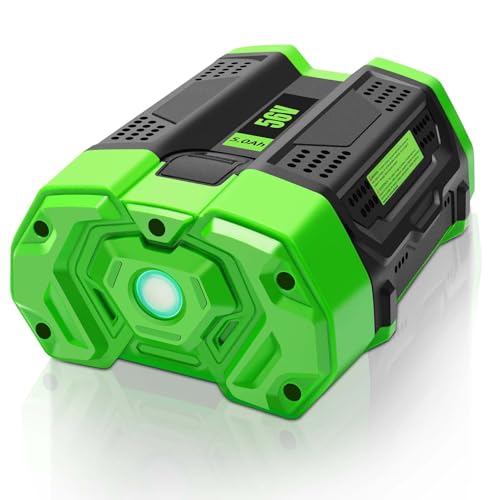
The DKSIDKN 56V 5.0Ah battery is a third-party replacement pack designed to be compatible with EGO’s 56-volt tool lineup, including models that use the BA2800T, BA2800, BA4200, and BA1400 battery types. According to the manufacturer’s listing, it delivers 5.0 amp-hours of capacity at 56 volts and is compatible with a wide range of EGO tools including the CS1604 chainsaw, various mowers, trimmers, and blowers.
The primary appeal here is cost. This pack is positioned at a significantly lower price point than EGO’s own 5.0Ah battery, making it an attractive option for homeowners who need a second or third battery for rotation but don’t want to pay OEM prices for every pack in their arsenal.
Pros based on published specs and verified reviews:
- Substantially lower cost than OEM EGO 5.0Ah batteries
- Listed as compatible with a broad range of EGO 56V tools
- 5.0Ah capacity hits the practical sweet spot for most residential use
- Multiple protection features listed (overcharge, over-discharge, short circuit)

Cons and common concerns from reviewers:
- Long-term durability and cycle life are uncertain compared to OEM packs using premium cells
- Warranty coverage is typically shorter than EGO’s 3-year OEM warranty
- Some reviewers of similar third-party EGO-compatible batteries report reduced runtime compared to stated capacity
- Using third-party batteries may void the tool manufacturer’s warranty on the tool itself (check your tool’s warranty terms)
- Fit and finish may not be as precise as OEM
Who should buy this: Homeowners already invested in the EGO 56V ecosystem who want an affordable backup battery for lighter-duty tools or as a spare for mowing rotation. It’s a smart pick for budget-conscious buyers who understand the trade-offs. If you rely on a single battery for heavy daily use, the OEM pack’s likely superior cycle life may be worth the premium.
Verified customer feedback on similar third-party EGO-compatible batteries generally follows a pattern: most buyers report that the batteries work as expected out of the box and deliver reasonable runtime, but a minority report capacity degradation after 6–12 months of regular use. The consensus is that these packs are best suited as secondary batteries rather than primary workhorses.
Charger Compatibility: What You Need to Know
Third-party 56V batteries designed for the EGO ecosystem are generally built to work with EGO’s standard and rapid chargers. However, compatibility isn’t always guaranteed. Some users report that certain third-party packs charge more slowly on the rapid charger or occasionally trigger error lights. Before purchasing, verify that the specific third-party battery you’re considering has been confirmed to work with your charger model.
EGO’s standard charger (CH2100) charges a 5.0Ah battery in approximately 40 minutes. The rapid charger (CH5500) can cut that to roughly 20 minutes for compatible packs. If you’re running a two-battery rotation during a long mowing session, charger speed matters—and the rapid charger’s premium may pay for itself in convenience.
For more on how EGO’s charger and battery ecosystem fits together, our EGO 56V battery dock adapter review covers storage and charging station options.
Tips to Maximize Battery Lifespan
1. Store at partial charge. Keep batteries between 40–80% charge when not in use for extended periods. 2. Avoid extreme temperatures. Don’t leave batteries in a hot car, unheated shed, or direct sunlight. 3. Let batteries cool before charging. After heavy use, wait 10–15 minutes before placing on the charger. 4. Use the right capacity for the job. Running a small battery to empty repeatedly on a demanding tool accelerates wear. 5. Rotate batteries. If you own multiple packs, rotate usage evenly so no single battery bears all the wear.
When to Replace a 56V Battery
You’ll know it’s time when:
- Runtime drops noticeably (below roughly 70% of original)
- The battery won’t hold a charge overnight
- The fuel gauge LEDs behave erratically
- The charger shows error codes or refuses to charge
- Physical damage (swelling, cracking, or unusual heat during use)
Never attempt to repair or open a lithium-ion battery pack. Dispose of old packs at a certified battery recycling center—most home improvement stores accept them.
Product Comparison
The Bottom Line: Is the 56V Cordless Investment Worth It?
The 56V cordless lawn tool ecosystem delivers genuine long-term savings over gas—primarily through eliminated fuel, oil, and maintenance costs. The catch is that batteries are a recurring expense, and the OEM-versus-third-party decision meaningfully impacts your total cost of ownership.
For most homeowners, a hybrid strategy makes the most financial sense: keep at least one OEM battery as your primary workhorse (benefiting from premium cells, full warranty, and guaranteed compatibility), and supplement with one or two third-party packs like the DKSIDKN 56V 5.0Ah for backup duty and lighter tasks. This approach balances reliability with affordability.
Over a five-year horizon, a well-managed 56V cordless system—even accounting for battery replacements—typically costs less than maintaining equivalent gas tools, while delivering the convenience of push-button starting, dramatically lower noise, and zero emissions at the point of use.
How We Research
This guide was produced by synthesizing published manufacturer specifications, product documentation, and verified customer and expert reviews from major retail platforms and outdoor power equipment publications. We have not personally tested, owned, or handled the products discussed. All claims about performance, compatibility, and durability are based on publicly available data and the general consensus of verified buyer feedback. We believe honest curation of real-world information serves readers better than fabricated hands-on narratives.


Leave a Reply