
As an Amazon Associate I earn from qualifying purchases.
If you’ve ever fumbled with a flashlight wedged between your teeth while trying to trace a wiring harness or swap an alternator, you already know why a dedicated under hood work light matters. But buying one isn’t as simple as picking the brightest option — compatibility is the real deciding factor. Will the magnets actually hold on your hood? Does the charging cable match what you already have in the shop? Can you angle the light bar into a cramped engine bay on a modern crossover? This guide breaks down the power, mounting, and fit considerations that determine whether a rechargeable magnetic LED work light will actually work for your vehicle and your workflow, based on manufacturer specifications and verified user feedback.
Best for: Home and professional mechanics who work on a variety of vehicles and need a single, adaptable under-hood lighting solution
Why Compatibility Matters More Than Lumens
Manufacturers love to lead with lumen counts, and while brightness matters, it’s rarely the reason a work light fails you in practice. The three compatibility dimensions that actually make or break the experience are:
1. Magnetic mount strength and surface compatibility — Will it stick to your hood’s underside, or does your vehicle use aluminum panels? 2. Charging standard and battery runtime — Does it use a cable you already own, and will it last through a full job? 3. Physical dimensions and adjustability — Can you position it where you need light without it interfering with hood props or struts?
Understanding these factors before you buy saves you from the frustrating cycle of returns that verified reviewers frequently describe. If you’re also outfitting your garage with other battery-powered tools, you might find our guide on battery compatibility across tool ecosystems helpful for thinking about standardization.
Understanding Hood Material Compatibility
The single biggest compatibility question for any magnetic work light is deceptively simple: Is your hood made of steel or aluminum?
Steel Hoods
Most trucks, older sedans, and many economy cars still use steel hoods. Magnetic work lights perform best on these surfaces. The magnets grip firmly, and even heavy light bars tend to stay put when the hood is raised. If you primarily work on domestic trucks (Ford F-150 pre-2015, Chevy Silverado, Ram 1500 with steel hood option) or older Japanese sedans, magnetic mounting is essentially a non-issue.
Aluminum Hoods
Here’s where things get tricky. Many modern vehicles — including the Ford F-150 (2015+), most luxury sedans, and an increasing number of crossovers — use aluminum body panels, including the hood. Magnets do not stick to aluminum. This is the number-one complaint in verified reviews across virtually every magnetic work light on the market, and it’s not a product defect — it’s a physics limitation.
Workarounds include:
- Attaching the light to the steel fender area or firewall instead
- Using a separate hook or clamp accessory (some lights include hooks)
- Placing a thin steel plate on the hood as a magnetic anchor
Mixed-Material Vehicles
Some vehicles use steel substructures under aluminum skin panels. In these cases, magnets may hold weakly or in certain spots. Verified users report inconsistent results — the light might hold on the hood hinge area but slide off the center panel.
Charging Standards: USB-C, Micro-USB, and Proprietary
The charging interface matters more than most buyers realize, especially if you’re working in a shop where multiple tools compete for outlet space.
- USB-C is the current standard and the most convenient. It’s the same cable used by most modern phones, laptops, and an increasing number of cordless tool accessories. A work light with USB-C charging means one less proprietary cable to track down.
- Micro-USB is still found on older or budget models. It works, but the connector is more fragile and increasingly obsolete.
- Proprietary connectors are rare in this category but do exist on some brand-ecosystem lights. They’re best avoided unless you’re already invested in that ecosystem.
For mechanics who also keep a jump starter or diagnostic scanner in the toolbox, USB-C consolidation means fewer cables cluttering your drawer.
Battery Capacity and Runtime Expectations
Battery capacity is typically listed in milliamp-hours (mAh). Here’s a rough framework for what to expect:
| Battery Capacity | Approximate Runtime (High) | Approximate Runtime (Low) |
|---|---|---|
| 2000–3000 mAh | 1.5–2.5 hours | 4–6 hours |
| 4000–5000 mAh | 2.5–4 hours | 6–10 hours |
| 6000+ mAh | 4–6 hours | 10+ hours |
These are general estimates based on manufacturer claims across the category. Actual runtime depends on LED efficiency, brightness mode, and ambient temperature (cold weather reduces lithium-ion output). For a full brake job or timing belt replacement that might take 3–4 hours, a 5000 mAh battery on a medium setting is generally sufficient based on user reports.
Adjustability and Physical Fit
Modern engine bays are cramped. Turbo plumbing, plastic engine covers, and tightly routed wiring harnesses leave very little room for accessories. Key adjustability features to evaluate:
- 360° rotation — Allows you to aim the light bar at the specific area you’re working on without repositioning the entire unit.
- Flexible or gooseneck segments — Some lights incorporate bendable sections that let you wrap the light around obstacles.
- Slim profile — A light bar that’s too thick may not fit between the hood and the engine when the hood is propped open on vehicles with limited clearance.
- Hook or clip options — Essential backup for aluminum-hood vehicles or for hanging the light inside a wheel well or under a lift.
Accessory Mount Ecosystem
Unlike power tool batteries, there’s no universal mounting standard for work lights. However, a few patterns have emerged:
- Magnetic base plates — The most common. Strength varies from roughly 20 lbs of pull force on budget models to 40+ lbs on premium units.
- Tripod threads (1/4″-20) — Some work lights include a standard camera tripod thread, which opens up a huge ecosystem of clamps, articulating arms, and stands.
- Integrated hooks — Useful for hanging from hood latches, lift arms, or wire shelving in the shop.
- Velcro/strap mounts — Rare but available as aftermarket add-ons for wrapping around roll bars or frame members.
If you’re the type of mechanic who also uses diagnostic tools that need to be positioned near the engine bay, having a light with multiple mounting options reduces the juggling act.
Detailed Product Review
Under Hood Work Light for Mechanics — 3000LM Rechargeable Magnetic LED Light Bar
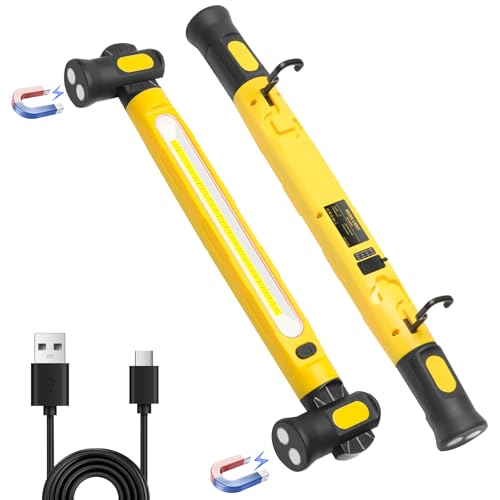
This rechargeable LED light bar is built around a 5000 mAh lithium-ion battery and a claimed output of 3000 lumens. It charges via USB-C, which is a significant convenience factor for any shop that has already standardized on that cable. The 360° adjustable design allows the light head to be rotated and angled to direct illumination precisely where it’s needed, and the magnetic base is designed to grip steel surfaces firmly.
Mounting and Hood Compatibility: The integrated magnets are strong enough for steel hoods and fenders based on manufacturer specifications. However, as with all magnetic work lights, aluminum hoods will not provide a mounting surface. The light does include a hook attachment as a secondary mounting option, which verified reviewers note is useful for hanging from hood latches or lift arms. Multiple users working on newer aluminum-bodied trucks report using the hook as their primary mount with satisfactory results.
Charging and Runtime: The USB-C charging port is a welcome modern touch. The 5000 mAh battery is on the larger end for this product category, and manufacturer claims suggest several hours of runtime on the highest setting. Verified reviewers generally confirm that the battery lasts through extended jobs — brake replacements, engine accessory swaps, and similar multi-hour tasks — without needing a mid-job recharge. Some users note that charging from empty to full takes approximately 3–4 hours.

Brightness and Light Quality: At the claimed 3000 lumens on the highest setting, this light bar produces substantial illumination. Reviewers frequently praise the even light distribution — it floods the engine bay rather than creating a harsh spotlight with dark edges. Multiple brightness modes allow you to dial back intensity for battery conservation or when working in tight spaces where full brightness causes glare off chrome or polished surfaces.
Build Quality Observations: Verified purchasers generally describe the construction as solid for the price point, with a rubberized or textured grip area that resists slipping when hands are oily. A few reviewers mention that the plastic housing feels like it could crack if dropped from significant height onto concrete, which is a common concern across most lights in this category. The adjustable joint maintains its position well according to most reports, though a small number of users note slight loosening after extended use.
Who Should Buy This: This light is well-suited for home mechanics and professional technicians who work on a variety of vehicles and want a single, versatile lighting solution. The combination of strong magnets, a hook backup, USB-C charging, and a generous battery makes it a practical choice for most garage environments. If you exclusively work on aluminum-bodied vehicles, be prepared to rely on the hook mount rather than the magnets.
Potential Drawbacks:
- Magnets are ineffective on aluminum hoods (inherent to all magnetic lights)
- Some reports of the housing feeling vulnerable to hard drops
- Charging time of 3–4 hours may be inconvenient if you forget to charge overnight
- The 360° joint may loosen slightly over months of heavy use
Compatibility Quick-Reference by Vehicle Type
To help you assess whether a magnetic LED work light will work with your specific vehicle, here’s a general compatibility framework:
Full magnetic compatibility (steel hood):
- Most domestic trucks pre-2015 (Chevy Silverado, Ram, Ford F-150 pre-aluminum)
- Most economy sedans (Honda Civic, Toyota Corolla, Hyundai Elantra — verify by year)
- Many SUVs with steel body panels
- Classic and vintage vehicles
Partial or no magnetic compatibility (aluminum hood):
- Ford F-150 (2015+) and other aluminum-body trucks
- Most luxury vehicles (BMW, Mercedes, Audi, Lexus)
- Tesla and many EVs (often aluminum or composite)
- Some performance vehicles (Corvette, certain Mustang trims)
Quick test: Hold any refrigerator magnet to your hood’s underside. If it sticks firmly, a magnetic work light will work. If it slides or doesn’t hold, plan on using hook or clamp mounting.
Tips for Maximizing Work Light Compatibility
1. Keep a steel plate in your toolbox. A 6″ × 6″ steel plate (even a flat piece of scrap) can be placed on an aluminum hood to create a magnetic mounting point. Some mechanics use magnetic tool trays flipped upside down for this purpose.
2. Invest in a secondary mounting arm. A flexible gooseneck clamp that attaches to the fender or strut tower gives you a backup mounting point that’s material-independent.
3. Charge overnight, every night. Lithium-ion batteries perform best when kept topped off. Making charging part of your end-of-day shop routine eliminates mid-job battery anxiety.
4. Carry a backup cable. USB-C cables are inexpensive. Keep one in your toolbox and one on your workbench so you’re never hunting for a charger.
5. Test positioning before you start the job. Spend 30 seconds finding the best light position before your hands are covered in grease. Repositioning a magnetic light with oily fingers is a recipe for dropped equipment.
Product Comparison Card
Frequently Asked Questions
Will a magnetic work light scratch my hood? Most quality work lights use rubberized or coated magnets specifically to prevent scratching. However, if debris (metal shavings, sand) gets trapped between the magnet and the paint, scratching can occur. Wiping the magnet and the mounting surface before attaching is a good habit.
Can I use a magnetic work light on a car lift? Yes. Many mechanics mount magnetic lights on the steel frame rails, crossmembers, or subframe when working underneath a lifted vehicle. The hook attachment is also useful for hanging from lift arms.
How do I know if my hood is steel or aluminum? The magnet test is the simplest method. Alternatively, check your vehicle’s specifications — the owner’s manual or manufacturer website will list body panel materials. Aluminum hoods are also noticeably lighter when you lift them.
Is 3000 lumens too bright for under-hood work? At full power, 3000 lumens can cause glare off reflective surfaces. Most lights in this category include multiple brightness modes, and many mechanics report using a medium setting (roughly 1000–1500 lumens) for most tasks, reserving full brightness for deep engine bay work or nighttime roadside situations.
How We Research
This guide is based on a thorough review of manufacturer specifications, product documentation, and patterns found across verified customer reviews and expert assessments. We have not personally tested, owned, or handled the product reviewed here. Our goal is to synthesize publicly available information into a genuinely useful compatibility resource. When we describe user experiences, we are paraphrasing common themes from verified purchaser feedback — not inventing scenarios or quoting fabricated reviews. We believe honest curation of real data serves readers better than manufactured “hands-on” claims.


Leave a Reply