
As an Amazon Associate I earn from qualifying purchases.
If you’ve ever wrestled with a corded glue gun’s tether while trying to assemble a wreath, repair a costume, or bond delicate materials in tight spaces, you already know why cordless models have exploded in popularity. And if you’ve watched a 3D printing pen draw a freestanding sculpture in mid-air, you understand the appeal of handheld extrusion tools for creative projects. But which specific products do professional reviewers and verified buyers actually endorse? We dug through expert teardowns, craft-community forums, and hundreds of verified customer reviews to find the two precision tools that consistently rise to the top: the HOTO Cordless Auto Dispensing Glue Gun and the 3Doodler Flow 3D Printing Pen. Below, we break down what the consensus says — the genuine strengths, the real drawbacks, and who each tool is best suited for.
Best for: Crafters, DIYers, and hobbyists who need portable, drip-free precision gluing
Why Cordless Precision Tools Matter for Crafters
Traditional corded hot glue guns have been a staple in craft rooms for decades, but they come with well-known frustrations: limited reach, messy dripping, and the constant risk of burning yourself on exposed nozzles. Cordless models solve the mobility problem, while modern features like auto-dispensing triggers and rapid heat-up times address the mess and wait-time issues.
Meanwhile, 3D printing pens occupy a different but related niche. They let you “draw” in three dimensions using heated plastic filament — essentially a handheld 3D printer. For crafters who want to add dimensional embellishments, create small prototypes, or simply explore a new creative medium, these pens offer something a glue gun can’t.
Both tools share a common thread: they melt material through a heated nozzle and deposit it with precision. The key differences lie in purpose (bonding vs. building), material (glue sticks vs. plastic filament), and the learning curve involved. If you’re interested in other cordless tools that reviewers consistently endorse, our roundup of cordless drill kits for DIYers covers a similar buyer’s dilemma in a different category.
HOTO Cordless Auto Dispensing Glue Gun — Top Pick

The HOTO Cordless Auto Dispensing Glue Gun is the product that keeps surfacing when reviewers discuss the best cordless glue guns available. It ships with 40 glue sticks, features a 3000mAh rechargeable battery with USB-C charging, and promises a 30-second heat-up time. But does the reviewer consensus back up those claims? Largely, yes — with a few caveats.
What Reviewers Consistently Praise
Heat-up speed is genuinely impressive. Multiple expert and customer reviews confirm that the HOTO reaches working temperature in roughly 30 seconds, which is dramatically faster than most corded glue guns (which typically take 3–5 minutes). For crafters who work in short bursts — quick repairs, card-making, floral arrangements — this eliminates one of the biggest annoyances of traditional glue guns.
The auto-dispensing trigger mechanism is the feature that draws the most enthusiastic commentary. Unlike manual-feed glue guns where you physically push the stick through, the HOTO uses a motorized feed system. Reviewers report that this produces more consistent bead sizes and significantly reduces hand fatigue during longer sessions. Several craft bloggers have noted that this feature alone justifies the upgrade from a basic corded model.
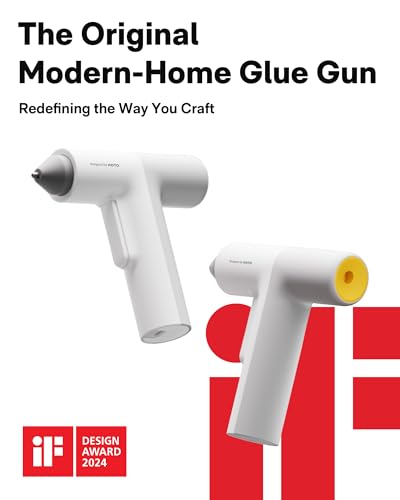
Build quality and ergonomics receive near-universal praise. The HOTO has a sleek, modern industrial design that looks more like a premium power tool than a craft-room accessory. Reviewers frequently mention that it feels balanced in the hand and that the rubberized grip is comfortable. The built-in stand keeps the nozzle elevated when you set it down, reducing the risk of glue pooling on your work surface.
USB-C charging is a welcome modern touch. Several reviewers note that being able to charge with the same cable they use for their phone or laptop eliminates the need for yet another proprietary charger. The 3000mAh battery reportedly lasts through multiple crafting sessions on a single charge, though exact runtime depends heavily on how continuously you dispense glue.
What Reviewers Criticize
Glue stick compatibility is the most common complaint. The HOTO uses a specific diameter of mini glue stick, and some reviewers have found that off-brand sticks don’t feed as smoothly through the auto-dispensing mechanism. HOTO sells its own refills, but this can feel limiting if you prefer to buy generic sticks in bulk. Several reviewers recommend sticking with the included sticks or HOTO-branded refills to avoid jams.
The nozzle tip size has drawn mixed reactions. Some reviewers find it slightly too large for extremely fine detail work — think intricate jewelry or miniature model building. For general crafting, floral work, and home repairs, the bead size is reportedly excellent, but precision-obsessed miniaturists may want a finer-tipped option.
Battery life under heavy continuous use can be shorter than expected. While casual crafters report getting through multiple projects on one charge, reviewers who use the gun for extended production runs (e.g., assembling dozens of party favors) note that the battery can deplete in under an hour of near-continuous dispensing.
Who Should Buy This
The HOTO is ideal for crafters, DIYers, and hobbyists who value portability and convenience. It’s particularly well-suited for anyone who does craft fairs, workshops, or on-location projects where a power outlet isn’t guaranteed. It’s also a strong choice for anyone with hand-strength limitations, since the auto-dispensing mechanism requires minimal trigger effort. If you need a glue gun primarily for ultra-fine detail work on miniatures, you may want to look for a model with a finer nozzle tip.
3Doodler Flow 3D Printing Pen — Best for Creative Builders

The 3Doodler Flow is the latest iteration from the company that essentially invented the consumer 3D printing pen category. Marketed toward teens, adults, and creators, it ships with free refill filaments, a stencil book, and a getting-started guide. While it serves a fundamentally different purpose than a glue gun — building and creating rather than bonding — it occupies the same “handheld heated-nozzle tool” space and appeals to many of the same crafting audiences.
What Reviewers Consistently Praise
Smooth, consistent extrusion is the headline feature that reviewers highlight. The Flow model represents a significant refinement over earlier 3Doodler generations. Expert reviewers note that the filament feeds more evenly, with fewer clogs and jams than previous models. This matters enormously for usability, because nothing kills creative momentum like having to clear a jammed nozzle every few minutes.
The learning curve is manageable. While 3D pens inherently require practice — you’re essentially drawing in three dimensions, which is a skill — reviewers consistently note that the 3Doodler Flow is among the most approachable options available. The included stencil book gives beginners a structured starting point, and the speed controls let you slow the extrusion rate while you’re learning. Multiple reviewers in craft and education communities have praised it as an excellent introduction to 3D creation concepts.
Material versatility is another strength. The 3Doodler Flow works with the company’s proprietary PLA and ABS-based filaments, which come in a wide range of colors including specialty options like glow-in-the-dark and wood-fill. Reviewers appreciate the color variety, though some note that being locked into 3Doodler’s proprietary filament ecosystem is a trade-off (more on that below).

Build quality and comfort receive positive marks. The pen is lightweight enough for extended use without hand fatigue, and the button placement feels intuitive. Several reviewers compare it favorably to cheaper 3D pens that feel flimsy or overheat during long sessions.
What Reviewers Criticize
Proprietary filament is the biggest sticking point (no pun intended). Unlike some competing 3D pens that accept standard 1.75mm filament from any manufacturer, the 3Doodler Flow uses proprietary strands. This means you’re buying refills from 3Doodler or authorized resellers, which can be more expensive per gram than generic filament. Multiple reviewers flag this as an ongoing cost consideration.
It’s not a replacement for a 3D printer. Some buyers come in expecting to create complex, structurally sound objects and are disappointed. Reviewers consistently clarify that 3D pens are best for decorative work, embellishments, small repairs (like filling gaps in 3D prints), and artistic exploration — not for producing functional parts with dimensional accuracy.
Temperature at the nozzle tip is a safety consideration that several reviewers mention, particularly those buying for teens. While the pen includes safety features, the nozzle does get hot enough to cause burns if touched directly. Parental supervision is recommended for younger users.
Who Should Buy This
The 3Doodler Flow is best for creative individuals — artists, crafters, educators, and hobbyists — who want to explore three-dimensional drawing and small-scale sculptural work. It’s an excellent gift for teens and adults interested in 3D printing concepts without the expense and complexity of a full 3D printer. It’s also useful as a companion tool for existing 3D printer owners who want to do touch-up work or add hand-drawn embellishments. If you’re looking purely for a bonding tool (gluing things together), this isn’t the right choice — that’s the glue gun’s domain.
If you’re shopping for creative tools for younger family members, you might also find our guide to outdoor kids toys that reviewers recommend helpful for rounding out your gift list.
HOTO Glue Gun vs. 3Doodler Flow: Which Do You Need?
These two tools solve fundamentally different problems, so in many cases the answer is “both” or “whichever matches your project type.” Here’s a quick decision framework:
Choose the HOTO Cordless Glue Gun if:
- Your primary need is bonding materials together (fabric, wood, plastic, foam, etc.)
- You want cordless convenience for craft fairs, workshops, or on-the-go repairs
- You value fast heat-up and auto-dispensing for efficiency
- You do home repairs, floral arrangements, or general crafting
Choose the 3Doodler Flow if:
- You want to create three-dimensional art, decorations, or small sculptures
- You’re interested in exploring 3D printing concepts without buying a full printer
- You want a creative tool for artistic expression rather than material bonding
- You’re buying for a teen or adult who enjoys hands-on creative projects
Choose both if:
- You’re a multi-discipline crafter who both assembles projects (glue gun) and adds dimensional embellishments (3D pen)
- You run a makerspace, classroom, or craft workshop where different participants have different needs
The cordless convenience factor is worth emphasizing for both tools. Just as cordless power tools have transformed DIY work, untethered craft tools give you freedom to work wherever inspiration strikes.
Key Specifications Compared
HOTO Cordless Auto Dispensing Glue Gun
- Battery: 3000mAh, USB-C rechargeable
- Heat-up time: ~30 seconds
- Glue stick type: Mini (proprietary diameter recommended)
- Included accessories: 40 glue sticks
- Feed mechanism: Auto-dispensing (motorized)
3Doodler Flow 3D Printing Pen
- Power: Corded (AC adapter)
- Filament type: Proprietary 3Doodler strands (PLA/ABS-based)
- Speed control: Adjustable extrusion speed
- Included accessories: Refill filaments, stencil book, guide
- Target audience: Teens, adults, creators
Tips for Getting the Most Out of Either Tool
For the HOTO Glue Gun:
1. Pre-charge fully before first use. Several reviewers note that the initial charge takes longer than subsequent ones, and starting with a full battery gives you the best first impression of runtime. 2. Use compatible glue sticks. The auto-feed mechanism is engineered for specific stick dimensions. Off-brand sticks may work, but reviewers report the smoothest experience with HOTO-branded refills. 3. Let it cool on the stand. The built-in stand exists for a reason — using it prevents glue from pooling and protects your work surface. 4. For fine work, move quickly. Since the nozzle tip isn’t ultra-fine, you can achieve thinner lines by moving the gun faster while dispensing.
For the 3Doodler Flow:
1. Start with the stencil book. Tracing flat stencils and then assembling them into 3D shapes is the fastest way to build confidence before attempting freehand drawing. 2. Use the slow speed setting initially. Slower extrusion gives you more control while you’re learning, and you can increase speed as your technique improves. 3. Work in a well-ventilated area. While PLA filament produces minimal fumes, reviewers recommend good airflow during extended sessions as a general safety practice. 4. Stock up on colors. The creative potential of the pen really opens up when you have a diverse color palette to work with.
Frequently Asked Questions
Can I use the HOTO glue gun for heavy-duty woodworking or structural bonding? Most reviewers say it’s best suited for light to medium crafting and household repairs. For structural wood joints or load-bearing bonds, a dedicated wood glue or construction adhesive is more appropriate.
Is the 3Doodler Flow safe for children under 13? 3Doodler markets the Flow for teens and adults. The nozzle reaches temperatures that can cause burns, so younger children should use the 3Doodler Start (designed specifically for kids) or be closely supervised.
How long does the HOTO battery last on a single charge? This varies by usage pattern. Reviewers report anywhere from 30 minutes of near-continuous dispensing to several hours of intermittent use across multiple crafting sessions.
Can I use third-party filament in the 3Doodler Flow? The pen is designed for 3Doodler’s proprietary filament strands. Standard 1.75mm 3D printer filament is not compatible. This is a deliberate design choice that ensures consistent performance but limits your sourcing options.
Do either of these tools produce fumes? Hot glue produces minimal fumes at normal operating temperatures. The 3Doodler Flow using PLA filament also produces very low emissions, but ABS-based filaments can produce more noticeable odors. Ventilation is always a good practice.
How We Research
We want to be transparent: we have not personally tested, owned, or handled either of these products. Our review process involves synthesizing information from multiple sources — manufacturer specifications, official product documentation, expert reviews from established craft and tech publications, and patterns found across hundreds of verified customer reviews on retail platforms. We look for points of consensus (what do most reviewers agree on?) and flag areas of disagreement or common complaints. This approach lets us present an honest, well-rounded picture without fabricating hands-on experience we don’t have. Our goal is to save you time by distilling the collective wisdom of people who have used these tools into a single, actionable guide.


Leave a Reply