
As an Amazon Associate I earn from qualifying purchases.
Robotic lawn mowers have matured rapidly, and ECOVACS’s Goat line sits at the forefront of wire-free, LiDAR-guided mowing. The flagship Goat A2000 LiDAR PRO promises dual-LiDAR auto-mapping and coverage up to half an acre — but is that technology leap worth the price premium over a more budget-friendly robot mower with app control and obstacle detection? In this comparison we break down the specs, real-world owner feedback, and value proposition of each machine so you can make a confident decision before your grass gets any taller.
Best for: Homeowners with complex yards up to half an acre who want a true set-and-forget experience
Why This Comparison Matters
If you’ve been researching robotic lawn mowers, you’ve likely noticed the enormous price spread in the category. At the top end, brands like ECOVACS, Husqvarna, and Mammotion pack in LiDAR, RTK-GPS, and sophisticated obstacle avoidance. At the entry level, newer brands offer app control, auto-charging, and basic boundary detection at a fraction of the cost. The question isn’t just “which mows better” — it’s whether the premium navigation technology translates into a meaningfully better ownership experience.
This is a familiar dilemma across product categories. We explored a similar “is the upgrade worth it?” question in our Theragun PRO Plus vs PRO comparison, and the answer always depends on how much you value the specific improvements. The same logic applies here: if the A2000’s dual-LiDAR solves a real problem for your yard, it’s money well spent. If your lawn is simple and flat, a budget mower might be all you need.
Key Spec Differences at a Glance
Before diving into the individual reviews, here’s a quick rundown of the most important differentiators:
- Navigation: The A2000 uses dual-LiDAR sensors for real-time 3D mapping. The budget mower relies on app-based boundary setting with basic obstacle detection sensors.
- Coverage area: The A2000 is rated for up to half an acre (roughly 21,780 sq ft). The budget mower’s coverage area is typically smaller and less precisely documented.
- Wire-free setup: Both claim wire-free operation, but the A2000’s LiDAR mapping creates a detailed virtual map of your yard, while the budget option uses simpler boundary methods.
- Cutting height adjustment: Both offer adjustable cutting heights, though the A2000 provides finer increments.
- Obstacle avoidance: The A2000’s TruEdge technology and dual-LiDAR give it a significant edge in detecting and navigating around garden furniture, toys, and pets. The budget mower uses basic bump-and-redirect or ultrasonic sensors.
- Auto-charging: Both return to their charging stations when battery is low.
ECOVACS Goat A2000 LiDAR PRO — Detailed Review

The ECOVACS Goat A2000 LiDAR PRO represents the current pinnacle of the Goat line. Its headline feature is dual-LiDAR auto-mapping: one sensor faces forward for obstacle detection and path planning, while a second sensor maps the terrain from above, creating a detailed 3D model of your yard. According to ECOVACS’s product documentation, this dual-sensor approach allows the mower to build and refine its map over successive mowing sessions, resulting in increasingly efficient coverage patterns.
What Owners Praise
Verified purchasers consistently highlight the wire-free setup as a game-changer. Traditional robotic mowers require burying a perimeter wire — a tedious, multi-hour installation process. The A2000 eliminates this entirely. Owners report that initial mapping takes a few sessions, but once the mower “learns” the yard, it navigates with impressive precision, hugging edges cleanly thanks to the TruEdge feature. Multiple reviewers note that the mower handles moderately complex yards — with flower beds, trees, and garden paths — without getting stuck or missing patches.
The ECOVACS app receives generally positive marks for its mapping interface, scheduling flexibility, and zone management. Owners appreciate being able to designate no-go zones directly on the virtual map rather than placing physical barriers.
Where It Falls Short
The most common complaints center on the initial learning curve. Several owners report that the first few mowing sessions produce uneven results as the LiDAR builds its map. The mower can also struggle with very steep slopes — ECOVACS rates it for inclines up to a certain degree, and owners with hilly terrain sometimes report the mower slipping or rerouting excessively. A few reviewers mention that the mower’s performance in heavy rain or on very wet grass is subpar, though this is common across the category.
Another point of friction is the price. This is a premium product, and some buyers question whether the dual-LiDAR justifies the cost over single-LiDAR or RTK-GPS alternatives. That said, for yards with lots of obstacles and irregular shapes, the dual-LiDAR approach appears to deliver genuinely superior navigation compared to simpler systems.
Who Should Buy It
The A2000 LiDAR PRO is best suited for homeowners with medium-sized yards (up to half an acre) that have moderate complexity — think multiple garden beds, trees, pathways, or irregular borders. If you want a true set-and-forget mowing experience and you’re willing to invest in the best navigation technology currently available in a consumer robot mower, this is the machine to get. It’s also a strong choice if you absolutely refuse to bury perimeter wire.
Budget Robot Mower with App Control — Detailed Review

This budget-friendly robot mower enters the market as a more accessible alternative for homeowners who want automated lawn care without the premium price tag. It features app control for scheduling and boundary management, adjustable cutting height, auto-charging, and obstacle detection. While it lacks the dual-LiDAR sophistication of the ECOVACS Goat A2000, it covers the basics that many homeowners need.
What Owners Praise
Buyers who leave positive feedback tend to emphasize the value proposition. For homeowners with small, relatively simple lawns — think a flat suburban front yard without many obstacles — this mower gets the job done at a significantly lower investment. The app control is functional if not fancy, allowing basic scheduling and start/stop commands. The adjustable cutting height is a welcome feature at this price point, and the auto-charging dock means you don’t have to babysit the mower’s battery.
Several reviewers note that the obstacle detection works adequately for larger objects like patio furniture and fence posts. The mower’s compact size also allows it to navigate tighter spaces that bulkier models might skip.
Where It Falls Short
The limitations become apparent quickly on more complex lawns. Without LiDAR or RTK-GPS, the mower relies on simpler navigation algorithms — often a semi-random pattern rather than the systematic back-and-forth rows that LiDAR-guided mowers achieve. This means it may take longer to cover the same area and can leave occasional uncut patches, especially near edges and corners.

Owner complaints frequently mention that the boundary detection is less reliable than advertised. Some report the mower occasionally wandering into flower beds or off the lawn entirely, particularly on properties without clear physical borders. The obstacle detection, while functional for large objects, can miss smaller items like garden hoses or toys. Build quality is another concern — several reviewers note that the plastic housing feels less robust than premium competitors, and a few report issues with the charging dock connection after several months of use.
The app, while serviceable, lacks the mapping sophistication of the ECOVACS ecosystem. You won’t get a detailed virtual map of your yard or the ability to create precise no-go zones.
Who Should Buy It
This mower makes sense for budget-conscious homeowners with small, simple, mostly flat lawns who want basic automation without a major investment. If your yard is under a quarter acre, relatively obstacle-free, and you’re comfortable with occasional manual touch-ups around edges, this is a reasonable entry point into robotic mowing. It’s also a decent option if you’re unsure whether you’ll like robotic mowing and want to test the concept before committing to a premium model. Similar to how we evaluated the OLY-PRO Mini Toolbox — sometimes the budget option is perfectly adequate for lighter-duty needs.
Head-to-Head: Where the A2000 Pulls Ahead
Navigation Precision
This is the single biggest differentiator. The A2000’s dual-LiDAR system creates a detailed, continuously improving map of your yard. It mows in efficient, systematic patterns — typically parallel rows — which means faster, more complete coverage with fewer missed spots. The budget mower’s semi-random navigation pattern is inherently less efficient and less thorough.
Edge Cutting
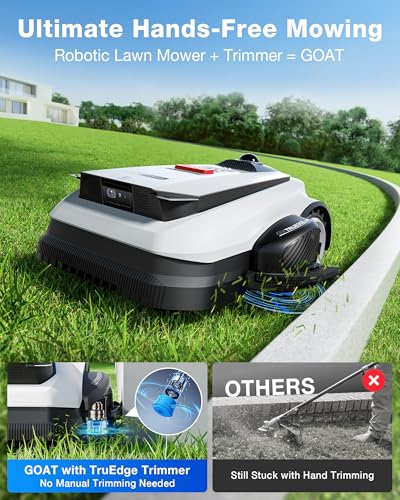
ECOVACS’s TruEdge technology allows the A2000 to mow closer to lawn borders, reducing the need for manual string-trimmer touch-ups. Budget mowers typically leave a wider uncut margin along edges and around obstacles.
Obstacle Handling
With real-time 3D obstacle detection, the A2000 can identify and navigate around objects as small as a garden stake. The budget mower’s simpler sensors are more likely to bump into or miss smaller obstacles.
App Ecosystem
The ECOVACS app provides a rich virtual map, zone management, detailed mowing history, and firmware updates. The budget mower’s app covers basic scheduling but lacks the depth and polish.
Where the Budget Mower Holds Its Own
Simple Lawns
On a small, flat, obstacle-free lawn, the performance gap narrows considerably. If your yard is essentially a rectangle of grass, you don’t need dual-LiDAR to mow it effectively.
Lower Risk
A less expensive mower means less financial pain if it’s damaged, stolen, or simply doesn’t meet your expectations. For first-time robot mower buyers, this lower barrier to entry has real value.
Maintenance Costs
Simpler technology generally means fewer things that can break. Replacement blades and basic maintenance for a budget mower tend to be less expensive than servicing a premium LiDAR-equipped unit.
The Verdict: Is the Upgrade Worth It?
For most homeowners with yards that have any meaningful complexity — multiple garden beds, trees, pathways, slopes, or irregular borders — the ECOVACS Goat A2000 LiDAR PRO is worth the investment. The dual-LiDAR navigation isn’t just a spec-sheet bullet point; it translates into genuinely better coverage, fewer missed patches, and a more hands-off experience. You’ll spend less time supervising the mower and less time with a string trimmer cleaning up edges.
However, if your lawn is small, flat, and simple, the budget mower can deliver acceptable results at a much lower cost. The key question is how much you value your time and how tolerant you are of occasional imperfections.
This mirrors the upgrade calculus we see across many product categories — the BenQ ScreenBar Halo 2 vs Halo comparison follows a similar pattern where the premium model’s improvements are meaningful but not universally necessary.
Buying Tips for Robot Mower Shoppers
1. Measure your lawn accurately. Know your square footage and slope grades before shopping. Overloading a mower rated for a smaller area leads to poor results and premature wear. 2. Count your obstacles. The more trees, beds, and garden features you have, the more you’ll benefit from advanced navigation. 3. Check slope ratings. If your yard has hills, verify the mower’s maximum incline spec. LiDAR mowers generally handle slopes better because they can plan routes that minimize steep traversals. 4. Plan for weather. Most robot mowers have rain sensors, but performance in wet conditions varies. Consider a model with a rain-delay feature if you live in a wet climate. 5. Budget for blades. Replacement blades are a recurring cost. Check availability and price before buying.
Frequently Asked Questions
Do I need to bury a perimeter wire with either mower?
No. Both mowers advertise wire-free operation. The A2000 uses dual-LiDAR to create virtual boundaries, while the budget mower uses app-based boundary settings with sensor-assisted detection.
Can the ECOVACS Goat A2000 handle rain?
The A2000 is designed for outdoor use and has weather resistance, but like most robot mowers, it performs best on dry grass. It includes a rain-delay feature that pauses mowing during heavy rain.
How long does the A2000 take to map my yard?
Based on owner reports, the initial mapping takes two to three mowing sessions. The map improves with each subsequent run as the LiDAR refines its model of your yard’s layout.
Is the budget mower loud?
Most robot mowers are significantly quieter than traditional gas mowers. The budget mower operates at a noise level comparable to other entry-level robot mowers — noticeable if you’re standing next to it, but unlikely to disturb neighbors.
Can I use either mower on a slope?
The A2000 handles moderate slopes better thanks to its LiDAR-assisted route planning. The budget mower may struggle on anything beyond gentle inclines. Always check the manufacturer’s maximum slope rating before purchasing.
How We Research
We have not personally tested or owned either of these robotic lawn mowers. Our analysis is based on a thorough review of manufacturer specifications, official product documentation, and patterns found across verified customer reviews and expert assessments. We cross-reference multiple sources to identify consistent praise and complaints, and we clearly distinguish between documented specs and owner-reported experiences. Our goal is to give you an honest, well-sourced comparison — not fabricated hands-on impressions.


Leave a Reply