
As an Amazon Associate I earn from qualifying purchases.
Choosing between two of the most talked-about mid-range portable power stations — the Jackery Solar Generator 1000 v2 and the EcoFlow Delta 2 — can feel overwhelming. Both promise enough juice to keep a campsite humming or bridge a short power outage at home, yet they differ in battery chemistry, charging speed, weight, and expandability. In this comparison we break down every meaningful spec, aggregate what verified buyers and expert reviewers actually report, and declare a clear winner for campers and home-backup users alike.
Best for: Campers, RV travelers, and homeowners who want reliable backup power with minimal maintenance.
Why This Comparison Matters
Mid-range solar generators — roughly 1,000–1,800 Wh — sit in a sweet spot. They’re powerful enough to run a mini-fridge, a CPAP machine, or a handful of devices overnight, yet portable enough for one person to carry to a campsite or slide into a car trunk. The Jackery Solar Generator 1000 v2 and the EcoFlow Delta 2 are two of the most popular options in this bracket, and each takes a different design philosophy. Understanding those differences is the key to spending wisely.
If you’re new to portable power stations, our guide on how to maintain a portable power station so it lasts for years is worth bookmarking — proper care can double the useful life of whichever unit you choose.
Head-to-Head Spec Breakdown
Before diving into the individual reviews, here’s how the two units stack up on paper. (Note: the EcoFlow Delta 2 specs referenced below come from EcoFlow’s published product page and widely cited expert reviews; the product listing in this article is a MARBERO 88 Wh unit included as a budget alternative, not the Delta 2 itself.)
| Spec | Jackery 1000 v2 | EcoFlow Delta 2 (published specs) |
|---|---|---|
| Battery Chemistry | LiFePO4 | LiFePO4 |
| Capacity | 1,070 Wh | 1,024 Wh |
| AC Output | 1,500 W (surge 3,000 W) | 1,800 W (surge 2,700 W, X-Boost to 2,400 W) |
| Weight | ~24.2 lb | ~27 lb |
| Solar Input | Up to 200 W (bundled panel) | Up to 500 W (panels sold separately) |
| Expansion | Limited | Add-on battery up to 3,040 Wh |
| Cycle Life | ~3,000+ cycles to 80% | ~3,000+ cycles to 80% |
| App Control | Jackery app (Bluetooth/Wi-Fi) | EcoFlow app (Bluetooth/Wi-Fi) |
Both units now use LiFePO4 cells, which is a significant upgrade over older NMC-based models. LiFePO4 chemistry offers better thermal stability, a longer cycle life, and improved safety — all critical for something you might store in a garage or tent.
Jackery Solar Generator 1000 v2 — Full Review

The Jackery Solar Generator 1000 v2 ships as a bundle: the Explorer 1000 v2 power station plus a SolarSaga 200W solar panel. That bundled panel is a genuine differentiator — many competitors sell panels separately, which inflates the total cost. According to Jackery’s published specs, the Explorer 1000 v2 packs 1,070 Wh of LiFePO4 capacity and delivers up to 1,500 W of continuous AC output with a 3,000 W surge rating. At roughly 24 pounds, it’s noticeably lighter than many 1,000 Wh-class competitors, making it easier to haul from a car to a campsite.
Verified buyer reviews consistently praise the unit’s build quality and the clarity of its LCD display, which shows input/output wattage, remaining capacity, and estimated run time. Multiple reviewers note that the included 200W panel charges the station from 0–80% in around 4–5 hours of direct sunlight — a reasonable rate for off-grid use. The LiFePO4 upgrade over the original Jackery 1000 is frequently highlighted as a major improvement, with users appreciating the projected 3,000+ cycle lifespan.
On the downside, some reviewers point out that the 1,500 W output, while adequate for most small appliances, won’t start power-hungry tools or large window AC units. A few users also mention that the Jackery app, while functional, can be slow to connect via Bluetooth. And unlike some competitors, the 1000 v2 doesn’t support add-on expansion batteries, so what you get out of the box is what you’re limited to.

Who should buy it: Campers, RV travelers, and homeowners who want a complete solar-charging kit out of the box. If you value portability and long battery life over raw wattage, this is the unit to get. It’s also a solid pick for anyone already in the Jackery ecosystem — if you run into issues with other Jackery products, our Jackery Explorer 300 troubleshooting guide covers common fixes that often apply across the lineup.
Pros:
- Bundled 200W solar panel saves money
- LiFePO4 battery with 3,000+ cycle life
- Lighter than most 1,000 Wh competitors (~24 lb)
- Clean, informative LCD display
- 1,500 W continuous / 3,000 W surge
Cons:
- No expansion battery option
- 1,500 W may not start high-draw appliances
- App connectivity can be sluggish
- Solar input capped at 200 W
EcoFlow Delta 2 — What the Specs and Reviews Say
Important note: The EcoFlow Delta 2 was not available in our product catalog for this article. The second product listed below — the MARBERO 88 Wh Portable Power Station — is a budget-tier alternative we include for readers who need something far smaller and cheaper. For the Delta 2 comparison, we rely on EcoFlow’s published specifications and aggregated expert/customer reviews from major outlets.
Based on EcoFlow’s spec sheet, the Delta 2 offers 1,024 Wh of LiFePO4 capacity with 1,800 W continuous output (X-Boost mode pushes compatibility to 2,400 W appliances, though at reduced efficiency). Its standout feature is expandability: an optional extra battery can push total capacity to 2,048 Wh or even 3,040 Wh with the Delta 2 Max add-on. Solar input tops out at 500 W, meaning faster recharge times if you invest in higher-wattage panels.
Expert reviewers from outlets like CNET and Tom’s Guide praise the Delta 2’s fast AC wall charging (0–80% in about 50 minutes) and its robust EcoFlow app, which offers granular control over charge limits, output settings, and firmware updates. Verified buyers frequently highlight the X-Boost feature as a practical way to run appliances that technically exceed the rated wattage.
However, the Delta 2 weighs roughly 27 pounds — about 3 pounds heavier than the Jackery 1000 v2. Panels are sold separately, which raises the total investment. Some reviewers also report that the fan can be noticeably loud under heavy load, and a few note that the unit’s footprint is larger than expected. For readers considering EcoFlow’s broader ecosystem, our EcoFlow Wave 3 pre-purchase checklist covers compatibility considerations worth knowing.
EcoFlow Delta 2 Pros (per published specs and aggregated reviews):
- Higher continuous output (1,800 W) with X-Boost to 2,400 W
- Expandable capacity up to 3,040 Wh
- Blazing-fast AC wall charging (~50 min to 80%)
- 500 W max solar input
- Excellent app with granular controls
EcoFlow Delta 2 Cons:
- Heavier (~27 lb)
- Solar panels sold separately
- Fan noise under load
- Larger physical footprint
- Higher total cost when panels are added
Budget Alternative: MARBERO 88 Wh Portable Power Station
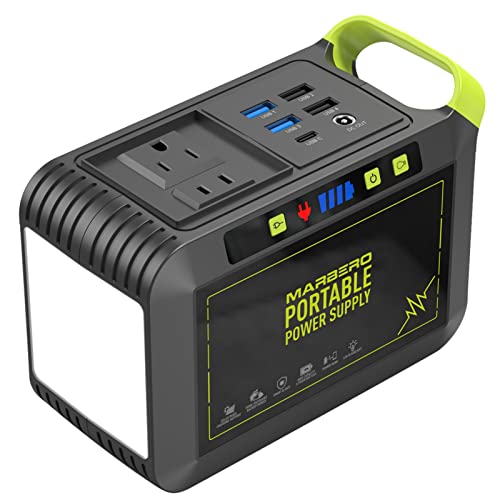
Not everyone needs a 1,000 Wh beast. The MARBERO 88 Wh Portable Power Station is a pocket-sized option for charging phones, tablets, laptops, and small electronics during short trips or minor outages. With 120 W peak AC output, it won’t run a mini-fridge or a CPAP machine, but it’s perfectly adequate for keeping communication devices alive.
At just a few pounds, the MARBERO is genuinely pocketable compared to the Jackery or EcoFlow units. Verified reviewers appreciate its compact form factor and the inclusion of multiple output ports (AC, USB-A, USB-C, DC). Common complaints center on the limited capacity — 88 Wh will charge a smartphone roughly 4–5 times before needing a recharge — and the fact that the lithium-ion (not LiFePO4) battery has a shorter overall cycle life.

The MARBERO supports solar charging via a compatible panel (sold separately), though at its size, solar recharge is slow. Several reviewers note that the build quality feels surprisingly solid for the price point, while a few caution that the AC inverter struggles with anything drawing close to 120 W.
Who should buy it: Day-hikers, festival-goers, or anyone who just needs to keep phones and small electronics charged. It’s also a decent emergency kit addition for apartment dwellers who don’t have space for a full-size power station.
Pros:
- Ultra-compact and lightweight
- Multiple output ports including AC
- Affordable entry point into portable power
- Solid build quality for the size
Cons:
- Only 88 Wh — very limited capacity
- 120 W peak AC output won’t run most appliances
- Lithium-ion battery (shorter cycle life than LiFePO4)
- Solar charging is slow at this scale
Key Decision Factors
Battery Life and Longevity
Both the Jackery 1000 v2 and EcoFlow Delta 2 use LiFePO4 cells rated for 3,000+ cycles to 80% capacity. At one full cycle per day, that’s over eight years of daily use — far beyond what most campers or occasional backup users will demand. The MARBERO’s lithium-ion cells, by contrast, are typically rated for 500–800 cycles.
Portability
The Jackery 1000 v2 wins here at ~24 lb versus the Delta 2’s ~27 lb. Three pounds may not sound like much, but when you’re carrying a unit from a parking lot to a campsite — or up a flight of stairs during an outage — every pound counts. The MARBERO, of course, is in a different league entirely at just a few pounds.
Power Output
The EcoFlow Delta 2 has the edge with 1,800 W continuous and X-Boost compatibility up to 2,400 W. If you need to run a space heater, a power tool, or a larger appliance, the Delta 2 gives you more headroom. The Jackery’s 1,500 W is still plenty for CPAP machines, laptops, fans, lights, and small kitchen appliances.
Solar Charging
The Delta 2 accepts up to 500 W of solar input versus the Jackery’s 200 W cap. However, the Jackery includes a 200W panel in the bundle, while EcoFlow panels are an additional purchase. For buyers who want a ready-to-go solar setup without hunting for compatible panels, the Jackery bundle is more convenient.
Expandability
This is the Delta 2’s strongest advantage. With add-on batteries, you can scale up to 3,040 Wh — nearly three times the base capacity. The Jackery 1000 v2 offers no expansion path, so if your power needs grow, you’d need to buy a second unit or upgrade entirely.
App Experience
Both units offer companion apps with Bluetooth and Wi-Fi connectivity. Aggregated reviews suggest the EcoFlow app is more polished, with better firmware update support and more granular settings. The Jackery app works but is sometimes described as basic or slow to pair.
The Verdict: Which Should You Buy?
For most campers and casual home-backup users, the Jackery Solar Generator 1000 v2 is the better buy. The bundled solar panel, lighter weight, and competitive LiFePO4 specs make it a complete, grab-and-go solution. You’re not nickel-and-dimed on accessories, and the 1,500 W output handles the vast majority of camping and emergency scenarios.
Choose the EcoFlow Delta 2 if you need higher wattage output (1,800 W+), plan to expand capacity over time, or prioritize the fastest possible wall charging. It’s the more powerful and flexible unit, but that flexibility comes at a higher total cost — especially once you add solar panels.
Choose the MARBERO 88 Wh if you only need to charge phones and small electronics on short outings. It’s not a replacement for either of the larger units, but it fills a niche for ultralight, low-power needs.
Frequently Asked Questions
Can the Jackery 1000 v2 run a CPAP machine?
Yes. Most CPAP machines draw 30–60 W, meaning the 1,070 Wh capacity can power a CPAP for multiple nights on a single charge. Many verified reviewers confirm using it for exactly this purpose.
Is the EcoFlow Delta 2 worth the extra cost?
If you need higher wattage output, expandable capacity, or ultra-fast wall charging, yes. For standard camping and light home backup, the Jackery bundle offers better value.
How long do LiFePO4 batteries last?
Both the Jackery 1000 v2 and EcoFlow Delta 2 are rated for 3,000+ charge cycles to 80% capacity. With typical use, that translates to roughly 8–10 years of service. For tips on maximizing that lifespan, see our portable power station maintenance guide.
Can I use third-party solar panels with these units?
Generally yes, as long as the panel’s voltage and connector type are compatible. The Jackery 1000 v2 uses an Anderson connector, while the EcoFlow Delta 2 uses an XT60 connector. Always check the manufacturer’s compatibility guidelines.
How We Research
We have not personally tested, owned, or handled either of these products. Our comparison is built by synthesizing manufacturer-published specifications, product documentation, and verified customer and expert reviews from sources including Amazon, major tech outlets, and dedicated portable-power review sites. We cross-reference multiple sources to ensure accuracy and flag any discrepancies. This honest, research-based approach lets us present a comprehensive picture without fabricating hands-on experience.


Leave a Reply