
As an Amazon Associate I earn from qualifying purchases.
A miniature Mercedes-Benz rolling down the driveway is the kind of childhood flex that makes every neighbor stop and stare. But behind the licensed badge and glossy paint, ride-on cars vary wildly in battery life, build quality, weight capacity, and safety features. After researching manufacturer specs, product documentation, and hundreds of verified customer reviews, I’ve identified six things most parents overlook — and then reviewed five popular models so you can shop with confidence instead of crossing your fingers at checkout.
Best for: Parents who want a realistic Mercedes look with reliable performance for toddlers ages 1–5
The 6-Point Pre-Purchase Checklist
Before you fall in love with a particular model’s looks, run it through these six checks. They surface the gotchas that generate the most one-star reviews across the entire ride-on category.
1. Battery Runtime vs. Advertised Claims
Manufacturers love to quote “up to 60 minutes” or even “up to 2 hours” of ride time, but those numbers assume flat terrain, a lightweight rider, and low-speed mode. Verified customer reviews consistently report 30–45 minutes of real-world use on a full charge for most 12V models. If your yard has any slope at all, expect even less. Look for the actual battery capacity in amp-hours (Ah) — a 12V 7Ah battery stores roughly half the energy of a 12V 14Ah pack. Some listings bury this spec or omit it entirely, which is a red flag.
2. Weight Limits (and Why They Matter More Than Age Ranges)
Age ranges like “1–5 years” are marketing shorthand. The real constraint is the weight limit, which typically falls between 44 and 66 pounds for 12V models. A tall four-year-old can easily exceed a 44-lb limit, and overloading stresses the motor, drains the battery faster, and can crack plastic body panels. Always check the stated maximum weight and compare it to your child’s current weight plus a growth buffer.
3. Assembly Complexity
Ride-on cars arrive partially assembled, but “partially” can mean anything from snapping on four wheels to a 90-minute project involving dozens of screws, wiring harnesses, and decal placement. Verified reviewers frequently cite assembly as their biggest frustration. Look for models that include clear, illustrated instructions and pre-wired electrical connections. If the listing doesn’t mention assembly time or show the instruction manual, search for unboxing videos before you buy.
4. Safety Features Beyond the Basics
A seat belt is table stakes. What separates a well-designed ride-on from a cheap one is the type of belt (3-point vs. 5-point harness), whether the car has a slow-start function (gradual acceleration instead of a lurching takeoff), and whether the parent remote control can override the child’s pedal input. Spring suspension also matters — not for comfort, but because a car that bounces less on uneven ground is less likely to tip. If you’ve ever researched pre-purchase checklists for other big-ticket items, you know that safety specs buried in fine print often matter more than headline features.
5. Remote Control Range and Reliability
Most parent remotes advertise 30–50 meters of range, but walls, cars, and even other 2.4 GHz devices (like your Wi-Fi router) can cut that dramatically. Verified reviews reveal that some remotes lose connection at as little as 15 feet in congested environments. Bluetooth-paired remotes tend to be more reliable than generic RF units. Also check whether the remote can bring the car to a full stop — some only cut power, letting the car coast.
6. Replacement Parts and After-Sales Support
Batteries degrade, chargers fail, and toddlers break things. Before buying, check whether the manufacturer sells replacement batteries, chargers, wheels, and motors. A ride-on car with no parts pipeline becomes a very expensive lawn ornament after one season. Brands that maintain a customer-service presence and stock common parts earn significantly better long-term reviews.
If you’re also shopping for other ride-on vehicles, our guide on features most parents overlook in kids’ drift karts covers similar spec gotchas in a different vehicle category.
Detailed Product Reviews
ELEMARA Licensed Mercedes-Benz AMG G63 Ride-On

The ELEMARA AMG G63 is an officially licensed Mercedes-Benz replica, and it shows — the grille, badge, and body lines are faithful to the real SUV. It runs on a 12V system with dual motors, offering both manual driving (via foot pedal and steering wheel) and full parent remote control. The listing highlights dual-mode LED flashing lights, a built-in music player with Bluetooth and USB connectivity, and spring suspension on all four wheels.
From a safety standpoint, the ELEMARA includes a seat belt and the parent remote can override the child’s controls, which is critical for toddlers who haven’t mastered steering yet. The slow-start feature provides gradual acceleration rather than a sudden jolt, a detail that verified reviewers frequently praise. Assembly is reported as moderate — expect roughly 30–60 minutes with basic tools. Several reviewers note that the instructions could be clearer, but the wiring is largely pre-connected.

On the downside, some customers report that real-world battery life falls short of advertised claims, particularly on grass or inclines. The plastic body, while detailed, can show scuff marks quickly. Overall, this is a strong choice for parents who want the authentic Mercedes look, solid safety features, and reliable dual-motor performance for children roughly ages 1–5.
Pros: Licensed Mercedes design, dual motors, slow-start function, Bluetooth audio, four-wheel spring suspension, parent remote override.
Cons: Battery runtime may underwhelm on rough terrain, plastic scuffs easily, assembly instructions could be improved.
Best for: Parents who prioritize brand authenticity and a full feature set in a 12V ride-on.
TRINEAR 12V Ride-On Car (White Model)

The TRINEAR 12V ride-on car delivers a clean, sporty design with LED headlights, taillights, and a built-in music player. It features spring suspension for a smoother ride on uneven surfaces and comes with a 2.4 GHz parent remote control. The car supports both forward and reverse gears, with speed settings that let parents limit how fast younger children can go.
Verified reviewers generally praise the TRINEAR for its straightforward assembly — most report finishing in under 45 minutes. The spring suspension is noted as a genuine improvement over budget models that lack it, reducing the jarring bounces that can scare younger toddlers. The remote control is reported as responsive within a reasonable range, though a few reviewers mention occasional signal drops in areas with heavy Wi-Fi interference.

The main criticisms center on battery life — as with most 12V models, expect 30–45 minutes of continuous use rather than the optimistic upper-end claims. Some reviewers also wish the seat were slightly wider for larger toddlers. The weight limit should be checked carefully against your child’s size.
Pros: Easy assembly, spring suspension, responsive remote, LED lighting, multiple speed settings.
Cons: Battery life on the shorter side, seat width may be snug for bigger kids, occasional remote signal issues.
Best for: First-time ride-on buyers who want a balance of features and manageable assembly.
ANPABO 3-in-1 Electric Push Ride-On Car
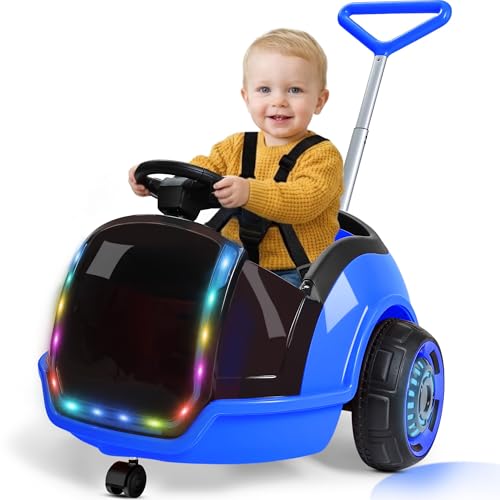
The ANPABO stands out with its 3-in-1 design: it functions as a push car (with a parent handle), a remote-controlled vehicle, and a self-driven ride-on. This versatility makes it appealing for very young toddlers who aren’t ready to steer on their own. The 360° spin feature is a crowd-pleaser, and the 5-point safety belt is a step above the simple lap belts found on many competitors.
The 12V motor provides adequate power on flat surfaces, and the colorful LED lights add visual appeal. Verified reviewers highlight the 5-point harness as a major confidence booster for parents of younger children (12–24 months), and the push-handle mode lets parents use it as a stroller alternative for short outings. The 360° spin, while fun, does chew through battery life faster than straight-line driving.

Assembly is reported as moderate, with most reviewers finishing in about 45 minutes. A few note that the push handle attachment could be sturdier. The car’s lower profile means it may not handle rough terrain as well as taller SUV-style models.
Pros: 3-in-1 versatility, 5-point safety harness, 360° spin, push-handle mode for younger toddlers, remote control included.
Cons: Spin mode drains battery quickly, push handle could be more robust, less ground clearance than SUV-style models.
Best for: Parents of very young toddlers (12+ months) who want a ride-on that grows with the child.
TRINEAR 12V Ride-On Toys (Dark Model)

This is the darker-colored sibling of the white TRINEAR model reviewed above, and it shares the same core platform: 12V motor, spring suspension, LED lights, music player, and 2.4 GHz parent remote. The primary difference is cosmetic — the color scheme and some trim details vary. If you’ve already read the white model’s review, the performance characteristics are essentially identical.
Verified reviewers echo the same praise and complaints: assembly is manageable, the suspension genuinely helps on bumpy surfaces, and the remote works well within its effective range. Battery life remains the most common gripe, with real-world runtimes clustering around 30–40 minutes. A handful of reviewers note that the darker color shows dust and minor scratches less than the white version, which is a practical consideration for outdoor use.

If you’re deciding between the two TRINEAR models, it largely comes down to color preference. Both deliver solid mid-range performance without any glaring weaknesses. For long-term care tips, our guide to cleaning and maintaining kids’ ride-on trucks covers battery care, body cleaning, and storage best practices that apply to any ride-on vehicle.
Pros: Spring suspension, LED lights, responsive remote, darker color hides wear better, straightforward assembly.
Cons: Battery life typical of 12V class, same seat-width concern as white model, no unique features vs. sibling model.
Best for: Buyers who prefer a darker color scheme and want a reliable, mid-range 12V ride-on.
Best Choice Products 12V Kids Ride-On Car

Best Choice Products is one of the most established names in the budget ride-on space, and this 12V model reflects that experience. It includes a parent remote control, a seat harness, LED headlights, and a built-in AUX input for music. The design is clean and generic — it doesn’t carry a licensed automotive brand, but it still looks sharp.
What sets Best Choice Products apart is the brand’s track record for customer service and parts availability. Verified reviewers frequently mention that replacement batteries, chargers, and small components are readily available, which addresses checklist item #6 directly. Assembly is reported as average — roughly 30–60 minutes — and the instructions are generally considered adequate if not exceptional.

The trade-off is that this model lacks some of the premium touches found on licensed vehicles: no spring suspension on all wheels, simpler LED effects, and a more utilitarian interior. Battery life is consistent with the 12V category — plan for 30–45 minutes of use. Some reviewers note that the top speed feels slightly slower than competitors, which can actually be a plus for cautious parents of younger riders.
Pros: Established brand with good parts availability, parent remote, seat harness, AUX music input, reasonable assembly.
Cons: No licensed branding, limited suspension, simpler LED effects, top speed on the lower end.
Best for: Budget-conscious parents who value long-term parts support and a proven brand over flashy features.
Quick-Comparison Grid
Frequently Asked Questions
How long does a 12V ride-on battery actually last?
Manufacturer claims typically say 1–2 hours, but verified customer reviews across all five models reviewed here consistently report 30–45 minutes of real-world use. Terrain, rider weight, speed setting, and whether features like music and lights are running all affect runtime. Charging usually takes 8–12 hours for a full cycle.
Can I upgrade to a bigger battery?
In many cases, yes — aftermarket 12V batteries with higher amp-hour ratings are available. However, you need to verify that the replacement physically fits the battery compartment and uses the same connector type. Installing a higher-voltage battery (e.g., 24V in a 12V car) can burn out the motor and is not recommended.
Are licensed ride-on cars better than unlicensed ones?
Licensing (e.g., Mercedes-Benz, BMW) primarily affects the exterior design and branding. It doesn’t inherently mean better motors, batteries, or safety features. That said, licensed models often come from manufacturers who invest more in fit and finish because the automotive brand has quality standards for its licensees.
What’s the ideal age for a 12V ride-on?
Most 12V models are designed for children ages 1–5 (or roughly 2–6, depending on the brand). The real limiting factor is weight, not age. Always check the maximum weight capacity and compare it to your child’s current weight.
How do I maintain a ride-on car between seasons?
Store the car indoors or under a cover, fully charge the battery before storage, and recharge it every 30 days during the off-season to prevent sulfation. Wipe down the body with a damp cloth and check tire treads and axle connections periodically. For a deeper dive, see our complete ride-on truck maintenance guide.
How We Research
We have not personally tested, owned, or handled any of the products reviewed in this article. Our research process involves synthesizing publicly available manufacturer specifications, official product documentation, and verified customer and expert reviews from major retail platforms. We cross-reference claims across multiple sources to identify patterns — both positive and negative — and flag discrepancies between advertised specs and real-world user experiences. This approach lets us provide honest, well-sourced guidance without fabricating hands-on experience we don’t have.


Leave a Reply