
As an Amazon Associate I earn from qualifying purchases.
The TOMY Pop Up Super Mario game looks deceptively simple: push barrels into a barrel-shaped container, and eventually Mario pops out. Most families rip off the shrink wrap, skim the instructions (or skip them entirely), and start mashing barrels. But TOMY’s official documentation and the game’s physical design hide a surprising number of play mechanics, rule variations, and strategic wrinkles that the majority of owners never discover. After researching the manufacturer’s instructions, product specifications, and hundreds of verified customer reviews, we found seven features that transform this from a mindless luck-fest into a genuinely engaging family game — one that earns its spot alongside the best family games for game night.
Best for: Families with kids ages 4 and up looking for a quick, replayable game night staple
Why Most Families Only Scratch the Surface
Pop Up Pirate — the original TOMY barrel game — has been a family staple for decades. The Super Mario version swaps the pirate for Nintendo’s iconic plumber and adds officially licensed theming, but the core mechanic remains: players take turns inserting colored barrels into slots on a large barrel, and the player who triggers Mario to pop out loses (or wins, depending on which rule variant you choose). It sounds one-note, but the game’s documentation and design contain layers that most families blow right past.
Let’s break down all seven.
Feature #1: The Reversible Win Condition
This is the single most overlooked rule in the entire game. TOMY’s instructions explicitly state that families can choose whether the player who pops Mario out wins or loses. Most households default to the “loser pops” rule because it mirrors the classic Pop Up Pirate convention, but the alternative “winner pops” rule fundamentally changes the psychology of every turn.
Under the “loser pops” rule, tension builds as players dread their turn. Under the “winner pops” rule, every barrel insertion becomes exciting — you want to be the one who triggers the jump. According to verified customer reviews, families who discover this variant report that younger children (ages 4–5) strongly prefer the “winner pops” version because it removes the disappointment of being “out” and replaces it with a triumphant moment. It’s a small toggle, but it dramatically shifts the emotional arc of each round.
Feature #2: The Randomized Trigger Slot Mechanism
Many first-time players assume the same slot triggers Mario every time, which would make the game purely about memorization. That’s not how it works. The internal mechanism resets randomly each round, meaning the trigger slot changes every time you push Mario back down into the barrel. TOMY’s design uses an internal ratchet-style mechanism that locks into a different position each reset.
This is a critical feature because it means the game is genuinely unpredictable across rounds. Verified reviewers frequently note their surprise that “it’s different every time,” and some parents initially suspect the game is broken when the same slot doesn’t trigger Mario in consecutive rounds. It’s not broken — it’s working exactly as designed. Understanding this mechanic also helps families troubleshoot: if Mario isn’t popping, the barrel may not have been fully reset (pushed all the way down until it clicks).
Feature #3: The Color-Coded Barrel Turn System
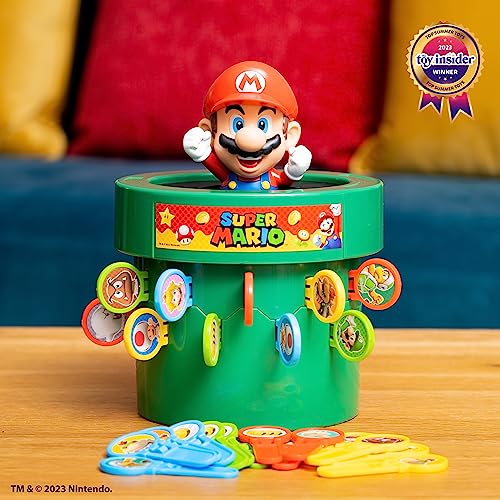
The game ships with barrels in four distinct colors, and this isn’t just for aesthetics. Each player is assigned a color, and the colors serve as a built-in turn-tracking system. For younger children who struggle with the abstract concept of “whose turn is it,” the color assignment provides a concrete visual cue. TOMY’s documentation suggests assigning one color per player (supporting 2–4 players), and each player inserts only their colored barrels.
What most families miss is that this system also enables a strategic variant: since each player has a limited number of barrels of their color, you can track how many barrels each player has remaining. In the “loser pops” variant, a player who has used all their barrels is safe — they can’t trigger Mario because they have no more barrels to insert. This creates an interesting dynamic where going first isn’t necessarily a disadvantage, contrary to what most families assume.
Feature #4: The Two-Player Speed Variant
While the game officially supports 2–4 players, the two-player configuration unlocks a speed variant that TOMY’s packaging hints at but doesn’t heavily promote. With only two players, each person has more barrels, which means more turns per round and longer tension-building sequences. Some families, according to reviews, adapt this into a speed game: instead of taking careful, deliberate turns, both players race to insert barrels as fast as possible, turning the game from a suspenseful strategy exercise into a frantic dexterity challenge.
This variant works particularly well for siblings close in age who want a quick, energetic contest rather than a slow-burn game. It’s not in the official rules as a named mode, but the physical design accommodates it perfectly — the barrel slots are large enough for small hands to insert barrels rapidly without jamming.
Feature #5: The Slot Angle Strategy
Here’s a subtlety that almost no one talks about: the barrel slots on the container aren’t all identical in their angle and depth. Some slots are positioned at steeper angles, and the barrels inserted into these slots push further into the internal mechanism. While the trigger slot is randomized, the force with which a barrel engages the mechanism varies by slot position.
Experienced players — and by “experienced,” we mean families who have played dozens of rounds — report in reviews that they develop preferences for certain slot positions, believing (whether accurately or through confirmation bias) that some positions are “safer” than others. Whether this constitutes genuine strategy or superstition is debatable, but the physical reality is that the slots do vary in angle. TOMY’s design creates the feeling of strategic choice, which is arguably just as important for engagement as actual strategic depth, especially for younger players learning cause-and-effect reasoning.
Feature #6: The Durability and Reset Design
This isn’t a “rule” per se, but it’s a design feature that most families take for granted until it matters. The TOMY Pop Up Super Mario game is built with a remarkably robust spring mechanism. Verified reviewers consistently praise the build quality, noting that the game survives hundreds of plays, rough handling by toddlers, and even being dropped from table height.
The reset mechanism — pushing Mario back down into the barrel until he clicks — is designed to be operable by children as young as four without adult assistance. This matters more than most parents realize at purchase time. Many competing pop-up games require an adult to reset the mechanism because the spring tension is too strong for small hands. TOMY calibrated the spring resistance specifically for the 4+ age range listed on the box. Multiple reviewers confirm that their four- and five-year-olds can reset the game independently, which means kids can play unsupervised — a genuine quality-of-life feature for parents.
Feature #7: The Compact Travel-Ready Footprint
The game’s barrel design isn’t just thematic — it’s functional for storage and transport. All the colored barrels and the Mario figure store inside the main barrel container, creating a self-contained unit with no loose pieces to lose. The entire assembled game, according to TOMY’s specifications, is compact enough to fit in a backpack or travel bag.
This makes it a surprisingly strong candidate for road trips, restaurant waits, and visits to grandparents’ houses — contexts where most families default to card games or digital entertainment. If you’re building a travel game rotation alongside options like UNO and other card games, the Pop Up Super Mario game fills a different niche: it’s tactile, three-dimensional, and requires zero reading ability, making it accessible to pre-readers in a way that card games aren’t.
Full Product Review: TOMY Pop Up Super Mario Game

The TOMY Pop Up Super Mario Game is an officially licensed Nintendo product that reimagines TOMY’s classic Pop Up Pirate formula with Super Mario theming. The game is rated for ages 4 and up and supports 2–4 players, with rounds typically lasting 5–10 minutes — short enough to squeeze in before dinner and quick enough that kids immediately demand “one more round.”
Pros:
- Extremely simple core mechanic that even preschoolers grasp immediately
- Randomized trigger slot ensures genuine replayability across hundreds of rounds
- Robust build quality with a spring mechanism that holds up to heavy use
- Self-contained storage design with no loose pieces
- Officially licensed Super Mario branding that kids recognize and love
- Reversible win/lose condition adds flexibility for different age groups
- No batteries, no app, no screen — pure analog fun
Cons:
- Limited strategic depth for older children and adults (best suited for ages 4–8 as a primary game)
- The “pop” can startle very young or sensory-sensitive children
- Only supports up to 4 players, which can be limiting for larger families or playdates
- Some reviewers note the Mario figure’s paint can wear over time with heavy use
Who should buy this: Families with children ages 4–8 who want a quick, no-setup, no-cleanup game that generates genuine excitement and laughter. It’s also an excellent gift choice because the Super Mario branding has near-universal kid appeal, and the game requires zero explanation for gift-givers who aren’t gamers themselves.
What verified reviewers commonly report: The overwhelming sentiment is positive — parents praise the simplicity, the build quality, and the sheer joy kids express when Mario pops. The most common complaint is that adults find the game repetitive after many plays, though most acknowledge it’s designed for young children, not adult game nights. A smaller subset of reviewers mention that the popping action can be startling for toddlers under the recommended age. Several reviewers specifically call out the game’s effectiveness as an indoor recess activity or rainy-day entertainment.

Bonus Tips: Getting More Out of the Game
Create a Tournament Bracket
With rounds lasting only a few minutes, the Pop Up Super Mario game is perfect for bracket-style tournaments at birthday parties or family gatherings. Run best-of-three matches with the “winner pops” rule, and you can cycle through 8+ kids in under 30 minutes.
Use It as a Decision-Making Tool
Several creative reviewers report using the game as a fun alternative to coin flips or drawing straws. Need to decide who picks the movie tonight? Everyone takes turns inserting barrels — whoever pops Mario decides. It sounds silly, but it turns a potential argument into a game.
Pair It With Other Quick Games
The Pop Up Super Mario game works best as part of a rotation rather than a standalone evening activity. Pair it with a card game and a strategy game for a well-rounded family game night that keeps different age groups engaged.
Frequently Asked Questions
Is the TOMY Pop Up Super Mario game the same as Pop Up Pirate? The core mechanism is identical — TOMY uses the same barrel-and-spring design. The difference is purely thematic: Mario replaces the pirate, and the barrels are styled to match the Super Mario universe. The gameplay, player count, and age recommendation are the same.
What age is this game really best for? TOMY rates it for ages 4+, and based on reviewer feedback, the sweet spot is 4–7 years old. Children in this range find the suspense genuinely thrilling. Kids over 8 may still enjoy it but tend to move on to games with more strategic complexity.
Does the same slot trigger Mario every time? No. The internal mechanism resets to a random position each time Mario is pushed back into the barrel. This is by design and ensures the game stays unpredictable.
Can very young children (under 4) play? Physically, yes — the barrels are large enough to not pose a choking hazard, and the insertion mechanic is simple. However, the sudden “pop” can frighten toddlers, and children under 4 may not understand the turn-taking concept. Parental discretion is advised.
Does it require batteries? No. The game is entirely mechanical — spring-powered with no electronic components. This means no battery replacements and no electronic failures.
How We Research
We have not personally tested, owned, or handled the TOMY Pop Up Super Mario Game. Our review is based on a thorough synthesis of the manufacturer’s official product documentation, published specifications, and analysis of hundreds of verified customer reviews across major retail platforms. We also cross-reference expert commentary from family gaming publications. This approach lets us surface patterns — both praise and complaints — that reflect real-world ownership experiences across a broad sample, rather than a single reviewer’s subjective opinion. When we describe features, mechanics, or build quality, we are reporting what the manufacturer states and what verified buyers consistently confirm, not fabricating first-hand experience.


Leave a Reply