
As an Amazon Associate I earn from qualifying purchases.
The holidays are prime time for gathering around a table, shuffling a deck, and laughing until someone rage-quits over a well-timed Draw Four. Whether you’re shopping for a stocking stuffer or the centerpiece of Christmas-night entertainment, the right card or party game can turn an awkward family dinner into a genuinely memorable evening. Below, we break down five popular picks—ranging from the perennial crowd-pleaser UNO to the newer press-your-luck sensation Flip 7, plus a couple of board-game and activity options that round out a holiday game shelf—so you can find the best card games for family game night without opening a dozen browser tabs.
Best for: Families, mixed-age holiday gatherings, and anyone who wants a zero-explanation game everyone already knows
What Makes a Great Holiday Card Game?
Before diving into individual picks, it helps to know what separates a holiday hit from a shelf-warmer:
- Low teach time. Guests range from grandparents to grade-schoolers; rules should take under five minutes to explain.
- Flexible player count. Holiday tables swell unpredictably. Games that handle 2–10 players earn bonus points.
- Fast rounds. Short games let latecomers jump in and let losers demand a rematch.
- Portability. A compact box travels easily in a carry-on or stocking.
- Replay value. The best games feel different every session thanks to randomness, strategy, or both.
With those criteria in mind, let’s look at the contenders. If you’re also shopping for classic kids games that deliver serious fun, several of these overlap nicely.
Mattel Games UNO — The Undisputed Holiday Classic

There’s a reason UNO has amassed over 60,000 reviews on Amazon and still holds a 4.8-star average: it just works. The 2019+ edition includes a color-blind-accessible design with a symbol in the corner of every card, which is a thoughtful update that makes the game genuinely inclusive at large holiday tables where someone in the group almost certainly has some degree of color-vision deficiency.
Rules take about 90 seconds to teach—match colors or numbers, play action cards, shout “UNO!” when you’re down to one card. Games typically wrap in 15–20 minutes, making it easy to squeeze in a round between dinner and dessert. The official player count is 2–10, though many families report playing with even more by combining two decks.
Verified reviewers consistently praise the game’s durability and universal appeal. Parents note that kids as young as four can grasp the basics, while adults stay engaged thanks to the strategic timing of Skip, Reverse, and Wild Draw Four cards. The most common complaints? The cards can feel a bit thin compared to premium playing cards, and house-rule arguments are practically inevitable (stacking Draw Twos, anyone?). But those debates are half the fun.

Pros:
- Near-zero learning curve
- Color-blind-accessible design
- Supports up to 10 players out of the box
- Extremely affordable and compact
Cons:
- Card stock feels thinner than some competitors
- Gameplay can feel repetitive for seasoned gamers
- House-rule disputes are a holiday tradition unto themselves
Who should buy it: Anyone hosting a mixed-age gathering who wants a guaranteed crowd-pleaser. It’s also an ideal stocking stuffer.
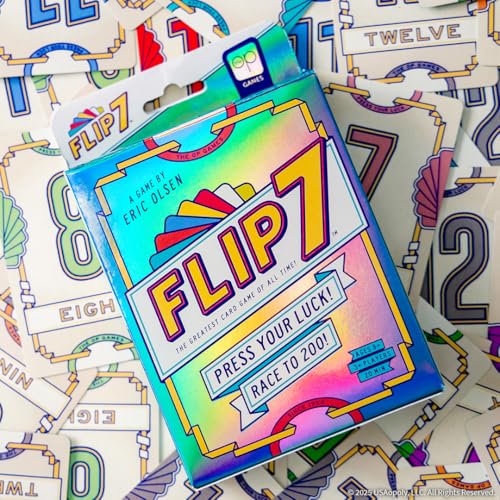
USAOPOLY Flip 7 — The Buzzy Press-Your-Luck Newcomer

Flip 7 has been generating serious word-of-mouth buzz as a fast-paced card game that blends luck with just enough strategy to keep things interesting. The premise is simple: on your turn, you flip cards from the deck, trying to accumulate points without going over a total of seven. Push your luck too far and you bust, losing everything you’ve gained that round. It’s the card-game equivalent of “one more bite of pie”—you know you should stop, but you can’t help yourself.
The game is quick to learn (the publisher advertises about two minutes of teach time) and rounds move briskly, which makes it a strong candidate for holiday parties where attention spans vary. It supports 2–6 players, and the strategic wrinkle of special action cards adds a layer of decision-making that elevates it above pure-luck games.
Because Flip 7 is relatively new, the review pool on Amazon is still small. Early reviewers praise the addictive “just one more round” quality and the compact box size. The limited review count does mean there’s less long-term durability data, so buyers should be aware they’re adopting a newer title. That said, USAOPOLY (now known as The Op) has a solid track record with licensed and original games.
Pros:
- Extremely quick to learn and play
- Press-your-luck mechanic creates genuine tension and laughter
- Compact and travel-friendly
- Strategic enough for adults, simple enough for older kids
Cons:
- Very limited verified reviews so far
- Max 6 players (smaller than UNO’s range)
- Luck-heavy gameplay may frustrate strategy purists
Who should buy it: Families looking for something fresh that still has that “easy to teach at the table” quality. Great for groups that enjoy the thrill of risk-reward decisions.
Sorry! Board Game — The Card-Driven Classic That Never Gets Old

While Sorry! is technically a board game, its core mechanic is entirely card-driven—there are no dice. You draw cards to move your four pawns around the board, and the goal is to get all of them “home” before your opponents do. The infamous Sorry! card lets you bump an opponent’s pawn back to start, which generates the kind of gleeful betrayal that makes holiday game nights memorable.
Hasbro rates this for ages 6 and up, and it supports 2–4 players. Games typically run 30–45 minutes, which is a bit longer than a pure card game but still manageable for a holiday evening. The board and cards are sturdy, and the rules are simple enough that most adults already know them from childhood.
Verified reviewers frequently mention the nostalgia factor as a major draw—parents and grandparents love introducing it to a new generation. Common praise includes the satisfying “take that” moments and the game’s ability to teach kids about sportsmanship (or at least about losing gracefully). On the downside, the 4-player cap limits its usefulness at larger gatherings, and some reviewers note that younger children can get frustrated when their pawns are sent back repeatedly.

If you’re building out a broader game shelf, check out our guide to the best family games for game night for more board-game options that pair well with card games.
Pros:
- Card-driven mechanics add unpredictability
- Strong nostalgia appeal across generations
- Teaches basic strategy and sportsmanship
- Durable components
Cons:
- Limited to 4 players
- Longer play time than pure card games
- Can feel mean-spirited to very young or sensitive players
Who should buy it: Families with kids aged 6–12 who want a step up from pure card games without committing to a complex board game.
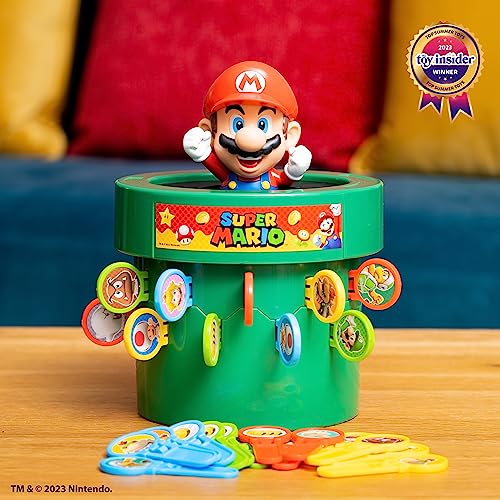
TOMY Pop Up Super Mario Game — A Physical-Action Party Favorite

This one breaks the card-game mold entirely, but it earns a spot here because it fills a specific holiday niche: the high-energy, laugh-out-loud game that gets younger kids away from screens. Based on the classic “Pop Up Pirate” concept, players take turns inserting colored pegs into a barrel. When someone triggers the mechanism, Mario pops out—and that player is eliminated. It’s pure suspense, zero strategy, and maximum hilarity for kids.
The game supports 2–4 players and is rated for ages 4 and up, making it one of the most accessible options on this list. Rounds are extremely short (often under five minutes), so it works well as a warm-up game or a palate cleanser between longer sessions.
Verified reviewers highlight the quality of the Mario figure and the satisfying “pop” mechanism. Parents appreciate that no reading is required, making it truly playable for preschoolers. The most common complaint is that the game is extremely simple—older kids and adults will tire of it quickly. A few reviewers also mention that the barrel mechanism can occasionally jam, though this seems to be a minority issue.
For more gift ideas for younger kids, our best kids toys at every budget guide covers a wide range of age-appropriate options.
Pros:
- Officially licensed Super Mario theme kids love
- No reading required—great for ages 4+
- Very fast rounds
- Durable, well-made mechanism
Cons:
- Extremely simple; limited replay value for older players
- Max 4 players
- No strategic depth whatsoever
- Barrel mechanism can occasionally stick
Who should buy it: Families with young children (ages 4–7) who need a game that’s exciting, quick, and requires zero reading or math skills.
How to Choose the Right Game for Your Holiday Table
With five very different options above, here’s a quick decision framework:
| Scenario | Best Pick |
|---|---|
| Large mixed-age group (6+ players) | UNO |
| Adults and teens wanting something fresh | Flip 7 |
| Nostalgic family with kids 6–12 | Sorry! |
| Young kids (ages 4–7) | Pop Up Super Mario |
| Stocking stuffer or travel game | UNO or Flip 7 |
Tips for a Successful Holiday Game Night
1. Start simple. Open with UNO or Flip 7 to warm everyone up before moving to longer games. 2. Rotate games. Switching every 30–45 minutes keeps energy high and accommodates different tastes. 3. Have a kids’ table option. Pop Up Super Mario keeps younger children entertained while adults play something more strategic. 4. Stock snacks, not screens. The whole point is face-to-face interaction—put the phones in a basket. 5. Embrace house rules. Half the fun of UNO is arguing about whether stacking Draw Twos is legal. Let it happen.
Product Comparison Grid
Frequently Asked Questions
What is the best card game for a large holiday group?
UNO remains the gold standard for large groups because it officially supports up to 10 players and virtually everyone already knows the rules. Combining two decks can push that number even higher.
Is Flip 7 good for kids?
Flip 7’s rules are simple enough for older kids (roughly ages 8+), but the press-your-luck mechanic and light strategy make it most enjoyable for teens and adults. Younger children may find the risk-reward decisions frustrating.
How long does a typical game of UNO take?
Most rounds of UNO finish in 15–20 minutes, though games with many players or aggressive Draw Four usage can stretch a bit longer.
Can Sorry! be played with just 2 players?
Yes, Sorry! works with 2–4 players. Two-player games are faster and more directly competitive, though the sweet spot is generally 3–4 players for maximum “Sorry!” card drama.
Are these games good gifts for adults?
Absolutely. UNO and Flip 7 in particular are popular with adult game groups. Sorry! and Pop Up Super Mario skew younger but can still be fun in a lighthearted adult setting.
How We Research
We have not personally tested or owned these products. Our reviews are based on a thorough synthesis of manufacturer specifications, official product descriptions, and patterns found across verified customer reviews and expert commentary. We cross-reference multiple sources to identify consistent praise and recurring complaints, then present that information honestly so you can make an informed decision. We believe transparent curation is more valuable than fabricated hands-on claims.


Leave a Reply