
As an Amazon Associate I earn from qualifying purchases.
If you’ve ever lifted a pair of binoculars to your eyes only to see a washed-out, blurry mess, you know how quickly bad optics can ruin a hike, a birding session, or a stadium event. Vortex Optics has built a reputation for delivering serious glass at accessible price points, and the Triumph HD line is their latest entry aimed squarely at outdoor enthusiasts who want HD clarity without the premium-tier price tag. In this review, we dig into the two current Triumph HD models — the full-size 12×50 and the compact 10×28 — synthesizing manufacturer specifications and verified customer feedback to help you figure out which pair belongs in your pack.
Best for: Birders, hunters, and nature watchers who prioritize image quality over portability
Why the Triumph HD Line Matters
Vortex has long dominated the mid-range optics conversation with lines like the Diamondback and Crossfire. The Triumph HD slots in as a value-oriented option that still features fully multi-coated lenses and HD (high-density, extra-low-dispersion) glass elements designed to reduce chromatic aberration — that annoying color fringing you see around high-contrast edges. Both models ship with Vortex’s unconditional, transferable VIP Warranty, which covers repair or replacement regardless of fault. That warranty alone sets these apart from many competitors at similar price points.
The two models serve very different use cases, though. The 12×50 is a full-size, roof-prism binocular built for stationary or slow-paced observation where image brightness and magnification matter most. The 10×28 is a compact, pocket-friendly option for hikers, travelers, and concert-goers who need decent optics without the bulk. Let’s break each one down.
Vortex Triumph HD 12×50 Binoculars — Full-Size Powerhouse

The Vortex Triumph HD 12×50 pairs 12x magnification with 50mm objective lenses, a combination that delivers a bright image even in lower-light conditions like dawn and dusk — prime time for wildlife observation. According to Vortex’s published specs, the 12×50 features a linear field of view of 271 feet at 1,000 yards, 15.8mm of eye relief (comfortable for eyeglass wearers), and a close focus distance of approximately 10 feet. The chassis is rubber-armored for grip and shock absorption, and the optics are nitrogen-purged and O-ring sealed for waterproof and fogproof performance.
The HD glass elements are the headline feature here. Extra-low-dispersion glass is typically found in higher-priced Vortex lines, so its inclusion in the Triumph HD represents genuine trickle-down value. Verified customer feedback consistently praises the sharpness and color fidelity of the 12×50, with many reviewers noting that the image quality punches well above what they expected at this price tier. Birders in particular report being able to resolve fine feather detail at moderate distances.
On the downside, 12x magnification amplifies hand shake, which some reviewers mention as a consideration for extended handheld use. A tripod adapter (standard ¼-20 thread) is compatible, and Vortex includes a harness strap attachment point, but the binocular itself weighs in at a noticeable heft that makes it less ideal for fast-paced hiking. Several reviewers also note that the included carrying case and neck strap feel basic — functional, but not luxurious.
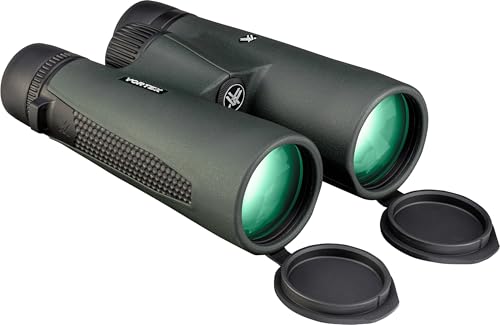
Who should buy this: The 12×50 is the right choice if you’re a birder, hunter, or nature watcher who typically observes from a fixed position — a blind, a deck, a vehicle, or a scenic overlook. It’s also a strong pick for anyone who needs to glass open landscapes where the extra magnification and large objective lenses pay dividends. If you wear glasses, the generous 15.8mm eye relief is a meaningful advantage.
Pros:
- HD glass delivers sharp, color-accurate images with minimal chromatic aberration
- 50mm objectives gather ample light for dawn/dusk use
- Waterproof, fogproof, and rubber-armored
- Vortex VIP lifetime warranty
- Comfortable eye relief for eyeglass wearers
Cons:
- 12x magnification amplifies hand tremor; tripod recommended for extended sessions
- Heavier and bulkier than compact models — not a grab-and-go option
- Included accessories (case, strap) are basic
Vortex Triumph HD 10×28 Binoculars — Compact and Trail-Ready

The Vortex Triumph HD 10×28 takes the same HD glass philosophy and shrinks it into a compact, roof-prism body that can slip into a jacket pocket or a daypack’s hip belt pocket. With 10x magnification and 28mm objective lenses, it offers a solid balance of reach and portability. Vortex specs list a field of view of 304 feet at 1,000 yards — actually wider than the 12×50 — along with 15mm of eye relief and a close focus distance of roughly 8 feet. Like its larger sibling, it’s fully multi-coated, nitrogen-purged, and O-ring sealed for waterproof and fogproof reliability.
Verified customer reviews frequently highlight how surprisingly sharp the 10×28 is for a compact binocular. Users coming from generic compact binoculars report a noticeable step up in clarity and edge-to-edge sharpness. The wider field of view compared to the 12×50 also makes it easier to locate and track moving subjects — a real advantage for birding on the trail or scanning a stadium.
The trade-offs are inherent to the compact form factor. The 28mm objectives simply cannot gather as much light as 50mm lenses, so the image dims noticeably in low-light conditions. Some reviewers note that the smaller barrels can feel cramped for users with larger hands, and the reduced exit pupil (2.8mm vs. 4.2mm on the 12×50) means the image is less forgiving of imperfect eye alignment. If you’re primarily a dawn-and-dusk observer, the compact’s limitations will be more apparent.

Who should buy this: The 10×28 is ideal for hikers, backpackers, travelers, and anyone who values having binoculars with them over having the absolute best image. It’s also a smart choice for kids or newer outdoor enthusiasts who might be intimidated by a full-size binocular. If you’re looking for budget compact binoculars to compare against, the Triumph HD 10×28 occupies a meaningful step up in optical quality.
Pros:
- Genuinely pocketable — light enough to carry all day without fatigue
- HD glass delivers impressive clarity for a compact
- Wider field of view than the 12×50 makes tracking easier
- Waterproof, fogproof, and backed by Vortex VIP warranty
- Close focus of ~8 feet is great for butterflies and wildflowers
Cons:
- 28mm objectives struggle in low-light conditions
- Smaller barrels may feel cramped for large hands
- Reduced exit pupil is less forgiving of eye placement
- Not the best choice for extended, stationary observation
Head-to-Head: 12×50 vs. 10×28 — Which Triumph HD Is Right for You?
Choosing between these two models isn’t about which is “better” — it’s about how you spend your time outdoors. Here’s a quick decision framework:
Choose the 12×50 if:
- You observe from a fixed position (blind, deck, vehicle)
- You need maximum brightness at dawn, dusk, or under tree canopy
- You want the highest magnification for distant subjects
- You don’t mind carrying a full-size binocular
- You wear eyeglasses (slightly better eye relief)
Choose the 10×28 if:
- You hike, backpack, or travel and need minimal weight
- You want binoculars you’ll actually carry every time you go out
- You observe primarily in good daylight conditions
- You value a wider field of view for tracking moving subjects
- You want a close focus distance under 10 feet for nature details
For the outdoor adventurer who already has a gift list going, either model makes a thoughtful and practical present — the compact for the ultralight hiker, the full-size for the dedicated birder.
Key Specs Compared
Here’s a side-by-side look at the numbers that matter most:
| Specification | Triumph HD 12×50 | Triumph HD 10×28 |
|---|---|---|
| Magnification | 12x | 10x |
| Objective Lens | 50mm | 28mm |
| Field of View (ft @ 1,000 yds) | 271 | 304 |
| Eye Relief | 15.8mm | 15mm |
| Close Focus | ~10 ft | ~8 ft |
| Exit Pupil | 4.2mm | 2.8mm |
| Waterproof / Fogproof | Yes | Yes |
| HD Glass | Yes | Yes |
| Fully Multi-Coated | Yes | Yes |
| Vortex VIP Warranty | Yes | Yes |
The exit pupil difference is worth understanding: a larger exit pupil (the 12×50’s 4.2mm) means a brighter image in dim conditions and more tolerance for imperfect eye positioning. In bright daylight, both models perform well because your pupil contracts to around 2-3mm anyway.
What Verified Reviewers Consistently Say
Across both models, a few themes emerge from verified customer feedback:
Praise: The optical quality relative to price is the most common positive. Reviewers frequently compare the Triumph HD favorably to competitors costing significantly more. The Vortex VIP warranty is mentioned repeatedly as a deciding factor — knowing that Vortex will repair or replace the binoculars no matter what happens provides genuine peace of mind. Build quality is generally described as solid and well-finished.
Criticism: The most common complaints center on the included accessories rather than the optics themselves. Lens caps, straps, and cases are described as adequate but uninspiring. A few reviewers of the 12×50 mention that the weight becomes noticeable on longer outings without a harness strap. For the 10×28, the most frequent concern is low-light performance — which is a physics limitation of the 28mm objective, not a quality issue.
Understanding HD Glass and Coatings
If you’re new to optics, the “HD” designation can feel like marketing jargon, but it refers to something specific: extra-low-dispersion (ED) glass elements that reduce chromatic aberration. Chromatic aberration shows up as purple or green fringing around high-contrast edges — think a dark bird silhouetted against a bright sky. HD/ED glass bends different wavelengths of light more uniformly, producing a cleaner, more color-accurate image.
“Fully multi-coated” means that every air-to-glass surface in the optical path has received multiple layers of anti-reflective coating. This maximizes light transmission and minimizes internal reflections that cause glare and reduce contrast. Cheaper binoculars may be “coated” (single layer on some surfaces) or “multi-coated” (multiple layers on some surfaces), but “fully multi-coated” is the standard you want for serious outdoor use.
Final Verdict
The Vortex Triumph HD line represents a compelling value proposition in the outdoor optics space. The 12×50 is our top pick for anyone who prioritizes image quality and brightness — it’s a full-size binocular that delivers HD-level performance backed by one of the best warranties in the industry. The 10×28 earns its place as the best compact option for active outdoor enthusiasts who need quality optics they’ll actually carry. Neither model is perfect — the 12×50 is heavy and the 10×28 struggles in low light — but both deliver honest performance that verified reviewers consistently praise.
If you’re powering your outdoor adventures with portable solar generators and spending extended time in the field, the 12×50 is the natural companion. If you’re a day-hiker who wants to be ready for whatever crosses the trail, the 10×28 earns its spot in your pack.
How We Research
We have not personally tested, owned, or handled the Vortex Triumph HD binoculars. Our review synthesizes publicly available manufacturer specifications, official Vortex product documentation, and verified customer reviews from retail platforms. We cross-reference multiple sources to identify consistent patterns in praise and criticism, and we clearly distinguish between spec-sheet claims and real-world user feedback. This honest, research-based approach ensures you get accurate, useful information without fabricated hands-on anecdotes.


Leave a Reply