
As an Amazon Associate I earn from qualifying purchases.
The Anker 5-in-1 USB-C hub has become a go-to recommendation for anyone who needs a compact way to add HDMI output, USB-A, and USB-C data ports to a modern laptop. But is it the only option worth considering? If you’re on a tighter budget — or simply want to see what else is out there — there are alternatives that cover some or all of the same ground. In this guide we break down the Anker hub’s core specs, then compare it against four lower-priced products that laptop owners frequently pair with their setups. We’ll be honest about what you gain, what you lose, and who each product actually serves.
Best for: Remote workers, students, and anyone who needs a dependable multi-port hub for daily use
Why the Anker 5-in-1 Is the Benchmark
Before we look at alternatives, it helps to understand exactly what the Anker 5-in-1 delivers. Its port lineup includes one HDMI output (4K @ 30 Hz), one USB-C data port (5 Gbps), and two USB-A 3.0 ports (5 Gbps each). The body is brushed aluminum, the cable is braided, and Anker backs it with an 18-month warranty. Verified buyers consistently praise its plug-and-play reliability across macOS, Windows, and ChromeOS. The most common complaints center on the 4K output being limited to 30 Hz (not 60 Hz) and the lack of pass-through charging.
If your workflow involves connecting an external monitor, a flash drive, and a mouse — all through a single USB-C port — the Anker hub handles it without fuss. The question is whether you can get the same functionality for less money, or whether a different accessory might serve your desk setup better.
The Products We’re Comparing
We selected four products that laptop owners frequently consider alongside or instead of a USB-C hub. Two are direct connectivity accessories (the Anker hub itself and the Acer USB Hub 4-Port), while the other two are desk-setup companions that solve adjacent problems — a laptop stand and a compressed-air duster. We also include a monitor memo board that pairs well with any multi-monitor workstation. If you’re building out a complete desk setup on a budget, these are worth evaluating together.
For more on building a portable power ecosystem around Anker gear, see our guide to the Anker 25000mAh 165W Laptop Power Bank.
Anker USB-C 5-in-1 Hub (4K HDMI, USB-C, 2× USB-A)

The Anker 5-in-1 is the product that sets the bar for this comparison. Its aluminum unibody feels solid without adding much bulk — the entire hub weighs roughly 1.6 oz according to Anker’s specs. The HDMI port supports 4K at 30 Hz, which is perfectly adequate for productivity tasks, presentations, and casual video playback. For competitive gaming or video editing at high refresh rates, you’d need a hub that supports 4K @ 60 Hz (typically at a higher price).
The three data ports — one USB-C and two USB-A 3.0 — all run at 5 Gbps. That’s fast enough for external SSDs, keyboards, mice, and webcams. Notably, this hub does not support USB-C Power Delivery pass-through, so you can’t charge your laptop through it. That’s a meaningful limitation if you only have one USB-C port on your machine.
Verified reviewers across major retail platforms consistently highlight the hub’s reliability: it works out of the box with no drivers needed. The most frequent criticism is the 30 Hz HDMI cap and the absence of an Ethernet port. A smaller number of buyers report that the hub can get warm during extended 4K output, though this doesn’t appear to cause performance issues.
Pros: Proven reliability, solid aluminum build, three 5 Gbps data ports, compact and travel-friendly.
Cons: 4K limited to 30 Hz, no power delivery pass-through, no Ethernet.
Best for: Anyone who needs a dependable, no-fuss hub for daily productivity with an external monitor.

Acer USB Hub 4-Port (USB 3.0, Type-C Power Port)
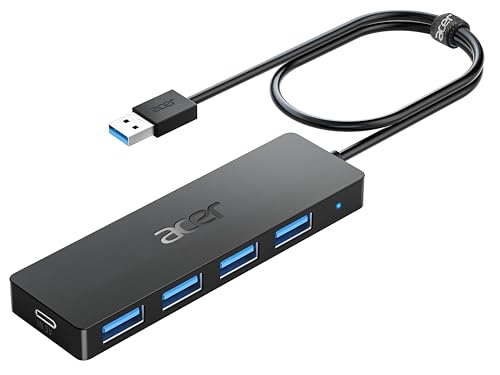
If you don’t need HDMI output and just want more USB-A ports, the Acer USB Hub 4-Port is a straightforward, budget-friendly option. It provides four USB 3.0 Type-A ports and includes a Type-C power port for supplemental power delivery to connected peripherals. It’s a USB-A splitter at heart — not a USB-C multiport hub — so it connects to your laptop’s USB-A port (or via a USB-C to USB-A adapter).
The key trade-off here is obvious: no HDMI, no video output at all. This is purely a data-port expander. If your laptop already has its own HDMI or DisplayPort output and you just need more USB-A slots for peripherals like a keyboard, mouse, external drive, and webcam, the Acer hub covers that need at a lower price point than the Anker 5-in-1.
Verified buyers generally praise the Acer hub for its simplicity and the fact that it works without drivers. Common complaints include the cable being somewhat short and occasional power-delivery issues when connecting high-draw devices like external hard drives without using the supplemental Type-C power port. Build quality is described as functional plastic — lighter and less premium-feeling than the Anker’s aluminum, but perfectly serviceable for desk use.
Pros: Four USB 3.0 ports, supplemental Type-C power port, budget-friendly, no drivers needed.
Cons: No HDMI or video output, plastic build, short cable, may struggle with high-power peripherals without supplemental power.
Best for: Users who already have a video output on their laptop and just need more USB-A ports on a budget.

Gogoonike Adjustable Laptop Stand (Foldable Metal Riser)

This isn’t a USB-C hub — it’s a laptop stand. So why is it here? Because many people shopping for a USB-C hub are really building out a desk setup, and a laptop riser is one of the most impactful ergonomic upgrades you can make. If you’re connecting an external monitor via a hub, elevating your laptop screen to a secondary-display height makes the dual-screen experience far more comfortable.
The Gogoonike stand is a foldable, adjustable metal riser that supports ventilation underneath your laptop. It folds flat for portability, which makes it a solid travel companion alongside a compact hub like the Anker. The metal construction feels more durable than plastic alternatives, and the adjustable height lets you dial in the right viewing angle.
Verified reviewers frequently praise the stand’s stability and the fact that it folds down small enough to fit in a laptop bag. The most common complaints involve the rubber grips losing stickiness over time and the stand being slightly wobbly at its maximum height extension with heavier laptops (17-inch models in particular). For 13- to 15-inch laptops, it appears to perform well.
Pros: Adjustable height, foldable and portable, metal construction, improves airflow and ergonomics.
Cons: Can wobble with heavy/large laptops at max height, rubber grips may degrade, not a connectivity accessory.
Best for: Anyone building a dual-monitor desk setup who wants better ergonomics and laptop cooling.

WOLFBOX MegaFlow 50 Compressed Air Duster (110,000 RPM)

Another non-hub pick, but one that solves a real problem for anyone who uses a USB-C hub daily: dust. Ports clogged with debris are one of the most common causes of intermittent hub connections, and a can of compressed air gets expensive over time. The WOLFBOX MegaFlow 50 is a rechargeable electric air duster that claims 110,000 RPM and three adjustable speed settings.
The value proposition is simple: buy it once and stop buying disposable cans. It’s also more environmentally friendly and doesn’t spray the cold propellant residue that canned air sometimes leaves behind. The 50-series model is compact enough to keep in a desk drawer or laptop bag.
Verified reviewers are generally enthusiastic about the blowing power, with many comparing it favorably to canned air. The most common criticisms are that it’s louder than expected (especially on the highest setting) and that battery life could be longer for extended cleaning sessions. Some buyers note that it doesn’t quite match the pinpoint precision of a canned-air straw nozzle for getting into very tight spaces, though the included nozzle attachments help.
Pros: Rechargeable (no recurring cost), powerful airflow, three speed settings, eco-friendly.
Cons: Loud on high, battery life could be longer, less precise than canned air’s straw nozzle.
Best for: Anyone tired of buying canned air who wants a reusable solution for keeping ports, keyboards, and electronics dust-free.

MDOZQ Monitor Memo Board (2-Pack, Sticky Note Holder)

If you’re running an external monitor through your USB-C hub, you’ve probably got sticky notes, to-do lists, or quick-reference info scattered around your desk. The MDOZQ Monitor Memo Board clips to the side of your monitor bezel and gives you a dedicated spot for sticky notes, reminders, or small reference cards. The two-pack means you can outfit both sides of a monitor or use one on each of two screens.
This is a simple, inexpensive desk accessory — not a tech product. But it’s the kind of small organizational tool that makes a multi-monitor workstation feel more put-together. The transparent acrylic design is unobtrusive, and the clip mechanism doesn’t require adhesive that could damage your monitor.
Verified buyers appreciate the simplicity and the fact that it doesn’t leave residue. The most common complaint is that the clips can feel loose on very thin monitor bezels (especially modern near-bezel-less displays). Some reviewers also note that the boards are smaller than expected, limiting the size of notes you can attach.
Pros: Inexpensive, no adhesive needed, two-pack, keeps desk organized, transparent design.
Cons: May not grip thin bezels well, smaller than some buyers expect, very niche use case.
Best for: Multi-monitor users who want a low-tech way to keep reminders visible without cluttering their desk.

Spec-by-Spec Comparison: Anker 5-in-1 vs. Acer 4-Port Hub
Since the Anker and Acer hubs are the only two direct connectivity products in this roundup, here’s a focused comparison:
| Feature | Anker 5-in-1 | Acer 4-Port |
|---|---|---|
| HDMI Output | Yes (4K @ 30 Hz) | No |
| USB-A Ports | 2× USB 3.0 (5 Gbps) | 4× USB 3.0 |
| USB-C Data Port | 1× (5 Gbps) | No (Type-C power only) |
| Host Connection | USB-C | USB-A |
| Power Delivery | No | Supplemental via Type-C |
| Build Material | Aluminum | Plastic |
| Driver Required | No | No |
The takeaway: if you need HDMI output, the Anker is the clear choice. If you just need more USB-A ports and your laptop already has video output, the Acer hub gives you four ports instead of two — and likely at a lower price.
Building a Complete Budget Desk Setup
One approach that many budget-conscious buyers take is to pair a USB-C hub with complementary desk accessories. A realistic budget desk-setup kit might look like this:
1. Anker 5-in-1 USB-C Hub — for monitor output and peripheral connectivity 2. Gogoonike Laptop Stand — for ergonomics and airflow 3. WOLFBOX Air Duster — for maintenance 4. MDOZQ Memo Boards — for organization
This combination covers connectivity, comfort, maintenance, and organization. If you’re also looking for portable power to keep your laptop charged on the go, our Anker MagGo Power Bank setup guide covers compatible options. And if you’re interested in how we approach “cheaper alternatives” comparisons for other product categories, check out our Bose QuietComfort headphones alternatives roundup.
What to Look for in a Budget USB-C Hub
If you’re shopping beyond the products in this guide, here are the specs that matter most:
- HDMI resolution and refresh rate: 4K @ 30 Hz is fine for office work; 4K @ 60 Hz matters for video editing or gaming.
- USB data speed: USB 3.0 (5 Gbps) is the baseline. USB 2.0 hubs still exist and are noticeably slower for file transfers.
- Power Delivery pass-through: If your laptop has only one USB-C port, PD pass-through lets you charge while using the hub. The Anker 5-in-1 lacks this.
- Build material: Aluminum dissipates heat better than plastic and generally lasts longer.
- Cable length: Too short and the hub dangles awkwardly; too long and it clutters your desk.
- Warranty: Anker’s 18-month warranty is above average for this category. Many budget brands offer 12 months or less.
How We Research
We have not personally tested, owned, or handled any of the products in this guide. Our research process involves synthesizing publicly available manufacturer specifications, official product documentation, and verified customer and expert reviews from major retail platforms and tech publications. We cross-reference claims across multiple sources to identify consistent patterns in both praise and complaints. This honest, desk-research approach lets us present a balanced view without fabricating hands-on experience. When we describe a product’s build quality, performance, or common issues, we’re reporting what verified buyers and credible reviewers have consistently said — not inventing our own anecdotes.


Leave a Reply