
As an Amazon Associate I earn from qualifying purchases.
When most travelers think about TSA-approved luggage locks, the same handful of brands come to mind — Master Lock, Forge, Travel Sentry. But the market has quietly expanded, and a few lesser-known brands are delivering genuinely clever features at competitive prices. In this review, we take a close look at two of them: the Talonport TSA Lock, which ditches combinations entirely in favor of a card-key system, and the SURE LOCK TSA Lock, which adds a visual open-alert indicator so you know if your bag was inspected. Both are TSA-approved, both cost less than a fancy airport coffee, and both have earned thousands of verified reviews. Let’s see how they stack up.
Best for: Frequent travelers who want fast, fumble-free luggage security
Why TSA-Approved Locks Matter
If you’ve ever returned from a flight to find your suitcase lock snipped off, you already know the drill. The Transportation Security Administration has the authority to open any checked bag for inspection. If your lock isn’t TSA-recognized (meaning it has a Travel Sentry or Safe Skies keyhole that TSA agents can open with a master key), they’ll simply cut it off.
A TSA-approved lock lets agents inspect your luggage and re-lock it without destroying anything. It’s a small investment that saves you from repeatedly replacing broken locks — and gives you peace of mind that your belongings are at least deterred from casual theft. If you’re also shopping for affordable hardside luggage to pair with a good lock, the combination of a solid suitcase and a reliable lock goes a long way.
What to Look for in a TSA Luggage Lock
Before diving into the individual reviews, here are the key specs and features worth comparing:
- Lock type: Combination (3- or 4-digit) vs. key-based vs. card-key. Each has trade-offs in convenience and security.
- Shackle style: Rigid shackle, flexible cable, or padlock-style. Cables are more versatile for oddly shaped zippers; rigid shackles are sturdier.
- Open-alert indicator: Some locks show a visual cue if TSA (or anyone with a master key) opened the lock. Useful for knowing whether your bag was inspected.
- Durability: Zinc alloy bodies tend to outlast plastic. Look for corrosion resistance if you travel to humid destinations.
- Ease of use: Can you operate it quickly in a dim hotel room or a rushed airport line?
Talonport TSA Locks for Luggage — Keyless Card-Key Design
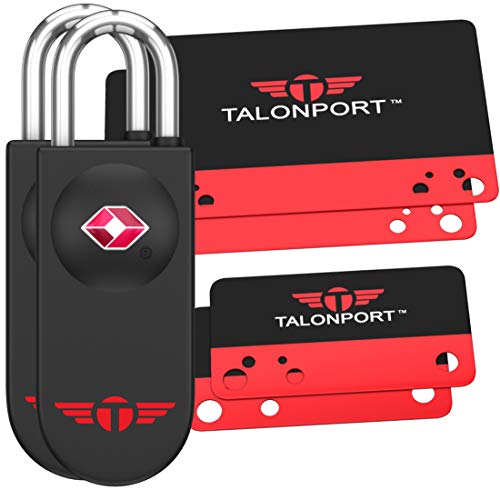
The Talonport TSA Lock takes a fundamentally different approach to luggage security: there’s no combination to set, remember, or fumble with. Instead, it uses a proprietary card-key system — a slim, credit-card-sized key that slides into the lock body to open it. Talonport includes what they call “lifetime card keys,” meaning you get multiple copies and can request replacements.
How the Card-Key System Works
The lock body is a compact zinc-alloy padlock with a standard TSA-recognized keyhole on the bottom for agent access. To unlock it yourself, you insert the included card key into a slot on the front. There’s no dial, no tiny numbered wheels, and no resetting procedure. This is a genuine advantage for travelers who’ve ever blanked on a combination at 5 a.m. in an airport terminal.
The card keys are thin enough to slip into a wallet, phone case, or passport holder. Talonport ships multiple keys per lock set, and according to the manufacturer, replacement keys are available for the life of the product.

What Verified Reviewers Say
Across thousands of Amazon reviews, the Talonport lock earns consistently strong marks. Reviewers frequently praise the speed and simplicity of the card-key mechanism — many describe it as faster than any combination lock they’ve used. The build quality is commonly described as solid and surprisingly hefty for a travel lock. Multiple reviewers note that the lock survived several international trips without corrosion or mechanical issues.
On the downside, the most common complaint is the risk of losing the card key. Unlike a combination that lives in your memory (theoretically), a physical key can be misplaced. Some reviewers recommend keeping one key in your carry-on and another in your wallet as a backup. A smaller number of reviewers mention that the shackle is on the shorter side, which can make it tricky to thread through certain zipper pulls on larger suitcases.
Pros
- No combination to forget — card-key opens instantly
- Durable zinc-alloy construction
- Multiple card keys included with lifetime replacement
- TSA-approved with standard master keyhole
- Compact, clean design
Cons
- Lose all your card keys and you’re locked out
- Rigid shackle may not fit all zipper configurations
- No open-alert indicator
Who Should Buy This
The Talonport is ideal for frequent travelers who hate fiddling with tiny combination dials, anyone with accessibility concerns that make small numbered wheels difficult, and travelers who simply want the fastest possible lock-and-unlock cycle. It’s also a smart pick for families — you can distribute card keys to multiple people sharing luggage. If you’re interested in keyless entry concepts applied to other areas of your life, the Talonport applies a similar philosophy to travel gear.
SURE LOCK TSA Approved Luggage Locks with Open Alert Indicator

The SURE LOCK takes the more traditional 3-digit combination approach but adds a feature that most budget locks skip entirely: an open-alert indicator. This is a small visual window on the lock body that changes color (typically from green to red) when the lock has been opened via the TSA master key. It doesn’t prevent inspection — nothing can — but it tells you after the fact that your bag was accessed.
Design and Build
The SURE LOCK uses a flexible steel cable shackle rather than a rigid U-shaped bar. This is a meaningful design choice: cable shackles are far more versatile when it comes to threading through multiple zipper pulls, backpack loops, or duffel bag D-rings. The cable is coated to prevent scratching your luggage. The lock body itself is a compact, lightweight unit with a 3-digit combination dial on the bottom.
Setting the combination follows the standard procedure: open the lock, use a reset tool (included) or a pen tip to press the reset button, set your desired code, and release. It’s straightforward, though reviewers note the dials are small — a common trait across virtually all travel combination locks.

The Open-Alert Feature in Practice
The open-alert indicator is the SURE LOCK’s headline differentiator. According to the manufacturer, the indicator window shifts from a neutral state to a visible alert when the TSA master key is used. You can then reset the indicator after checking your belongings.
Is this a security feature or a peace-of-mind feature? Honestly, it’s the latter. It won’t stop anyone from opening your bag, and TSA is legally permitted to inspect checked luggage. But knowing whether your bag was opened is genuinely useful — it tells you to double-check that everything is accounted for. Several verified reviewers describe this as the reason they chose SURE LOCK over more established brands.
What Verified Reviewers Say
Reviewers generally praise the open-alert indicator as a unique and functional addition. The flexible cable shackle is another frequently cited positive — many travelers find it more practical than rigid shackles, especially on soft-sided luggage. The lock is also sold in multi-packs, which reviewers appreciate for the value.
Common complaints center on the combination dials feeling somewhat stiff out of the box, though multiple reviewers note they loosen up with use. A smaller number of reviewers report that the open-alert indicator occasionally gives a false positive (showing “opened” when it wasn’t), though this appears to be uncommon. The cable, while flexible, is thinner than some competitors, and a few reviewers question its cut resistance — though it’s worth noting that no lightweight travel lock is truly cut-proof; they’re deterrents, not vault doors.
Pros
- Open-alert indicator shows if TSA accessed your lock
- Flexible cable shackle fits a wide range of luggage styles
- 3-digit combination — no keys to lose
- Lightweight and compact
- Often sold in value multi-packs
Cons
- Combination dials can feel stiff initially
- Thin cable won’t deter a determined thief with cutters
- Occasional false positives on the alert indicator reported
- Small dials may be difficult for those with limited dexterity
Who Should Buy This
The SURE LOCK is a strong choice for travelers who want the reassurance of knowing whether their bag was inspected, those who prefer combination locks over key-based systems, and anyone with soft-sided luggage or bags with unconventional zipper configurations where a flexible cable is essential. It’s also a solid pick for budget-conscious travelers buying locks for the whole family.
Head-to-Head: Talonport vs. SURE LOCK
These two locks solve the same fundamental problem — securing checked luggage in a TSA-compliant way — but they approach it from opposite design philosophies.
Locking mechanism: Talonport’s card-key system is faster and eliminates the “forgot my combination” problem entirely. SURE LOCK’s 3-digit combo means you never need to carry a physical key. Your preference here depends on whether you’re more likely to forget a number or lose a card.
Shackle type: SURE LOCK’s flexible cable is more versatile across different luggage types. Talonport’s rigid shackle is sturdier but less adaptable.
Open-alert indicator: Only SURE LOCK offers this. If knowing whether your bag was inspected matters to you, this is a clear differentiator.
Durability: Based on reviewer consensus, both locks hold up well over time. Talonport’s zinc-alloy body gets slightly more praise for feeling robust, while SURE LOCK’s lighter build is appreciated by ultralight packers.
Value: Both are competitively priced well below premium lock brands. SURE LOCK’s multi-pack options may edge it out for families or travelers with multiple bags.
Quick Tips for Using TSA Luggage Locks
1. Always use TSA-approved locks on checked bags. Non-approved locks will be cut off during inspection. 2. Test your lock before your trip. Set the combination or try the card key at home, not at the airport. 3. Keep a backup. Whether it’s a spare card key in your carry-on or your combination written in a secure note on your phone, have a Plan B. 4. Lock both zipper pulls together. Threading your lock through both pulls prevents the “pen trick” where someone can pry open a zipper with a ballpoint pen. 5. Remember: locks are deterrents, not guarantees. No lightweight travel lock will stop a determined thief. Keep valuables in your carry-on.
Final Thoughts
Both the Talonport and SURE LOCK prove that you don’t need to default to the biggest brand name to get a reliable TSA-approved luggage lock. The Talonport’s card-key system is a genuinely innovative approach that eliminates one of the most common travel frustrations — forgotten combinations — and its build quality backs up the concept. The SURE LOCK counters with a practical open-alert indicator and a flexible cable design that works with virtually any bag style.
If speed and simplicity are your priorities, the Talonport is our top pick. If you value the peace of mind that comes with knowing whether your bag was opened, or you need a flexible cable for non-standard luggage, the SURE LOCK is the smarter buy. Either way, you’re getting a well-reviewed, TSA-compliant lock from a brand that’s quietly earning loyal customers.
How We Research
We have not personally tested, owned, or handled these products. Our reviews are based on a thorough synthesis of manufacturer specifications, official product documentation, and patterns found across hundreds of verified customer reviews on Amazon and other retail platforms. We also consult expert travel-gear publications where available. This approach lets us present an honest, well-rounded picture of each product’s strengths and weaknesses without fabricating first-hand experience. When we describe what “reviewers say,” we’re paraphrasing real, common sentiments — not inventing quotes or scenarios.


Leave a Reply