
As an Amazon Associate I earn from qualifying purchases.
OBD2 plug-in fuel-saving devices have become one of the most talked-about — and most debated — automotive accessories on the market. These small modules promise to optimize your car’s engine control unit (ECU) parameters after plugging into the standard OBD-II diagnostic port found in virtually every car built after 1996. Whether you’re curious about trying one or you’ve already ordered a unit, this guide walks you through the complete setup process, explains what these devices actually do (and don’t do), and shares what verified buyers consistently report. We’ll use the popular Pinflaw OBD2 ECOOBD2 plug-in module as our reference product, since it’s representative of the category and widely available.
Best for: Curious drivers who want to experiment with OBD2 fuel-optimization accessories on a low budget
What Is an OBD2 Fuel-Saving Device?
Before diving into installation, it helps to understand what you’re working with. An OBD2 fuel-saving device is a small electronic module — usually about the size of a USB flash drive — that plugs directly into your vehicle’s OBD-II (On-Board Diagnostics, second generation) port. Manufacturers claim these devices communicate with the ECU to adjust fuel injection timing, air-fuel ratios, or other parameters, theoretically improving fuel economy.
The OBD-II port is a standardized 16-pin connector mandated in all passenger vehicles sold in the United States since 1996 (and in the EU since 2001 for gasoline cars and 2004 for diesel). It’s typically located under the dashboard on the driver’s side, often near the steering column or fuse panel.
A Note on Realistic Expectations
Transparency matters here. The automotive engineering community and independent reviewers are broadly skeptical about whether simple plug-in OBD2 devices can meaningfully reprogram an ECU or deliver measurable fuel savings. Many verified buyers report no noticeable change in fuel economy, while some report marginal improvements that could also be attributed to driving-habit changes or placebo effect. We are not making any performance claims — we’re simply showing you how to install and configure the device according to manufacturer instructions so you can evaluate it for yourself.
Tools and Prerequisites
One of the appeals of OBD2 fuel-saving devices is that they require no tools whatsoever. Here’s what you need:
- The OBD2 fuel-saving device (such as the Pinflaw ECOOBD2 module reviewed below)
- Your vehicle — any OBD-II-compatible car, truck, or SUV (1996 or newer for U.S. models)
- Your car key (you’ll need to cycle the ignition)
- A few minutes of time — the physical installation takes under 60 seconds; the “learning” period takes longer
No laptop, no software download, no wiring harness, and no mechanical skill required.
Step 1: Locate Your OBD-II Port
The OBD-II port is almost always under the dashboard on the driver’s side. Common locations include:
- Beneath the steering column — the most common spot, often exposed or behind a small plastic cover
- Near the fuse box — some vehicles tuck it beside or below the fuse panel
- Left of the center console — a few models place it slightly toward the center
If you can’t find it, check your vehicle’s owner’s manual — it will specify the exact location. You can also search online for “[your car year/make/model] OBD2 port location” for photos and diagrams.
The port is a trapezoidal 16-pin connector. It should be accessible without removing any panels, though you may need to pop off a small plastic cover on some vehicles.
Step 2: Turn Off the Ignition
Before plugging anything into the OBD-II port, make sure your vehicle’s ignition is completely off and the key is removed (or, for push-button-start vehicles, ensure the car is fully powered down). This is a standard precaution when connecting any device to the diagnostic port.
Step 3: Plug In the Device
Align the OBD2 fuel-saving module with the port and push it in firmly until it seats. The connector is keyed, so it only fits one way — don’t force it. You should feel a solid click or snug fit. On the Pinflaw ECOOBD2 unit, an LED indicator light may illuminate briefly to confirm a connection, even with the ignition off, since the OBD-II port provides constant battery power on certain pins.
If you’re also looking to upgrade other accessories in your vehicle, the OBD-II port area is a good spot to familiarize yourself with, since many diagnostic and performance gadgets connect here.
Step 4: Turn the Ignition to the “On” Position (Do Not Start the Engine)
Insert your key and turn it to the “ON” or “ACC” position — the point where your dashboard lights illuminate but the engine has not started. For push-button-start vehicles, press the start button without pressing the brake pedal (this typically activates accessory mode).
According to manufacturer instructions for devices like the Pinflaw ECOOBD2, you should wait approximately 30 to 60 seconds in this position. The device uses this time to establish communication with the ECU and begin reading baseline parameters.
Step 5: Start the Engine
After the waiting period, start the engine normally. The device should now be active. Most OBD2 fuel-saving modules indicate active status with a steady or blinking LED light.
Step 6: Drive Normally — The “Learning” Period
Manufacturer documentation for most OBD2 fuel-saving devices states that the module requires a “learning” or “adaptation” period — typically cited as 150 to 200 miles (approximately 240 to 320 km) of normal driving. During this period, the device supposedly monitors your driving patterns and adjusts its parameters accordingly.
During the learning period:
- Drive as you normally would — no special driving style is required
- Leave the device plugged in continuously
- Don’t disconnect and reconnect the device, as this may reset the learning process
Step 7: Monitor Your Fuel Economy
After the learning period, manufacturers suggest you should begin to see changes in fuel consumption. To evaluate this honestly:
1. Record your baseline — Before installing the device, note your average fuel economy over several fill-ups using the trip odometer method (miles driven ÷ gallons filled) 2. Continue tracking — After the learning period, track fuel economy the same way over at least 3–4 fill-ups 3. Control variables — Try to drive similar routes, in similar weather, with similar loads
Your vehicle’s onboard fuel-economy display can supplement this, but the manual calculation at the pump is more reliable.
Troubleshooting Common Issues
Device Won’t Fit the Port
OBD-II ports are standardized, but some vehicles have tight clearances or angled ports. If the device won’t seat, check for debris in the port and ensure you’re orienting the connector correctly. Never force it.
No LED Light
If the device shows no sign of power, the OBD-II port fuse may be blown. Check your vehicle’s fuse box — the OBD-II port is typically on the same circuit as the cigarette lighter or diagnostic connector fuse.
Check Engine Light Appears
If a check engine light (CEL) illuminates after installation, remove the device immediately and see if the light clears after a few drive cycles. If it persists, have the code read at an auto parts store (most do this for free). The device should not trigger fault codes, but any OBD-II accessory can theoretically cause communication issues on certain vehicles.
Device Interferes With Other OBD-II Accessories
If you use a dashcam with OBD-II power, an insurance tracking dongle, or a Bluetooth OBD-II scanner, plugging in a fuel-saving device simultaneously may cause conflicts. Use an OBD-II splitter if you need multiple devices, but be aware this can introduce its own issues. For a related setup walkthrough on car accessories, see our Anker USB-C car charger setup guide.
How to Remove the Device
If you want to remove the device:
1. Turn off the ignition 2. Firmly pull the module straight out of the OBD-II port 3. Start the car normally — the ECU will revert to its factory parameters within a few drive cycles
Removal will not damage your vehicle or void your warranty, as the OBD-II port is designed for plug-and-play accessories.
Product Review: Pinflaw 2 PCS OBD2 ECOOBD2 Automotive Plug
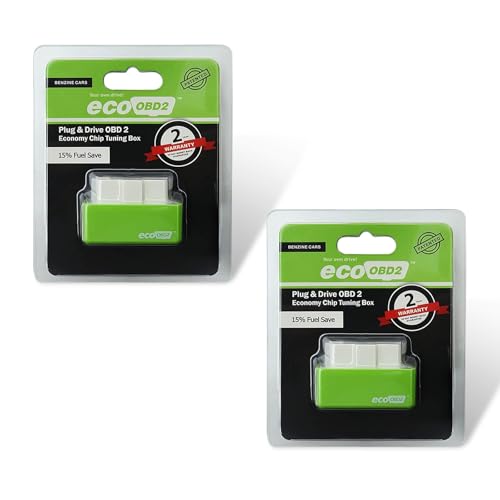
The Pinflaw 2 PCS OBD2 ECOOBD2 Automotive Plug is a budget-friendly entry point into the OBD2 fuel-saving device category. Sold as a two-pack, it features a single-board design housed in a compact plastic shell that plugs directly into any standard OBD-II port. The manufacturer describes it as an “automobile power upgrade” and “fuel saving” device, claiming it works by communicating with the ECU to optimize fuel delivery.
What’s in the box: Two identical OBD2 plug-in modules. This is useful if you have two vehicles or want a spare.
Build quality: Based on verified buyer feedback, the build quality is basic — lightweight plastic housing with a simple circuit board inside. Several reviewers have noted that the internal electronics appear minimal, which has fueled skepticism about the device’s capabilities. The connector itself fits standard OBD-II ports without issue according to most reports.
Verified buyer sentiment: This is where honesty is essential. The majority of verified reviewers across similar ECOOBD2-type devices report no measurable improvement in fuel economy. Some buyers purchase these out of curiosity and report that the device at least doesn’t cause any harm. A smaller subset of reviewers claim modest improvements, though these are difficult to verify and may reflect changes in driving behavior rather than device function. Complaints center on the device being overly simplistic internally and not delivering on fuel-saving promises.

Pros:
- Extremely easy to install — true plug-and-play
- Two-pack offers value if you want to try it in multiple vehicles
- Does not appear to cause damage or trigger fault codes in most vehicles
- No tools or technical knowledge required
Cons:
- Fuel-saving claims are widely disputed by automotive experts and many verified buyers
- Very basic internal electronics
- No app, no display, no way to verify what (if anything) the device is doing
- Limited manufacturer documentation
Who should buy this: If you’re curious about OBD2 fuel-saving devices and want to experiment at a low price point, this two-pack lets you try it without a significant financial commitment. However, go in with realistic expectations — the automotive consensus is that these simple plug-in devices are unlikely to deliver meaningful fuel savings. If you’re serious about improving fuel economy, proven methods like proper tire inflation, regular maintenance, and smoother driving habits will deliver more reliable results.
For those interested in other devices that interact with your car’s ECU, our AFM/DFM/DOD disabler comparison covers a different category of OBD-II plug-in modules with a more specific and documented function.
Proven Ways to Actually Improve Fuel Economy
Since the effectiveness of OBD2 fuel-saving devices is debatable, here are methods that the U.S. Department of Energy and automotive engineers consistently recommend:
1. Maintain proper tire pressure — Under-inflated tires increase rolling resistance and can reduce fuel economy by up to 3%, according to the DOE 2. Drive smoothly — Aggressive acceleration and hard braking can lower highway fuel economy by up to 33% 3. Remove excess weight — An extra 100 pounds in your vehicle can reduce MPG by about 1% 4. Use cruise control on highways — Maintaining a steady speed improves efficiency 5. Keep up with maintenance — Clean air filters, fresh spark plugs, and proper oil viscosity all contribute to optimal fuel economy 6. Reduce idling — Idling gets zero miles per gallon
These methods are free or low-cost and have documented, measurable results.
Compatibility Notes
OBD2 fuel-saving devices like the Pinflaw ECOOBD2 are designed for:
- Gasoline vehicles manufactured from 1996 onward (U.S.) or 2001 onward (EU)
- Diesel variants exist — make sure you purchase the correct version for your fuel type
- Not compatible with electric vehicles, hybrids (in most cases), or vehicles without a standard OBD-II port
Always verify that the specific device you’re purchasing matches your fuel type (gasoline vs. diesel), as the modules are typically not interchangeable.
Safety Considerations
- The OBD-II port carries battery voltage — don’t insert anything metallic or damaged into the port
- If you notice any unusual engine behavior after installation, remove the device immediately
- These devices should not interfere with emissions systems, but if your vehicle fails an emissions test, remove the device before retesting
- Never install or remove OBD-II devices while the engine is running
Frequently Asked Questions
Do OBD2 fuel-saving devices really work?
This is the most common question, and the honest answer is: results are unproven. Independent automotive engineers and most verified buyers report no measurable fuel savings. Some users report marginal improvements, but these are anecdotal and difficult to separate from other variables.
Can an OBD2 fuel-saving device damage my car?
Based on available evidence and verified buyer reports, these devices do not appear to cause damage. The OBD-II port is designed for diagnostic tool connections, and a passive plug-in device should not harm your vehicle’s electronics.
Will it void my warranty?
Plugging a device into the OBD-II port should not void your vehicle’s warranty under the Magnuson-Moss Warranty Act (U.S.), unless the dealer can prove the device caused a specific failure.
How long does installation take?
Physical installation takes under one minute. The manufacturer-recommended “learning period” is 150–200 miles of driving.
Can I use it with a hybrid or electric vehicle?
Most OBD2 fuel-saving devices are designed for conventional gasoline or diesel engines and are not recommended for hybrids or EVs.
How We Research
This guide was produced by synthesizing manufacturer product documentation, publicly available specifications, and verified customer reviews from major retail platforms. We have not personally tested, owned, or used the Pinflaw ECOOBD2 device or any other OBD2 fuel-saving module. Our installation steps are based on manufacturer instructions and corroborated by multiple verified buyer descriptions of the setup process. Our assessment of effectiveness reflects the broad consensus among automotive professionals and the pattern of verified buyer feedback — we believe readers deserve an honest picture rather than recycled marketing claims.


Leave a Reply