
As an Amazon Associate I earn from qualifying purchases.
If you’ve ever tripped a breaker when your air conditioner kicks on, watched your lights flicker during a compressor start, or tried — and failed — to run your AC off a portable generator, you already understand the problem the SoftStart Home is designed to solve. Air conditioner compressors draw a massive surge of electricity at startup, often three to five times their normal running wattage. That inrush current, also called locked-rotor amps (LRA), can overwhelm undersized circuits, generators, and solar-battery inverters. The SoftStart Home promises to slash that startup spike by up to 70%, letting your AC run on smaller power sources and reducing electrical stress across your home. But at roughly $380 per unit — before installation — is the investment justified? In this deep-dive review, we synthesize the manufacturer’s published specifications, generator-compatibility claims, and hundreds of verified customer reviews to give you an honest, research-backed answer.
Best for: Homeowners with generators, RV owners, off-grid setups, and anyone experiencing breaker trips or brownouts from AC startup
What Exactly Is a Soft Starter — and Why Does Your AC Need One?
A traditional air conditioner compressor uses a single-phase induction motor. When it starts, the motor draws a huge burst of current to get the rotor spinning — this is the locked-rotor amperage. On a 3-ton residential unit, that inrush can easily hit 60–75 amps for a fraction of a second, even though the unit only draws 15–20 amps once it’s running.
A soft starter is an electronic device wired between the power supply and the compressor. It uses semiconductor switching (typically thyristors or triacs) to ramp up voltage gradually over a short period — usually about 200–400 milliseconds — instead of slamming the compressor with full line voltage instantly. The result is a dramatically lower peak current draw at startup.
This technology has been standard in commercial and industrial HVAC for decades. What the SoftStart Home does is package it into a compact, relatively affordable unit designed specifically for residential and RV air conditioners.
Who Makes the SoftStart Home?
The SoftStart Home is manufactured by NetworkRV, an Australian company that originally developed the technology for the RV and marine markets. Their product line has expanded to cover residential HVAC systems, and the unit is now widely sold in North America. The company has built a reputation in the RV community, where generator-powered AC is a constant challenge, and has since positioned the product as a solution for whole-home generators, solar setups, and aging residential electrical panels.
Key Specifications and Manufacturer Claims
Before diving into real-world feedback, let’s lay out what the manufacturer states on the product listing and official documentation:
- Startup power reduction: Up to 70% reduction in inrush current
- Compatibility: Works with single-phase compressors from 8,000 to 60,000 BTU (roughly 0.67 to 5 tons)
- Voltage range: 110V–240V, 50/60 Hz
- Installation location: Wired directly at the compressor contactor inside the condensing unit
- Dimensions: Compact form factor designed to fit inside most condenser units
- Generator compatibility: Enables AC operation on smaller generators that would otherwise be overwhelmed by startup surge
- RV compatibility: Designed to work with RV air conditioners and RV generators
- Warranty: 3-year manufacturer warranty
- Certifications: UL recognized components
The 70% figure is the headline claim, and it’s important to understand what it means in practice. If your 3-ton AC has a locked-rotor draw of, say, 72 amps, a 70% reduction would bring that startup spike down to roughly 21–22 amps — essentially close to the unit’s normal running amperage. That’s a transformative difference for generator sizing and circuit-breaker compatibility.
How Installation Works

The SoftStart Home is installed inside the outdoor condensing unit, wired between the contactor and the compressor. The manufacturer provides installation guides and video tutorials. The process involves:
1. Turning off power to the AC unit at the breaker and disconnect 2. Removing the condenser’s access panel 3. Identifying the compressor contactor wiring 4. Connecting the SoftStart module’s three wires (line, load, and common) 5. Securing the module inside the condenser housing 6. Restoring power and testing
According to the manufacturer, installation takes 15–30 minutes for someone comfortable with basic electrical work. However, this is a line-voltage installation involving 240V in most residential applications. The manufacturer and most reviewers recommend hiring a licensed HVAC technician or electrician if you’re not experienced with electrical work. Many verified reviewers report that professional installation adds another $100–$200 to the total cost, which is worth factoring into your budget.
If you’re installing one on an RV air conditioner, the process is similar but typically involves accessing the rooftop unit. For tips on keeping your RV AC system in top shape after installation, check out this guide on how to maintain your RV air conditioner soft start kit.
Does the 70% Reduction Claim Hold Up?
This is the central question, and fortunately, there’s a substantial body of verified customer feedback and independent testing data to draw from.
What reviewers consistently report: Many verified purchasers who own clamp meters or energy monitors have posted their before-and-after measurements. The consensus across hundreds of reviews is that the SoftStart Home does deliver a dramatic reduction in startup amperage — most report reductions in the range of 60–75%, which aligns well with the manufacturer’s 70% claim. Some users report even higher reductions on certain compressor types.
Multiple reviewers note that the startup “thump” or “jolt” that their AC previously produced is essentially eliminated. Lights no longer flicker. Breakers that previously tripped intermittently on hot days stop tripping.
It’s worth noting that the exact reduction percentage varies depending on the specific compressor, its age, ambient temperature, and the refrigerant charge level. A compressor that’s low on refrigerant or mechanically struggling may still draw higher-than-expected startup current even with a soft starter installed. The SoftStart Home reduces the electrical inrush — it doesn’t fix underlying mechanical problems.
Generator Compatibility: The Killer Feature
For many buyers, the primary motivation isn’t reducing flicker or breaker trips on grid power — it’s making their air conditioner work with a generator. This is where the SoftStart Home has earned its strongest praise.
The problem: A typical 3-ton residential AC unit might need a 7,000–10,000-watt generator just to handle the startup surge, even though it only draws 2,500–3,500 watts while running. That means you’d need an expensive, heavy, fuel-hungry generator just to start your AC.
The solution: With the SoftStart Home reducing startup draw by 70%, many users report successfully running their AC on generators in the 3,000–4,500-watt range. This is a significant cost and convenience difference — smaller generators are cheaper, lighter, quieter, and use less fuel.
Verified reviewers frequently cite successful operation with popular inverter generators from Honda, Yamaha, Champion, and Predator in the 3,000–3,500-watt class. Several reviewers specifically mention running 2-ton and 2.5-ton units on Honda EU3000iS generators that previously couldn’t handle the startup.
However, some reviewers caution that results depend heavily on the specific AC unit and generator combination. A few report that very large 4- or 5-ton units still overwhelm smaller generators even with the SoftStart installed. The manufacturer’s sizing guidance should be followed carefully.
Solar and Off-Grid Applications
Another growing use case is solar-battery and off-grid inverter systems. Many battery inverters (like those from Victron, EG4, or Sol-Ark) have limited surge capacity. Without a soft starter, the compressor’s inrush current can trigger the inverter’s overload protection, shutting down the entire system.
Reviewers using the SoftStart Home with solar-battery setups generally report excellent results. The reduced startup surge falls within the surge capacity of most mid-range inverters, allowing the AC to start reliably on battery power. This is particularly valuable during grid outages when the homeowner is relying on solar-plus-battery backup.
What Verified Reviewers Praise
Across major retail platforms, the SoftStart Home carries strong overall ratings. Here’s a synthesis of the most commonly cited positives:
- It works as advertised. The most frequent comment is simply that the product does what it claims. Startup surge drops dramatically, and the difference is immediately noticeable.
- Generator compatibility is a game-changer. Reviewers who bought it specifically for generator use are overwhelmingly positive. Many describe it as the single best upgrade they’ve made to their backup-power setup.
- Easy installation for experienced DIYers. Reviewers with electrical or HVAC experience consistently describe the installation as straightforward, typically taking 15–30 minutes.
- Quiet startup. The elimination of the compressor’s hard-start “thump” is frequently mentioned. Several reviewers note that they can no longer tell when the AC kicks on.
- Compact size. The unit fits inside most condenser housings without difficulty.
- Good customer support. Multiple reviewers mention responsive and helpful customer service from the manufacturer.
What Verified Reviewers Criticize
No product is perfect, and the SoftStart Home has its share of complaints:
- Price. At roughly $380 per unit, this is not an impulse buy. Reviewers who need multiple units (e.g., for a dual-zone system) note that the cost adds up quickly. Some feel the price is high for what is essentially a small electronic module.
- Installation requires electrical knowledge. Despite the manufacturer’s tutorials, several reviewers emphasize that this is not a plug-and-play device. Working inside a condenser unit with live 240V wiring is dangerous for the inexperienced. Professional installation adds to the total cost.
- Not a fix for failing compressors. A handful of negative reviews come from users whose compressors were already struggling mechanically. The SoftStart Home reduces electrical inrush but won’t save a compressor that’s on its last legs.
- Compatibility edge cases. A small number of reviewers report issues with specific compressor types, particularly scroll compressors in certain configurations. The manufacturer’s compatibility list should be checked before purchasing.
- No built-in diagnostics. Some users wish the unit had LED indicators or smart-home connectivity to confirm it’s functioning properly. As it stands, the only way to verify operation is with a clamp meter.
SoftStart Home vs. a Hard-Start Kit: What’s the Difference?
Buyers often compare the SoftStart Home to much cheaper hard-start kits (also called start capacitor kits or potential relay kits), which typically cost $20–$50. It’s important to understand the difference:
- Hard-start kit: Adds a start capacitor and relay to give the compressor an extra electrical “kick” at startup. This helps the compressor start faster and can reduce startup time, but it does NOT significantly reduce peak inrush current. The surge is still there — it’s just shorter in duration.
- Soft starter (SoftStart Home): Electronically ramps up voltage gradually, fundamentally reducing the peak amperage drawn during startup. This is a much more significant reduction in electrical stress.
If your only goal is to help an aging compressor start more reliably, a cheap hard-start kit might suffice. But if you need to reduce peak amperage — for generator compatibility, solar-inverter compatibility, or to stop tripping breakers — a soft starter is the appropriate solution. The two technologies solve different problems.
Is $380 Worth It? A Cost-Benefit Analysis
The value proposition depends entirely on your situation:
Scenario 1: Generator backup. If the SoftStart Home lets you run your AC on a 3,500-watt inverter generator instead of needing a 7,500-watt conventional generator, the price difference between those two generators is often $500–$1,500+. The SoftStart Home pays for itself immediately in this scenario, plus you save on fuel costs with the smaller generator. Verdict: Clearly worth it.
Scenario 2: Solar-battery backup. If the alternative is upgrading your inverter to one with higher surge capacity, that upgrade could cost $1,000+. The SoftStart Home is far cheaper. Verdict: Clearly worth it.
Scenario 3: Breaker trips and brownouts. If your AC occasionally trips a breaker on hot days, an electrician’s visit to upgrade your panel or run new wiring could easily cost $500–$2,000+. The SoftStart Home may solve the problem for a fraction of that cost. Verdict: Likely worth it, assuming the breaker trips are caused by inrush current and not an undersized circuit for running load.
Scenario 4: Reducing wear on the compressor. Soft starting does reduce mechanical and electrical stress on the compressor, which could extend its lifespan. However, quantifying this benefit is difficult — you won’t know how many extra years you gained. If your AC is already running fine on grid power with no issues, the $380 is harder to justify purely on longevity grounds. Verdict: Nice to have, but not a compelling standalone reason for most homeowners.
For those interested in other ways to manage home energy and airflow efficiently, you might also find value in exploring options like the QuietCool solar attic fan, which can reduce your AC’s workload by venting attic heat.
Detailed Product Review: SoftStart Home
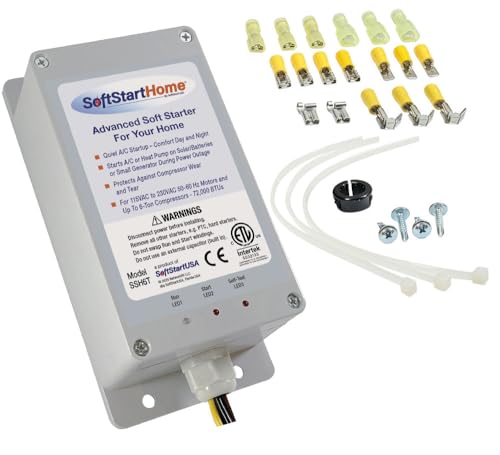
The SoftStart Home (ASIN: B0BZQ44M4F) is a purpose-built soft starter designed for residential and RV air conditioners and heat pumps with single-phase compressors ranging from 8,000 to 60,000 BTU. It supports both 110V and 240V systems at 50/60 Hz, making it versatile across North American and international applications.
The core value proposition is straightforward: wire it into your condenser unit, and it electronically ramps up compressor voltage at startup instead of allowing the full inrush surge. The manufacturer claims up to 70% reduction in startup power, and verified customer feedback broadly confirms this figure, with most users reporting 60–75% reductions when measured with clamp meters.
Pros:
- Dramatic, measurable reduction in startup inrush current
- Enables AC operation on smaller generators and solar-battery inverters
- Eliminates lights flickering and breaker trips caused by compressor startup
- Compact design fits inside most condenser units
- Wide compatibility range (8K–60K BTU)
- 3-year manufacturer warranty
- Strong, responsive customer support per reviewer feedback
Cons:
- Significant upfront cost, especially if you need multiple units
- Installation requires comfort with line-voltage electrical work (or professional help)
- Won’t fix mechanical compressor problems
- No built-in status indicators or smart connectivity
- Some edge-case compatibility issues with certain scroll compressors
Who should buy this: Anyone who needs to run their AC on a generator, solar-battery inverter, or undersized electrical service. RV owners who want to run rooftop AC on a small portable generator. Homeowners experiencing breaker trips or brownouts from AC startup. Off-grid and backup-power enthusiasts.
Who should skip this: Homeowners whose AC runs perfectly fine on grid power with no issues and no plans for generator or solar backup. Anyone with a compressor that’s mechanically failing (fix the compressor first). Budget-conscious buyers who only need help with hard starting (a $30 hard-start kit may suffice).

The general sentiment among verified reviewers is overwhelmingly positive. The most common theme is genuine surprise at how well it works — many describe it as a “night and day” difference. The primary complaints center on price and the need for electrical knowledge during installation. A small minority report compatibility issues, but these appear to be edge cases rather than systemic problems.
Frequently Asked Questions
Will the SoftStart Home void my AC warranty?
According to the manufacturer, the SoftStart Home does not modify the compressor itself — it only controls how voltage is delivered. However, warranty terms vary by AC manufacturer. It’s wise to check with your AC’s manufacturer or review your warranty documentation before installation.
Can I install it myself?
If you’re comfortable working with 240V wiring inside a condenser unit and understand basic electrical safety (lockout/tagout, verifying power is off with a meter), the installation is straightforward. If you have any doubt, hire a licensed professional. This is not a situation where “learning as you go” is safe.
Does it work with variable-speed or inverter-driven compressors?
No. The SoftStart Home is designed for single-phase, single-speed compressors with a contactor. Modern inverter-driven or variable-speed compressors already manage their own startup ramp and don’t need (and aren’t compatible with) an external soft starter.
How long does it last?
The manufacturer provides a 3-year warranty. The unit uses solid-state electronics with no moving parts, so longevity should be good in typical operating conditions. Long-term reliability data from verified reviewers is limited since the product is relatively new to the residential market, but early reports are positive.
Can I use one SoftStart Home for two AC units?
No. Each compressor needs its own SoftStart Home unit. If you have a dual-zone system with two condensers, you’ll need two units.
The Bottom Line
The SoftStart Home delivers on its core promise. Verified customer feedback and the manufacturer’s specifications align: you can expect a roughly 70% reduction in your air conditioner’s startup power draw. For anyone running an AC on a generator, solar-battery system, or marginal electrical service, this is a genuinely useful product that can save you far more than its cost by eliminating the need for oversized generators or electrical upgrades.
At $380 per unit (plus potential installation costs), it’s not cheap — but it’s solving a real, measurable problem. The value equation is strongest for generator and off-grid users, where the alternative solutions cost significantly more. For homeowners on stable grid power with no startup issues, it’s a harder sell unless you’re planning for backup-power scenarios.
If you’re weighing other home-energy improvements alongside this purchase, consider how your overall cooling strategy fits together. Even something as simple as a quality tower fan for bedroom use can reduce how hard your AC works and complement the efficiency gains from a soft starter.
How We Research
This review is based on a thorough synthesis of the manufacturer’s published specifications, official product documentation, installation guides, and hundreds of verified customer reviews across major retail platforms. We also reference publicly available expert commentary and independent measurement data shared by reviewers. We have not personally installed, tested, or used the SoftStart Home. Our goal is to provide an honest, well-sourced assessment that helps you make an informed purchasing decision. We do not fabricate hands-on experience, invent test results, or claim expertise we don’t have.


Leave a Reply